Why Is Your House Wired in Parallel?
Root Concept
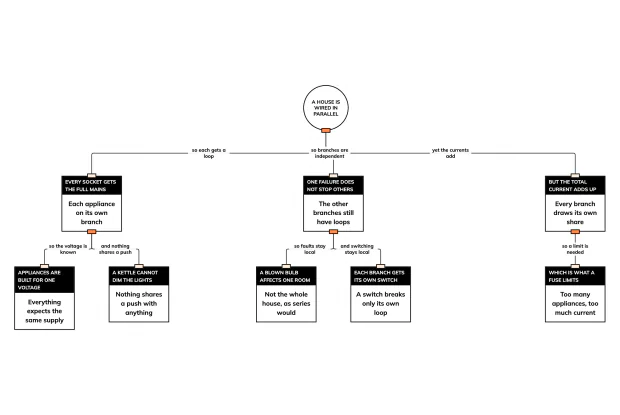
A house is wired in parallel so that every appliance sits on its own branch, which gives each the full supply voltage and makes each independent of the others — at the cost that the branch currents add up, which is why a limit and a fuse are needed.
CodePLU Goal
Upgrading Human Mental Models
Learn how to think in Workflows

Concept Development By codeplu.com
The third branch is the price of the first two. Every advantage of parallel wiring creates the one problem that has to be engineered around.
The Evidence Is in Every Room
Switch on a kettle and the lights do not dim. Switch on a second lamp and the first is as bright as it was. Take a dead bulb out of a ceiling fitting and the rest of the house carries on. None of this is remarkable until you notice that a house wired the other way would behave completely differently, and that you already have all the evidence needed to work out which way yours is.
In a series house there would be one loop through everything, so switching on a kettle would dim every light in the building and every device would behave differently depending on what else was on. Worse, one blown bulb would open the loop and the whole house would go dark, exactly as old fairy lights did.
So domestic wiring is parallel. Each socket and each light sits on a branch of its own, with its own complete path back to the supply, which means every one of them receives the full supply voltage and none of them is affected by what the others are doing.
That choice buys a great deal, and it has a price that has to be engineered around. Because every branch draws its own current, the currents add: the more things that are switched on, the more total current flows in the wiring that feeds them all. Nothing limits that automatically, which is why a house needs fuses and circuit breakers. The advantages and the hazard come from the same decision.
What the Choice Buys, and What It Costs
Why does every socket get the full supply?
Because each branch is its own complete loop from the supply and back, so the full push is available across whatever is on that branch rather than being shared with anything else. That is the result from the first tutorial of this track, applied to a building. It matters more than it might sound, because it is what makes appliances possible to design at all: a manufacturer can build a toaster knowing exactly what voltage it will receive, in any house, regardless of what else is plugged in. In a series house no such guarantee could exist — the voltage reaching any device would depend on the total of everything else switched on at that moment, and the same toaster would behave differently every evening.
Why does one failure not take the rest down?
Because breaking one branch leaves the others as complete loops, which is the only rule this whole subject has needed so far. A blown bulb opens the path through that fitting and nothing else, so every other branch is untouched and carries on exactly as before. The same property is what makes switches possible: a light switch is in series with the light it controls and in parallel with everything else, so operating it breaks precisely one loop. A house whose switches each controlled the whole building would be useless, and that is what a series house would be. Independence is not a convenience here; it is what makes a building controllable at all, and it is the same complete-loop rule doing the work.
So what is the catch?
The currents add up. Each branch draws whatever current its own resistance and the supply voltage dictate, independently of the others, so the wire feeding them all carries the total — and that total rises every time something else is switched on. The resistance tutorial already gave the reason in the abstract: adding parallel paths lowers the total resistance, and lower resistance at the same push means more current. A kettle alone might draw around 13 amps; add a heater and an iron on the same circuit and the feeding cable is carrying the sum of all three, which it was never designed for. Nothing in the physics limits that total — the limit has to be imposed deliberately.
What does a fuse actually do about it?
It is a deliberately weak link that fails before the wiring does. A fuse is a thin piece of wire chosen to melt at a particular current, and melting breaks the loop and stops everything on that circuit. A circuit breaker does the same job with a switch that trips rather than a wire that melts, which is why it can be reset. The point of either is that too much current in a cable makes it hot — the resistance tutorial explained where that heat comes from — and a hot cable inside a wall is how electrical fires start. The fuse is sized to the cable it protects, which is why fitting a larger one is dangerous rather than convenient.
Real World Example
Three Things That Only Make Sense in Parallel
None of these would be true in a house wired the other way, which is what makes them evidence rather than trivia.
Step 1
Every appliance states one voltage on its label
Look at the plate on the back of almost anything electrical and it names a single supply voltage. That is only a meaningful thing to print because the manufacturer can rely on receiving it — which is true precisely because every socket is its own branch with the full supply across it. In a series house the voltage at any socket would depend on everything else running at the time, no label could be accurate, and appliances could not be built to a standard at all. The label is the parallel decision made visible. A standard only exists because the supply can be relied on.
Step 2
An overloaded extension lead gets hot
An extension lead with several high-power appliances on it is carrying the sum of all their currents through one cable, and that cable has a resistance, so it warms. Plug in enough and it becomes genuinely hot — which is why the leads carry a stated maximum and why coiled ones are rated lower, since a coil cannot shed heat as well as a straight run. This is the adding-up of branch currents happening somewhere visible, and it is the clearest everyday sign that parallel wiring has a cost. The heat is the resistance of the cable spending some of the push, exactly as a filament does deliberately.
Step 3
A house has several fuses, not one
A consumer unit holds a row of breakers rather than a single one, because the house is divided into several parallel circuits — upstairs sockets, downstairs sockets, lighting, cooker — each with its own cable and its own limit. Dividing it that way means a fault in one circuit disconnects only that circuit, which is the independence argument applied one level up. The lighting breaker is rated lower than the sockets because the cable feeding the lights is thinner and carries less. Each circuit is protected against its own cable rather than against the house as a whole.
FAQs
Final Words
A house is wired in parallel, and you can establish that without looking at any wiring. A kettle does not dim the lights, a second lamp does not weaken the first, and one dead bulb leaves the rest of the building lit — none of which would be true of a single loop through everything.
What parallel buys is that each branch is its own complete loop, so every socket gets the full supply and nothing depends on anything else. That is what lets an appliance be built to a stated voltage, and what lets a switch control one light instead of the house. The price is that the branch currents add, so the feeding cable carries the total — which is why every circuit has a fuse sized to the cable it protects.
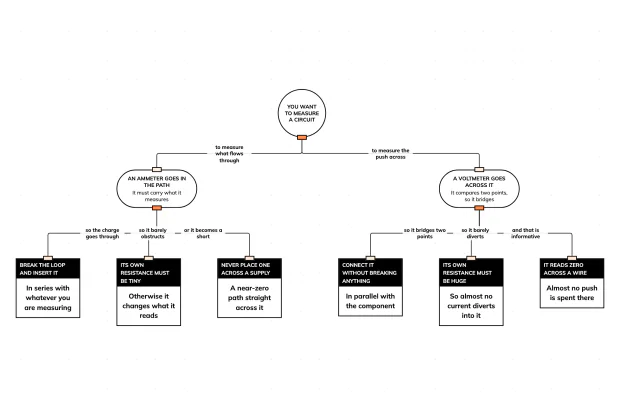
The last tutorial is about measuring any of this: where a meter goes, and why the wrong place tells you nothing.
Continue This Track
This concept is part 4 of More Than One Path.
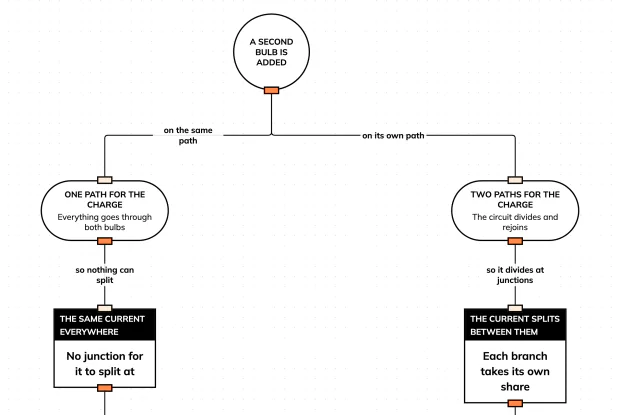
What Happens When You Add a Second Bulb?
Add a bulb to a working circuit and it either dims both or changes nothing. Find out what you actually decided when you connected it, in an interactive playground.
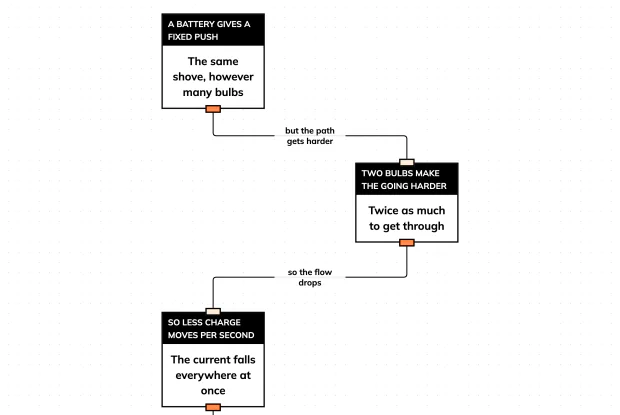
Why Are Bulbs in Series Dimmer?
Two bulbs on one path are both dimmer, and the obvious explanation is wrong. Follow what actually changed, in an interactive playground.
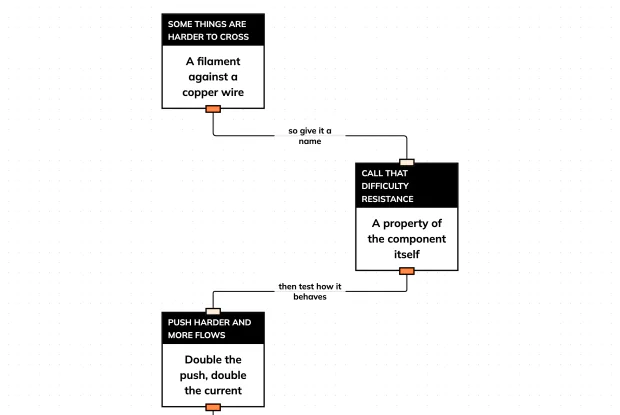
What Is Resistance? And What V = IR Actually Claims
Resistance is the word for how hard a component is to get through — and the equation everyone memorises is a claim about the world. Find out what it asserts, in an interactive playground.
Why Is Your House Wired in Parallel?
Switch on a kettle and the lights do not dim. That is not an accident of good wiring — it is a consequence of one decision. Trace it in an interactive playground.
Where Does a Meter Go in a Circuit? Through or Across
An ammeter goes in the loop and a voltmeter goes beside it, and the reason is the same reason a good measurement must not disturb what it measures. Sort them in an interactive playground.