Why Are Bulbs in Series Dimmer?
Root Concept
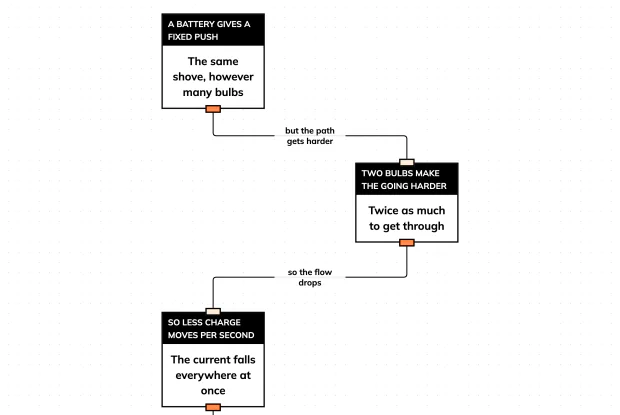
Two bulbs in series are dimmer because the battery’s fixed push now has to get charge through both of them, so the current falls everywhere in the loop and the push divides between the bulbs — each receiving less of both, which is what dimmer means.
CodePLU Goal
Upgrading Human Mental Models
Learn how to think in Workflows

Concept Development By codeplu.com
Two separate things fall at once — the flow and the share of the push. The brightness drops because of both, which is why one of them alone never explains it.
The Obvious Explanation Is Testable, and It Fails
Two bulbs on a single path are both noticeably dimmer than one bulb on its own. There is an explanation almost everybody reaches for first: the first bulb uses some of the electricity up, so there is less left for the second.
That explanation makes a prediction, which is what makes it worth taking seriously rather than dismissing. If the first bulb consumed part of what arrives, the second would get less than the first, and the second bulb would be dimmer than the first. Set it up and look. **They are equally dim**, and swapping them over changes nothing.
So whatever is happening, nothing is being used up on the way round. The previous tutorial made the same point with a meter — the current reads identically before the bulb and after it — and this is the same result without any apparatus at all. The idea has to go, and something has to replace it.
What replaced it is two changes happening together, and most explanations give only one. The current through the whole loop is lower than it was with a single bulb, because the going is harder. And the battery’s push is now shared between two bulbs instead of being spent on one. Each bulb ends up with less charge passing per second AND less push behind it, and brightness depends on both.
What Actually Changed
What does the battery supply, and what does it not?
A battery supplies a fixed push and nothing else. The circuits track established that it holds a chemical store and uses it to shove charge round the loop, and the size of that shove is a property of the battery — a 1.5V cell gives the same push whatever you connect to it. What a battery does NOT supply is a fixed current. How much charge actually moves per second depends on the circuit as well as the battery, which is the whole of what follows. Getting this the wrong way round is the root of most circuit confusion: people treat the battery as a tank of current being handed out, when it is a pump applying a pressure.
Why does the current fall when you add a bulb?
Because a bulb is hard to get through, and now there are two of them in the way. A bulb’s filament is deliberately a poor conductor compared with the wire — that is what makes it heat up and glow — so charge gets through it only slowly for a given push. Put a second one on the same path and the charge has to get through both, which is harder still, so for the same fixed push less charge moves per second. And because there is only one path with no junctions, that lower current is the current everywhere in the loop at once: both bulbs, both sides of each, and the battery itself. Nothing is lower in one place than another.
What does "the push is shared" mean?
That the total push the battery provides gets used up across the components in the loop, in proportion to how hard each one is to get through. With one bulb, all of the push is spent getting charge through that bulb. With two identical bulbs, about half the push is spent on each. This is the quantity called voltage, and the useful way to hold it is as the push used up across a particular component rather than as a thing stored in the wire. It is also the one quantity in a series circuit that divides — the current does not divide, because there is nowhere for it to divide at, and the two facts are easy to swap by accident.
So why is the bulb dimmer?
Because brightness is energy transferred per second, and both of the things that decide it have gone down. Energy arrives at a bulb carried by charge, so the rate it arrives at depends on how much charge passes per second — the current — and on how much energy each bit of charge gives up there — the share of the push. In a series pair the current is lower than it was AND each bulb gets only half the push, so the energy transferred per second falls by more than either change alone would cause. Two halves multiplying rather than one half, which is why two bulbs in series are dramatically dimmer rather than mildly so.
Real World Example
Three Checks on the Explanation
An explanation earns belief by making predictions that could fail. These three could, and do not.
Step 1
Swap the two bulbs over: nothing changes
If the first bulb consumed part of what arrives, its position in the loop would matter and swapping the bulbs would swap which one is brighter. Do it and nothing happens at all — the pair looks exactly as it did. That is a strong result for a test that takes ten seconds, because position mattering is the clearest prediction the used-up model makes and the easiest one to check. The order of components on a single path has no effect on anything. A model that survives this test has at least earned a second one.
Step 2
Add a third bulb and all three dim together
The used-up model predicts the bulbs get progressively dimmer along the chain, with the last one faintest. What happens is that all three are equally dim, and all three are dimmer than two were. The push is now divided three ways and the going is harder still, so the current falls further. Every bulb in the chain is affected identically because they all sit on the same path and carry the same current, which is the point the previous tutorial made with a meter. Progressive dimming along a chain is the thing the wrong model predicts, and it never appears.
Step 3
A voltmeter across each bulb reads about half
Measure the push used up across one bulb in a series pair on a 3V supply and it reads around 1.5V; the other reads the same; together they account for the full 3V. That is the sharing made numerical, and it is the measurement that distinguishes voltage from current once and for all — one of them divides between the bulbs and the other does not. Where to put the meter to get that reading is the subject of the last tutorial in this track. Until then it is enough to know the two readings add up to what the battery supplies.
FAQs
Final Words
The explanation everybody reaches for — the first bulb uses some of it up — makes a prediction that fails in ten seconds. If it were true the second bulb would be dimmer than the first, and swapping them would swap which. Both are equally dim and swapping does nothing, so nothing is being consumed on the way round.
Two things changed instead, and most explanations name only one. The going got harder, so for the battery’s fixed push less charge moves per second — and with no junctions that lower current is the current everywhere at once. And the push is now shared across two bulbs rather than spent on one, so each receives about half. Brightness is energy transferred per second and depends on both, so two roughly halved quantities leave each bulb at about a quarter.
That word "harder" has been carrying a lot of weight. The next tutorial gives it a name and a number.
Continue This Track
This concept is part 2 of More Than One Path.
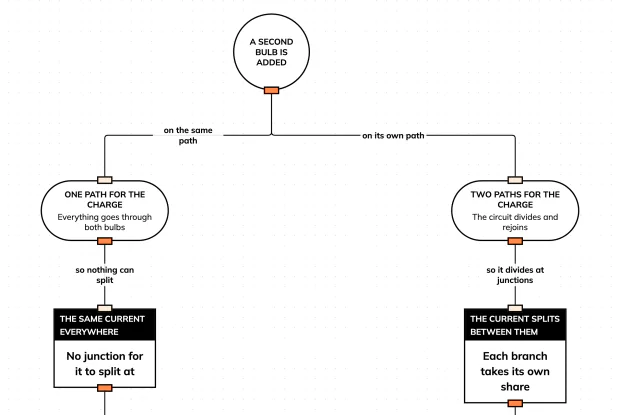
What Happens When You Add a Second Bulb?
Add a bulb to a working circuit and it either dims both or changes nothing. Find out what you actually decided when you connected it, in an interactive playground.
Why Are Bulbs in Series Dimmer?
Two bulbs on one path are both dimmer, and the obvious explanation is wrong. Follow what actually changed, in an interactive playground.
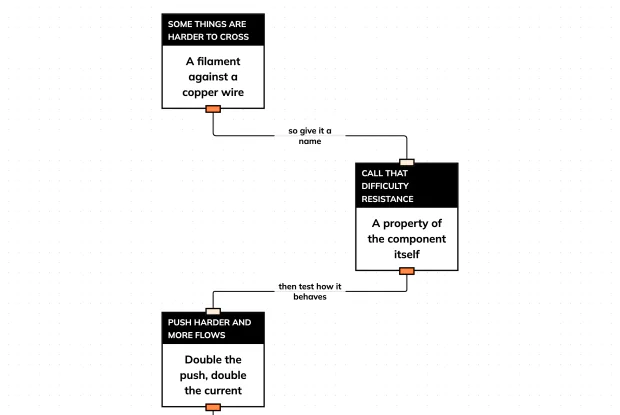
What Is Resistance? And What V = IR Actually Claims
Resistance is the word for how hard a component is to get through — and the equation everyone memorises is a claim about the world. Find out what it asserts, in an interactive playground.
Why Is Your House Wired in Parallel?
Switch on a kettle and the lights do not dim. That is not an accident of good wiring — it is a consequence of one decision. Trace it in an interactive playground.
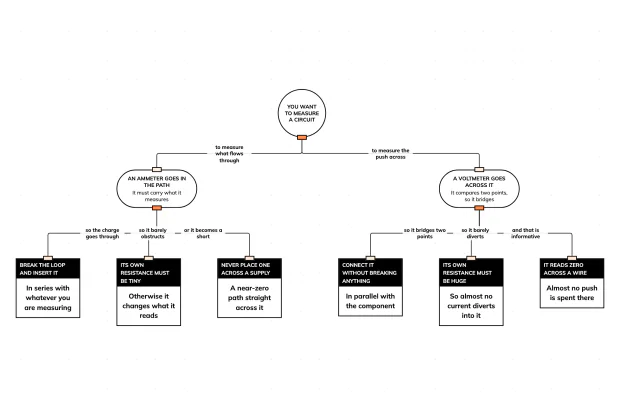
Where Does a Meter Go in a Circuit? Through or Across
An ammeter goes in the loop and a voltmeter goes beside it, and the reason is the same reason a good measurement must not disturb what it measures. Sort them in an interactive playground.