What Is Resistance? And What V = IR Actually Claims
Root Concept
Resistance is how hard it is to push charge through a component, and the relationship V = IR is the discovery that for a given component the push divided by the flow stays the same however hard you push — which makes that ratio a property of the component rather than a reading.
CodePLU Goal
Upgrading Human Mental Models
Learn how to think in Workflows

Concept Development By codeplu.com
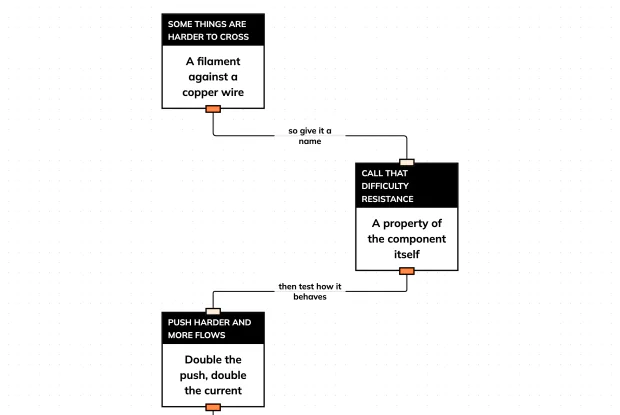
The fourth step is the only surprising one. The others name things; that one is a result somebody had to go and measure.
The Word That Has Been Doing the Work
The last tutorial leaned hard on the idea that a bulb is "harder to get through" than a wire, and never said what that meant. It is time to give the word a proper meaning, because it turns out to be measurable, and the measurement produced one of the few genuinely surprising results in basic electricity.
Start with what is obvious. Charge moves easily along copper and with difficulty through a lamp filament — the conductors tutorial explained why, in terms of electrons free to move through a metal. The word for that difficulty is **resistance**, and so far it is only a label for something already noticed.
The interesting question is whether it is a fixed property of the component or something that changes depending on how hard you push. That is a question you can settle with an experiment rather than an argument: connect a component, vary the push, and measure the current each time.
What you find for a plain resistor is that doubling the push doubles the current, and tripling it triples the current, so the push divided by the current comes out the same every time. That constant ratio is the resistance, and the fact that it IS constant is the discovery. **V = IR is not a formula for finding V. It is the claim that this ratio does not change** — and because the claim is about the world, it can be and sometimes is false.
Taking the Claim Apart
What makes something resistant?
The charges have to get past the atoms of the material, and in some materials that is much more obstructed than in others. The conductors tutorial described a metal as a fixed grid of atoms with electrons free to move through it; those electrons do not sail through unimpeded, they collide with the grid constantly, and each collision transfers a little energy to the atoms as heat. A material whose structure obstructs them more has a higher resistance, and so does a longer sample, because there is more of it to cross. A thicker sample has lower resistance, because there is more room to get through — which is exactly why the cable to a distant shed is thick and a lamp filament is extremely thin.
What exactly did the experiment find?
That for a given component the ratio of push to flow is a constant. Put 1 volt across a resistor and measure, say, 0.1 amps. Put 2 volts and you get 0.2 amps; 3 volts gives 0.3. The current is not just rising, it is rising in exact proportion, so dividing volts by amps gives 10 every single time. That constant is what we mean by the resistance, and its unit — the ohm — is defined as exactly that: one volt per amp. Nothing here was derived from theory. Somebody connected things up, varied one quantity, measured the other, and found a straight line through the origin where there did not have to be one.
So what is the equation actually asserting?
That push, flow and difficulty are locked together, so fixing any two fixes the third. Written as V = IR it says: the push used up across a component equals the current through it multiplied by its resistance. Read as a sentence about behaviour, it tells you that a bigger resistance needs a bigger push for the same flow, and that the same push through a bigger resistance gives less flow. That is the physics, and it is worth holding in that form before any number goes near it — an equation treated as a recipe teaches arithmetic, and rearranging it is a skill the maths category already covers properly.
Where does the claim break down?
In the very component this track has been using. A filament lamp gets hot when current passes, and a hot filament resists more than a cold one, so its resistance is not constant — push twice as hard and you get rather less than twice the current. Plot it and the line bends. That makes a filament lamp a **non-ohmic** component, and it is worth saying plainly rather than quietly ignoring, because a rule stated without its exceptions is the kind that gets remembered as universal. Ohm’s law holds for metals at a steady temperature, which covers an enormous amount of practical electricity and does not cover everything. Knowing where a rule stops is part of knowing the rule.
Real World Example
Three Components, Read as Resistances
Resistance is not a defect to be minimised. In each of these it has been deliberately selected, high or low, for what it does.
Step 1
A lamp filament: resistance chosen to be high
A filament is made of tungsten, drawn extremely thin and coiled to pack a long length into a small space — both of which raise its resistance enormously. That is the entire design intent. A large share of the push is spent getting charge across it, and the energy that costs comes out as heat and then as light. A bulb with a low-resistance filament would be a short piece of wire that barely warmed, which is to say it would not be a bulb. The property that looks like an obstacle is the product.
Step 2
A connecting wire: resistance chosen to be low
The same reasoning run backwards. Copper is used for wiring because its resistance is very low, and cable is made thick for the same reason, so that almost none of the battery’s push is wasted getting charge from one component to the next. Any push spent in the wire is push not available at the thing you actually wanted to run, and the energy it costs appears as warmth in the cable rather than as anything useful. Long runs are made thicker precisely because length raises resistance. Low resistance here is not an absence of a property; it is a property chosen at a small value on purpose.
Step 3
A fixed resistor: a resistance chosen by value
A resistor is a component whose only job is to have a particular resistance, printed on it in coloured bands. Put one in series with an LED and it takes a deliberate share of the push, leaving the LED with the smaller amount it can survive — without it the LED gets the full supply and is destroyed almost instantly. Here resistance is being bought by the exact value, which only makes sense because the ratio is constant and therefore predictable in advance. A component whose resistance wandered could not be sold by its value, which is the practical payoff of the constancy.
FAQs
Final Words
Resistance is the name for how hard a component is to push charge through, and the conductors tutorial already supplied the mechanism: electrons crossing a metal collide with the grid of atoms, and a material, length or thinness that obstructs them more resists more.
The part worth knowing is what the measurement found. Vary the push across a plain resistor and the current rises in exact proportion, so push divided by flow comes out the same every time — and that constant ratio is the resistance, in volts per amp. **V = IR is that discovery written down.** It is a claim that the ratio holds, not a recipe for finding a number: more resistance needs more push for the same flow.
Being a claim about the world, it can fail — and it fails in the component this track has been using, since a hot filament resists more than a cold one. The next tutorial asks why every house is wired the same way.
Continue This Track
This concept is part 3 of More Than One Path.
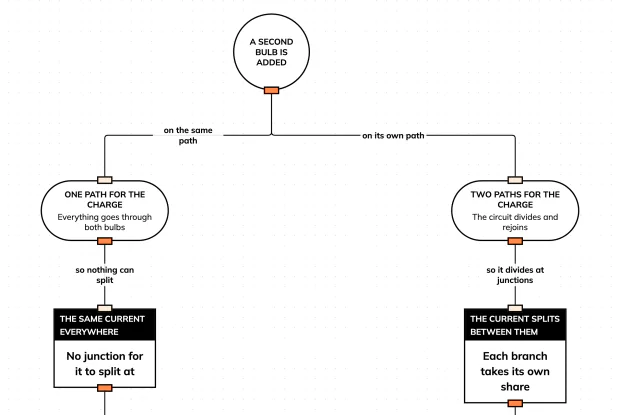
What Happens When You Add a Second Bulb?
Add a bulb to a working circuit and it either dims both or changes nothing. Find out what you actually decided when you connected it, in an interactive playground.
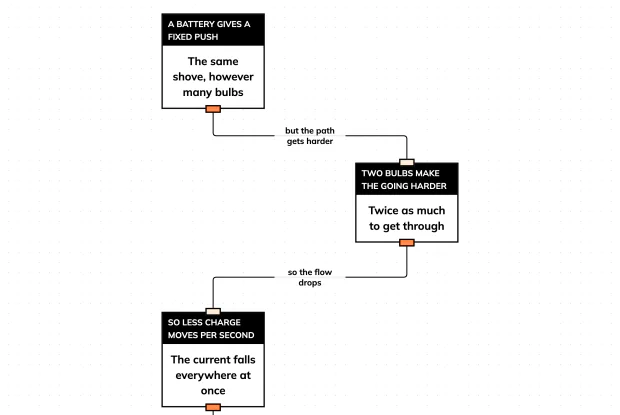
Why Are Bulbs in Series Dimmer?
Two bulbs on one path are both dimmer, and the obvious explanation is wrong. Follow what actually changed, in an interactive playground.
What Is Resistance? And What V = IR Actually Claims
Resistance is the word for how hard a component is to get through — and the equation everyone memorises is a claim about the world. Find out what it asserts, in an interactive playground.
Why Is Your House Wired in Parallel?
Switch on a kettle and the lights do not dim. That is not an accident of good wiring — it is a consequence of one decision. Trace it in an interactive playground.
Where Does a Meter Go in a Circuit? Through or Across
An ammeter goes in the loop and a voltmeter goes beside it, and the reason is the same reason a good measurement must not disturb what it measures. Sort them in an interactive playground.