More Than One Path
Five parts paying the promise the circuits track left open when it said you now had enough to make sense of adding a second bulb. It turns out "add a bulb" is not one instruction: you can put it on the same path or give it a path of its own, and the two behave so differently that connecting a component is a decision rather than an action. The second part goes after the explanation everybody reaches for — that the first bulb uses some of it up — which makes a prediction that fails in ten seconds, because the two bulbs are equally dim and swapping them changes nothing. What actually happened is two things at once: the going got harder so the current fell everywhere, and the push divided between them. The third names the word that had been carrying all the weight, and shows that V = IR is a discovery rather than a formula — somebody varied the push, measured the flow, and found a constant ratio where there did not have to be one. The fourth asks why every house is wired the same way, where one decision explains the label on every appliance, the switch on every wall and the need for a fuse. And the last is about measuring any of it: through or across, and why a meter in the wrong place tells you nothing.
CodePLU Goal
Upgrading Human Mental Models
Learn how to think in Workflows
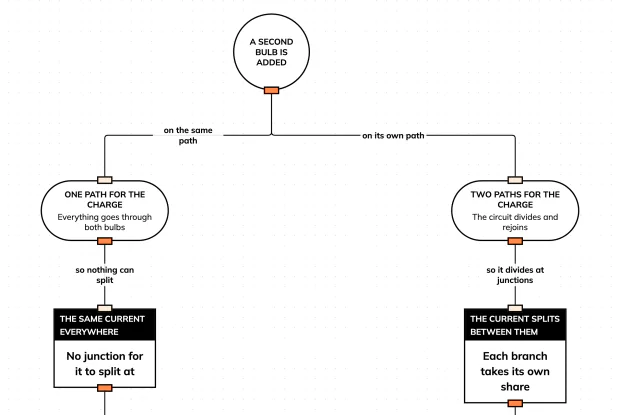
What Happens When You Add a Second Bulb?
Add a bulb to a working circuit and it either dims both or changes nothing. Find out what you actually decided when you connected it, in an interactive playground.
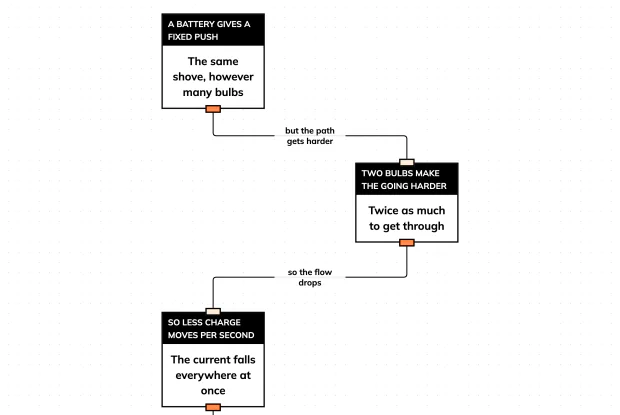
Why Are Bulbs in Series Dimmer?
Two bulbs on one path are both dimmer, and the obvious explanation is wrong. Follow what actually changed, in an interactive playground.
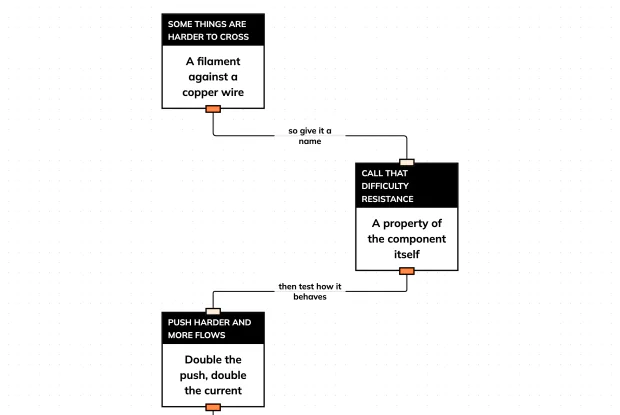
What Is Resistance? And What V = IR Actually Claims
Resistance is the word for how hard a component is to get through — and the equation everyone memorises is a claim about the world. Find out what it asserts, in an interactive playground.
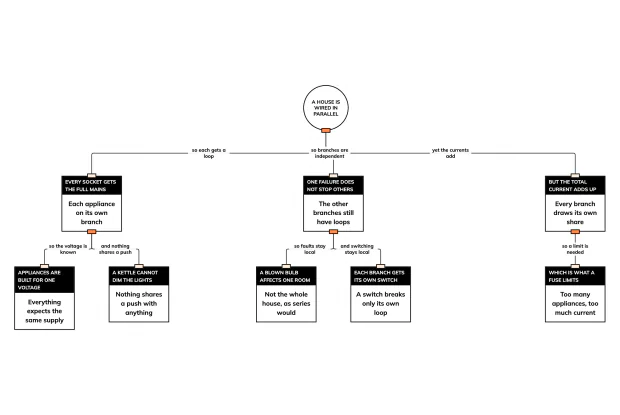
Why Is Your House Wired in Parallel?
Switch on a kettle and the lights do not dim. That is not an accident of good wiring — it is a consequence of one decision. Trace it in an interactive playground.
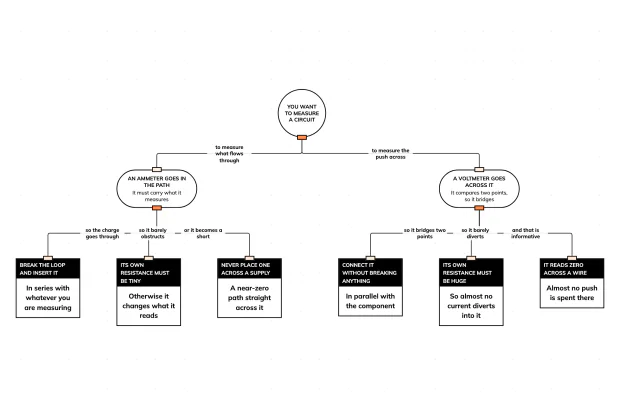
Where Does a Meter Go in a Circuit? Through or Across
An ammeter goes in the loop and a voltmeter goes beside it, and the reason is the same reason a good measurement must not disturb what it measures. Sort them in an interactive playground.