What Happens When You Add a Second Bulb?
Root Concept
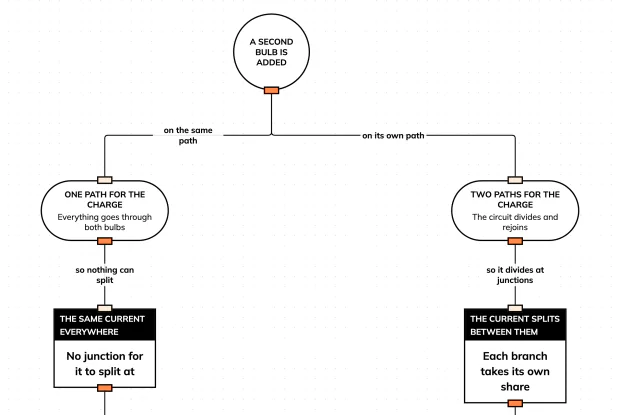
A second bulb can be added on the same single path, which makes it a series circuit where the current is the same everywhere and the push is shared, or on a path of its own, which makes it a parallel circuit where the current splits and each bulb gets the full push.
CodePLU Goal
Upgrading Human Mental Models
Learn how to think in Workflows

Concept Development By codeplu.com
Both branches start from the same act — a second bulb goes in. The whole difference is made at the first row, and everything below is a consequence.
One Bulb Works. Now Add Another.
A battery, a bulb and two wires make a loop, and the bulb lights. The circuits track established why: the charge needs an unbroken path out of the battery and back into it, the bulb transfers energy out of the circuit as light and heat, and the charge itself is never used up on the way round.
Now add a second bulb. Most people expect one answer, and there are two — because "add a bulb" is not one instruction. You can put the new bulb on the same path, so the charge goes through the first bulb and then through the second. Or you can give it a path of its own, so the circuit divides, each bulb sits on its own branch, and the paths rejoin before returning to the battery.
Those are the only two choices, they have names — series for one path, parallel for two — and they behave so differently that it is worth doing before reading on. Wire two bulbs in series and both are noticeably dimmer than one bulb was. Wire them in parallel and both are as bright as the single bulb, and unscrewing one leaves the other burning.
That second result is the one that catches people, because it looks as though the battery has somehow produced twice as much. It has not. What matters here is that connecting a component is a decision rather than an action, and the decision is made the moment you choose where the wire goes.
Following Each Choice
What does "one path" actually mean?
That there is no junction anywhere in the loop, so a charge leaving the battery has no decision to make: it must pass through the first bulb, then the second, then return. This has an immediate consequence that surprises almost everybody — the current is the SAME at every point in a series circuit. Not bigger before the first bulb and smaller after it. Nothing is being consumed, so there is nothing to be smaller. Put an ammeter anywhere in that loop, before either bulb or between them or after both, and it reads the same value. This is the first real test of whether the idea that charge is used up has actually been given up, because that idea predicts a falling current and the measurement shows a flat one.
So why are two bulbs in series dimmer?
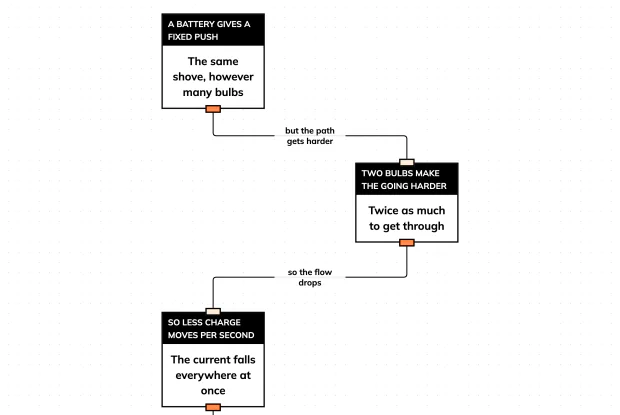
Because the battery’s push is now shared between them. The battery provides a fixed amount of push — the circuits track described it as giving charge a shove using a chemical store — and with two bulbs on one path, that push has to get the charge through both of them. Each bulb therefore receives about half of what a single bulb would have had to itself, so less energy is transferred at each one, so each glows more faintly. The current is lower everywhere than it was with one bulb, which is consistent: harder going for the same push means less charge moving per second. The next tutorial takes that argument apart properly, because the word "shared" is doing a lot of work in it.
What does "a path of its own" change?
It gives the charge somewhere to divide. A parallel circuit has junctions: the loop splits into branches and the branches rejoin, so charge leaving the battery goes one way or the other rather than through everything. Each branch is its own complete path from the battery and back, which means each bulb receives the full push rather than a share of it — and that is why both are as bright as the single bulb was. The current is not the same everywhere any more: in the main wire it is the total, and it splits at the junction, with each branch taking a share and the shares adding back up where they rejoin. Nothing is created at the junction and nothing is lost at it.
Why does unscrewing one parallel bulb leave the other lit?
Because breaking one branch does not break the other. The rule from the first track still holds exactly — a circuit works only when there is an unbroken path out of the battery and back — and in a parallel circuit there is more than one such path. Removing a bulb destroys the loop that went through it and leaves the other loop entirely intact, so the second bulb carries on without noticing. In series there is only ever one loop, so breaking it anywhere breaks it everywhere, which is why a single failed bulb in an old string of fairy lights takes the whole string out. Same rule, two layouts, opposite results.
Real World Example
Three Things You Can Check Yourself
These are not demonstrations of a stated fact; each is a test that the two circuits answer differently, which is what makes them worth doing.
Step 1
Old fairy lights: one bulb out, the whole string dark
Strings of lights built in series went dark completely when a single bulb failed, and finding the dead one meant testing them in turn. That is the one-path rule in its most annoying form: there is a single loop, and a gap anywhere in it is a gap in all of it. Modern strings are wired so that a failed bulb does not open the circuit, which is why they stay lit. The frustration of the old ones was never a quality problem — it was a direct consequence of the layout chosen to keep them cheap.
Step 2
Every room in your house keeps full brightness
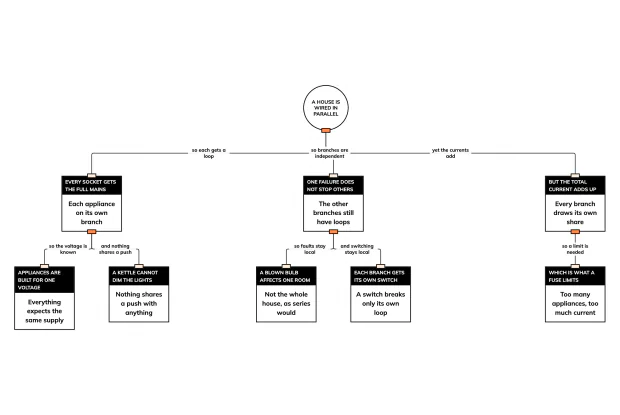
Switch on a second lamp at home and the first does not dim. Switch on ten and it still does not. If a house were wired in series, every appliance would share the supply with every other one and turning on a kettle would dim every light in the building — and the whole house would go dark whenever one bulb failed. That this does not happen is evidence you can collect without any apparatus, and it tells you domestic wiring must be parallel. Why that was the right choice is the fourth tutorial of this track.
Step 3
An ammeter reads the same on both sides of a bulb
Put a meter in a simple series loop before the bulb and note the reading; move it to after the bulb and read again. The two numbers are the same, and that measurement is the one that settles the oldest misconception in the subject. If current were used up by the bulb the second reading would be lower, and it is not. What the bulb takes is energy, which arrives with the charge and leaves as light and heat; the charge continues round undiminished and goes back to the battery to be pushed again. The meter settles it, not the argument.
FAQs
Final Words
Adding a second bulb is not one instruction, and the two ways of doing it behave so differently that the connection is a decision. On the same path you have a series circuit: one loop, no junctions, the same current at every point, and the battery’s push shared so both bulbs dim. On its own path you have a parallel circuit: the loop divides and rejoins, each branch gets the full push, and both bulbs stay as bright as one was.
The consequences follow from the layout, not from anything new. Series has one loop, so a break anywhere is a break everywhere — the old string of fairy lights. Parallel has several, so removing one bulb leaves the others untouched: the same complete-path rule, applied to a circuit with more than one complete path.
The next tutorial goes after the word doing the most work here. "The push is shared" explains the dimming, and it is not yet an explanation of anything.
Continue This Track
This concept is part 1 of More Than One Path.
What Happens When You Add a Second Bulb?
Add a bulb to a working circuit and it either dims both or changes nothing. Find out what you actually decided when you connected it, in an interactive playground.
Why Are Bulbs in Series Dimmer?
Two bulbs on one path are both dimmer, and the obvious explanation is wrong. Follow what actually changed, in an interactive playground.
What Is Resistance? And What V = IR Actually Claims
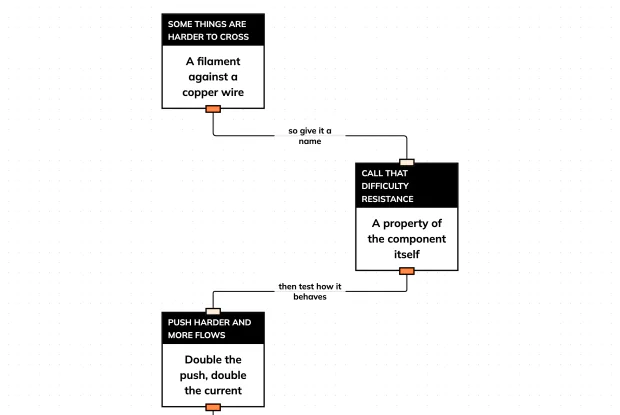
Resistance is the word for how hard a component is to get through — and the equation everyone memorises is a claim about the world. Find out what it asserts, in an interactive playground.
Why Is Your House Wired in Parallel?
Switch on a kettle and the lights do not dim. That is not an accident of good wiring — it is a consequence of one decision. Trace it in an interactive playground.
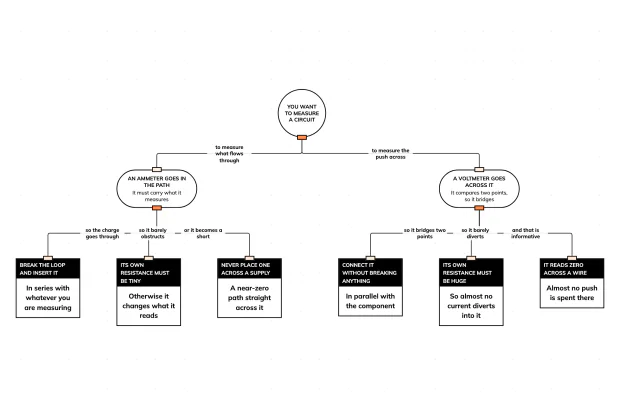
Where Does a Meter Go in a Circuit? Through or Across
An ammeter goes in the loop and a voltmeter goes beside it, and the reason is the same reason a good measurement must not disturb what it measures. Sort them in an interactive playground.