Why Do You Only Get Chickenpox Once? Memory Cells
Root Concept
After an infection, some of the multiplied lymphocytes remain as memory cells, so a second encounter with the same pathogen produces antibodies far faster and in far greater quantity than the first, usually clearing it before symptoms develop.
CodePLU Goal
Upgrading Human Mental Models
Learn how to think in Workflows

Concept Development By codeplu.com
Nothing in the chain is new biology. The only new fact is that some cells are kept.
The Same Machinery, Running Much Faster
The previous tutorial left the lymphocyte route looking like a poor bargain. It takes days to assemble, it works against one pathogen and nothing else, and by the time it is producing antibodies in quantity the infection has usually run most of its course. The question it leaves open is why a system this slow is worth having.
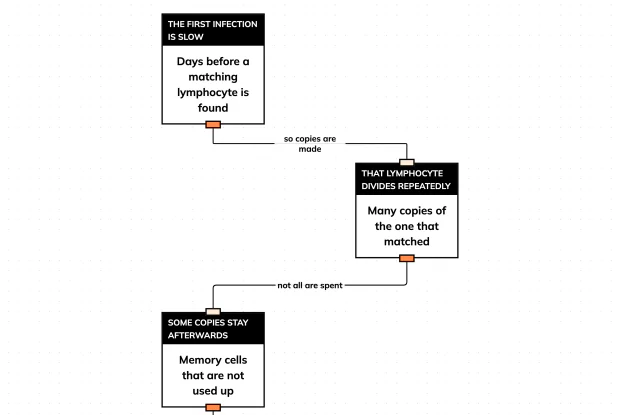
The answer is that it is slow once. When a lymphocyte matching a pathogen is found and divides to produce a large population, not all of those copies are spent clearing the infection. Some remain afterwards, often for decades, and they are called memory cells. They are not doing anything in the meantime and they are not producing antibodies. What they are is a population already in place, already matching that one pathogen, and already large.
That single fact changes the arithmetic completely. The slow part of the first response was finding the one matching lymphocyte among an enormous variety and then building the numbers up. Neither of those has to happen again. If the same pathogen arrives years later it meets a population that already matches it, and antibodies appear in hours rather than days and in far greater quantity. The pathogen is cleared before it can multiply enough to cause symptoms, which is why somebody who has had chickenpox does not get it a second time, and why they usually have no idea they were ever exposed again.
Each Step in the Reasoning
What exactly is a memory cell?
A lymphocyte left over from a previous infection, matching one particular pathogen, and long-lived. When a lymphocyte finds a pathogen it matches, it divides repeatedly, and the resulting cells take two roles. Most become cells that produce antibodies in quantity and die off once the infection is cleared, since there is nothing further to do and maintaining them costs the body resources. A smaller proportion become memory cells, which produce no antibodies at all and persist, in some cases for the rest of a person's life. They do nothing visible for years. Their value is entirely in already existing — the work of finding the match and multiplying has been done and does not have to be repeated.
Why is the second response so much faster?
Because the two slowest steps have been skipped. In a first infection the body must wait for a pathogen to encounter the one lymphocyte among millions that happens to match it, and then wait again while that cell divides enough times to build a useful population. Both take days. On a second encounter the matching population is already present and already numerous, so it begins dividing and producing antibodies almost at once. Drawn as a graph, the first response is a slow rise beginning around day four or five and reaching a modest peak; the second is a steep rise beginning within a day and reaching a peak many times higher. The pathogen never gets the head start it had the first time.
What does a vaccine actually do?
It produces the first three steps of the chain without the first step making anybody ill. A vaccine contains the pathogen in a form that cannot cause the disease — killed, weakened, or reduced to a fragment of its surface, depending on the vaccine. The immune system has no way of knowing this. It finds the matching lymphocyte, that lymphocyte divides, antibodies are produced, and memory cells remain afterwards exactly as they would after a real infection. When the real pathogen later arrives, it meets a memory population already in place and is dealt with as a second encounter. The biology is the same chain the playground draws; only the starting material is different.
Why do some diseases come back then?
Several reasons, and each is a failure of a specific step rather than of the principle. Influenza and cold viruses change the surface features antibodies recognise, so a memory population matching last year's shape does not match this year's — the lock has changed and the key no longer fits. "The common cold" is also not one pathogen but a great many different viruses, so immunity to one says nothing about the next. And for some pathogens the memory population fades over years rather than lasting a lifetime, which is why protection against certain diseases is renewed periodically. Chickenpox happens to be a case where a single infection usually produces lasting memory.
Real World Example
Smallpox and the Milkmaids
Vaccination was worked out from an observation about who did not catch a disease, more than a century before lymphocytes or antibodies were known about at all.
Step 1
Milkmaids did not get smallpox
Smallpox was one of the most feared diseases in eighteenth-century Europe, killing a large proportion of those it infected and disfiguring many who survived. It was widely observed in rural areas that milkmaids seemed to escape it. They did commonly catch cowpox, a much milder disease picked up from the udders of cattle, which produced sores on the hands and little else. The association between having had cowpox and not getting smallpox was part of country lore well before anybody tested it, and several people appear to have acted on it independently. What nobody had was any account of why one disease should protect against another.
Step 2
Jenner tested the idea in 1796
Edward Jenner took material from a cowpox sore on a milkmaid's hand and introduced it into a scratch on the arm of a boy, James Phipps, who developed the mild cowpox illness and recovered. Some weeks later Jenner deliberately exposed him to smallpox, and he did not develop it. By the standards of modern research this was an extraordinary thing to do to a child, and it is worth saying so plainly, and Jenner knew neither what caused smallpox nor what a risk he was taking. The result was nevertheless clear, repeatable by others, and the basis of the word vaccination, from vacca, the Latin for cow.
Step 3
The explanation came much later
Jenner had no idea why it worked. Lymphocytes, antibodies and memory cells were all more than a century away, and the virus responsible for smallpox could not be seen until electron microscopes existed. What he had found was that cowpox and smallpox viruses are similar enough on the surface that antibodies raised against one also fit the other — the memory population built against cowpox matched smallpox closely enough to work. A deliberate worldwide vaccination campaign followed in the twentieth century, and smallpox was declared eradicated in 1980 — so far the only human disease driven out of the world entirely.
FAQs
Final Words
The chain holds together on one fact. A lymphocyte that matched a pathogen divides into a large population, and not all of that population is spent clearing the infection — some remains as memory cells. Everything else follows. The slow steps were finding the match and building the numbers, and neither has to happen twice, so a second encounter produces antibodies in hours instead of days and the pathogen never multiplies enough to be noticed.
A vaccine is that same chain started deliberately, with material that carries the right shapes but cannot cause the disease. This track began by separating diseases that are caught from diseases that are not, followed a pathogen along the six steps of its journey, and then watched what happens at each stage once it arrives. The next track leaves disease behind and returns to plants, with the question of how a plant feeds itself at all.
Continue This Track
This concept is part 5 of Why We Fall Ill.
What Actually Makes You Ill? Not Always Germs
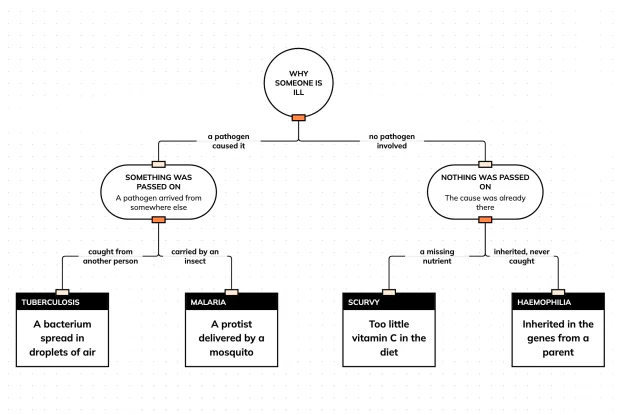
Not every disease is caught. Some are caused by a pathogen that arrived from somewhere else, and some by a missing nutrient or an inherited gene. Sort four of them in an interactive playground.
How Does a Pathogen Reach a New Host? Six Steps
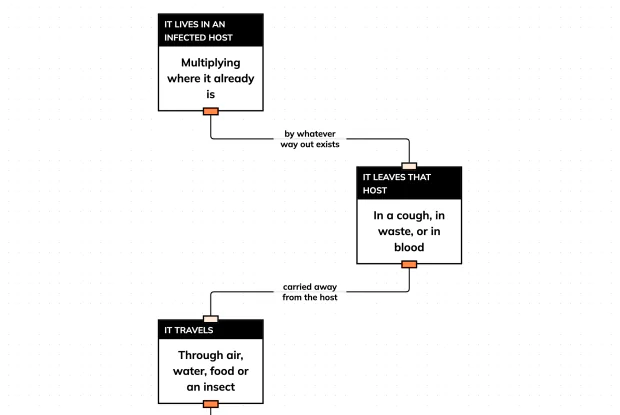
A pathogen has to leave one host, travel, arrive at another, get past its defences and multiply. Follow the whole chain in an interactive playground and see why every control measure targets one link.
What Happens When a Pathogen Gets In? Trace It
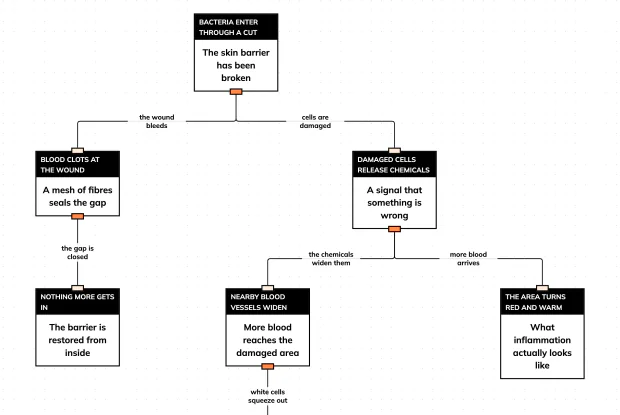
A cut lets bacteria past the skin, and the body does several things at once — sealing the gap, widening vessels and bringing white cells in. Trace the whole web of consequences in an interactive playground.
Two Ways to Fight an Infection — Eat or Mark
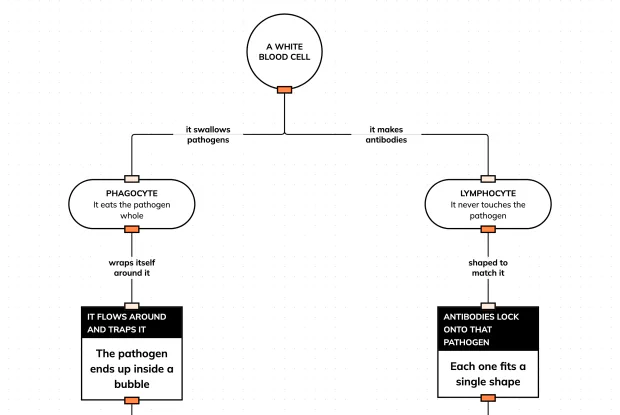
White blood cells are not one thing. Phagocytes swallow pathogens whole; lymphocytes never touch them and make antibodies instead. Follow both routes from one starting point in an interactive playground.
Why Do You Only Get Chickenpox Once? Memory Cells
The first infection takes days to clear and the second never happens at all. Follow the reasoning step by step in an interactive playground, and see what a vaccine actually does.