How Does a Pathogen Reach a New Host? Six Steps
Root Concept
An infectious disease spreads along a chain in which a pathogen leaves an infected host, travels by some route, reaches a new host, enters through a way past its defences and multiplies there, and interrupting any single link prevents the infection.
CodePLU Goal
Upgrading Human Mental Models
Learn how to think in Workflows

Concept Development By codeplu.com
Every link has to hold for the disease to spread. That is the weakness worth knowing about.
A Journey With Six Places to Fail
Calling a disease infectious says that its cause can move from one host to another. It does not say how, and the how turns out to be the useful part, because a journey with six steps in it is a journey with six places it can be stopped.
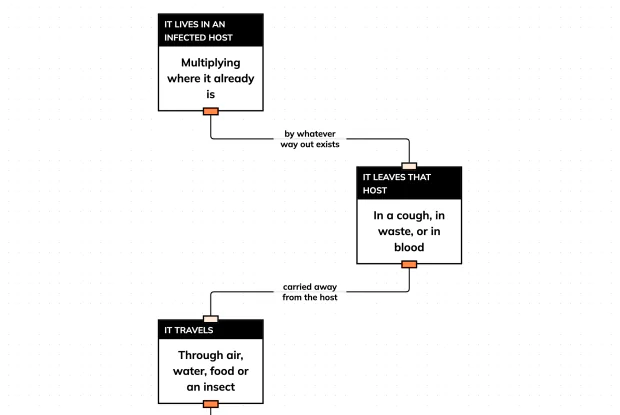
The chain always has the same shape. A pathogen is multiplying inside a host, where it has food and warmth. To reach anybody else it must first get out, and how it gets out depends on where in the body it lives — a pathogen in the airways leaves in a cough, one in the gut leaves in waste, one in the blood needs something that punctures skin. Then it has to survive the journey, which is where many fail, because the outside world is dry and cold and a bacterial cell is mostly water. Then it must reach another host, get past the defences that host has, and multiply there in numbers large enough to do damage.
What makes the chain worth drawing is that it is fragile. Every one of the six steps must succeed, and almost everything ever done to control an infectious disease is an attack on one specific link. Clean water attacks the travelling step. Handwashing attacks arrival. A mosquito net attacks the route. A vaccine attacks the last step by making sure the pathogen cannot multiply freely once it is in. Knowing which link a measure targets is knowing why it works.
Following the Chain
How does a pathogen get out of a host?
Through whatever opening its own location gives it, which is why different diseases spread in such different ways. A pathogen living in the nose, throat or lungs leaves in the droplets thrown out by a cough or a sneeze, and a single sneeze produces an enormous number of them. One living in the intestine leaves in faeces, which is why diseases like cholera and typhoid are tied so closely to sanitation. One living in the blood cannot get out at all on its own and depends on something making a hole — a mosquito feeding, or a shared needle. The symptoms of many infections are themselves part of the exit: coughing and diarrhoea are unpleasant for the host and extremely effective for the pathogen.
Why is the journey the hardest part?
Because outside a host there is nothing to live on and a great deal to survive. A bacterial cell is mostly water and the air is drying; there is no food, the temperature is wrong, and ultraviolet light in sunlight damages genetic material. Most pathogens that leave a host die before they reach another one, which is the single biggest reason infections do not spread even faster than they do. Different pathogens solve this differently. Some survive only minutes in air and must be passed almost immediately. Some form tough spores that last for years in soil. Some never face the outside world at all, because an insect carries them directly from one bloodstream into another.
What are the main routes between hosts?
Four cover most cases. Airborne or droplet spread carries pathogens in the moisture breathed, coughed or sneezed out, and accounts for colds, influenza and tuberculosis. Water and food carry pathogens that have left in faeces and reached something that is then drunk or eaten, which is cholera and most food poisoning. Direct contact covers anything passed by touching, including skin infections and anything picked up from a surface a sick person touched first. And a vector is a living carrier, usually an insect, that moves the pathogen from one host to another — the mosquito in malaria, which also feeds the pathogen and keeps it warm on the way, so it never meets the outside world at all.
Why does getting in need a way past the defences?
Because intact skin is genuinely very difficult to cross. It is a thick layer of dead, keratin-filled cells with no gaps, and almost no pathogen gets through it while it is unbroken. The ways in are the places where the covering is necessarily thinner: the lining of the nose and airways, the lining of the gut, the surface of the eye. Each of those is defended, which the next tutorial takes up, but each is a far softer target than skin. The other way in is a hole — a cut, a bite, a needle — which is why a wound matters out of all proportion to its size, and why an insect that pierces skin to feed is such an effective carrier.
Real World Example
The Broad Street Pump, London, 1854
The clearest demonstration that the chain is what matters came thirty years before anyone could see the organism responsible. John Snow broke the travelling step while the cause was still unknown.
Step 1
The accepted explanation was the wrong link
Cholera killed thousands in London and the prevailing theory held that it spread through bad air rising from filth, an idea known as miasma. That theory did identify a real association, because the districts with the worst smells were indeed the worst affected. But it attacked the wrong link in the chain. If the route were air, then improving ventilation and clearing smells should have helped, and it did not. The association was real and the mechanism behind it was not what anyone assumed, which is a failure mode worth recognising in its own right.
Step 2
Mapping the deaths pointed at water
During an outbreak in Soho in 1854, Snow marked every death on a map of the streets and found them clustered tightly around one public water pump in Broad Street. People living nearer other pumps were largely unaffected, and the exceptions were informative rather than awkward — workers at a nearby brewery, who drank beer rather than water, escaped almost entirely. The pattern fitted a pathogen travelling in water and fitted nothing else, so Snow argued that the route was drinking water contaminated with the waste of people who already had the disease, which at the time was a deeply unfashionable claim.
Step 3
Removing the handle broke the chain
Snow persuaded the local authorities to remove the pump handle, so the water could not be drawn. Cases in the area fell away. The outbreak was already declining by then and historians debate how much the handle itself changed, but the principle was established and the investigation is treated as the beginning of epidemiology. The striking part is that nobody had seen the bacterium responsible — Vibrio cholerae was not identified until 1883, nearly thirty years later. Breaking a link does not require knowing what is travelling along it, only knowing which way it goes.
FAQs
Final Words
Six steps, every one of which has to succeed. The pathogen multiplies in a host, finds a way out, survives a journey by air, water, contact or a carrier, reaches somebody else, gets past a defence somewhere, and multiplies again. Fail at any point and there is no new infection.
That is why the chain is worth drawing rather than simply saying diseases are catching. Clean water, handwashing, ventilation, mosquito nets, keeping unwell people apart, covering a cut — each of these is an attack on one named link, and knowing which link explains why a measure works for one disease and does nothing for another. The chain ends with getting past the body's defences, which has been assumed so far and is about to be taken seriously. The next tutorial follows what happens the moment a pathogen actually gets in.
Continue This Track
This concept is part 2 of Why We Fall Ill.
What Actually Makes You Ill? Not Always Germs
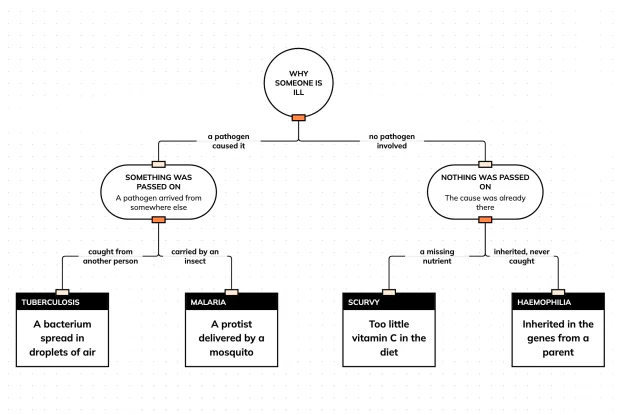
Not every disease is caught. Some are caused by a pathogen that arrived from somewhere else, and some by a missing nutrient or an inherited gene. Sort four of them in an interactive playground.
How Does a Pathogen Reach a New Host? Six Steps
A pathogen has to leave one host, travel, arrive at another, get past its defences and multiply. Follow the whole chain in an interactive playground and see why every control measure targets one link.
What Happens When a Pathogen Gets In? Trace It
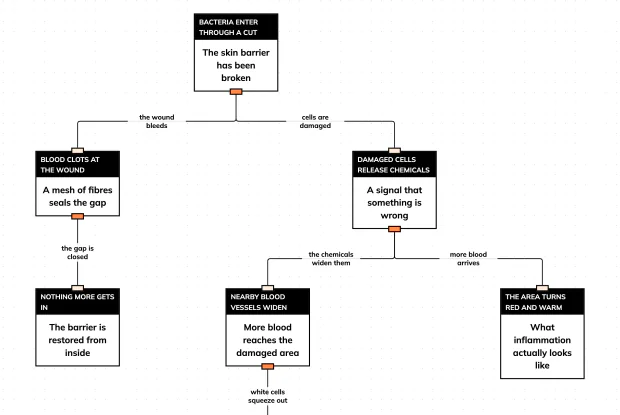
A cut lets bacteria past the skin, and the body does several things at once — sealing the gap, widening vessels and bringing white cells in. Trace the whole web of consequences in an interactive playground.
Two Ways to Fight an Infection — Eat or Mark
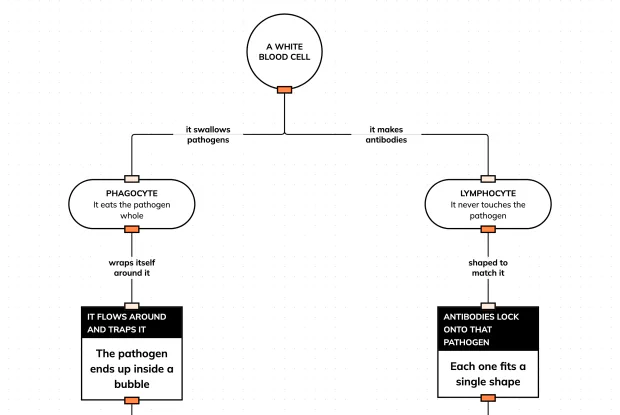
White blood cells are not one thing. Phagocytes swallow pathogens whole; lymphocytes never touch them and make antibodies instead. Follow both routes from one starting point in an interactive playground.
Why Do You Only Get Chickenpox Once? Memory Cells
The first infection takes days to clear and the second never happens at all. Follow the reasoning step by step in an interactive playground, and see what a vaccine actually does.