What Actually Makes You Ill? Not Always Germs
Root Concept
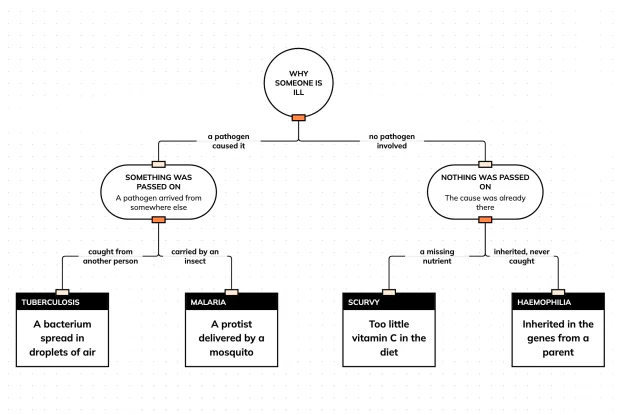
A disease is infectious when it is caused by a pathogen that can pass from one host to another, and non-infectious when its cause lies in the diet, the genes or the body itself, so nothing is transmitted and nothing can be caught.
CodePLU Goal
Upgrading Human Mental Models
Learn how to think in Workflows

Concept Development By codeplu.com
The question is never how bad it is. It is whether anything travelled from somewhere else.
Two Very Different Reasons to Be Unwell
The last track ended with microbes, and it would be easy to carry away the impression that being ill and being infected are the same thing. They are not, and the difference is the first thing this track has to establish, because every later tutorial depends on it.
Some diseases are caused by an organism that arrived from outside. A bacterium breathed in from the air, a protist injected by a mosquito, a virus picked up from a door handle: in each case something living, or at least something with genetic material, has got into the body and multiplied. Those organisms are called pathogens, and the diseases they cause are infectious, which means precisely that they can pass from one host to another. There is a chain, and the chain can in principle be broken.
Other diseases involve no pathogen at all. Scurvy happens because a diet is short of vitamin C, and no amount of contact with a person who has it will give it to anyone else. Haemophilia is written into a person's genes and was present before they were born. These are non-infectious, and the word does not mean mild — many of the most serious conditions in the world are non-infectious. It means only that nothing was transmitted, so nothing can be caught, and controlling the disease means something entirely different from controlling its spread.
Telling the Two Apart
What exactly is a pathogen?
A pathogen is any organism or particle that causes disease in a host. The previous track gave the materials: bacteria, fungi and protists are all living organisms from three different kingdoms, and viruses are not organisms at all but behave as pathogens anyway. What makes something a pathogen is not what it is made of but what it does — damaging the host it lives in, either by destroying cells directly or by releasing substances that poison them. The word is relative, too. A bacterium that is harmless in the intestine can cause serious illness in the bloodstream, so the same species can be a pathogen in one place and an ordinary resident in another. It is a role rather than a category.
Why does the word infectious mean what it does?
An infectious disease is one in which the cause can move from a host to a new host, so the disease can spread through a population. That is a statement about the cause, not about the symptoms. It explains why the two groups are managed in completely different ways. An infectious disease can be controlled by interrupting the journey — the next tutorial follows that journey step by step — so clean water, ventilation, handwashing and mosquito nets are all attempts to break the chain somewhere along it. A non-infectious disease has no chain to break. Scurvy is prevented by vitamin C being in the diet, and nothing about isolating anyone would make the slightest difference.
What causes a disease if no pathogen does?
There are several routes, and they have nothing in common except the absence of transmission. A deficiency disease comes from something missing in the diet: scurvy from too little vitamin C, rickets from too little vitamin D. An inherited disease comes from the genes a person was born with, which is the subject of the last track in this subject. Some conditions arise from the body's own control going wrong, as when the immune system attacks the body it belongs to. Others come from long exposure to something harmful, or simply from tissues wearing out over a lifetime. None of these can be passed to anybody, however close the contact.
Can one disease belong to both groups?
Not strictly, but the edges are genuinely blurred and it is more honest to say so than to pretend otherwise. Some cancers are triggered by infection with a virus, so a non-infectious disease has an infectious cause somewhere behind it — the cancer itself is not catching, but the virus that raised the risk is. Susceptibility is often inherited too, so two people exposed to the same pathogen may fare very differently because of genes neither chose. The classification still works, because the question it asks is specific: can the cause of this disease travel from one person to another? But real cases sometimes need that question asked carefully, and a sorting that works for most examples is not the same as one that works for every example.
Real World Example
Scurvy on an Eighteenth-Century Ship
Scurvy is the clearest historical case of the two groups being confused, because every surface feature of it suggested a disease that spread, and the real cause was something absent rather than something present.
Step 1
It behaved exactly like an infection
On a long voyage scurvy would appear among the crew after a couple of months and then affect more and more of them, which is precisely the pattern an infectious disease produces. The men were crowded together in poor conditions, so contagion was the obvious explanation and was widely believed. Various causes were proposed over the years — bad air, damp, idleness, something in the salt meat. Every one of these assumed that something was being done to the men, because a disease that spreads through a group looks like something arriving rather than something running out.
Step 2
A controlled trial pointed somewhere else
In 1747 the naval surgeon James Lind took twelve sailors who already had scurvy, divided them into six pairs, and gave each pair a different supposed remedy while keeping everything else the same. The pair given oranges and lemons recovered quickly; the others did not. This is often described as one of the first controlled clinical trials, and its importance here is what the result implied. A treatment that works by adding a food to the diet points to a cause that is a lack, not a presence, which no amount of isolating the sick men would have revealed.
Step 3
The missing substance was found much later
The actual explanation took until the 1930s, when vitamin C was identified and its role understood. The body uses it to build collagen, the protein that holds skin, blood vessels and gums together, and most mammals manufacture their own — humans are among the few that cannot and must get it from food. Without it existing collagen is not maintained, which is why old wounds reopened and gums bled. The disease spread through a ship's crew only because every man on board was eating the same food, and the apparent contagion was nothing more than shared circumstance.
FAQs
Final Words
One question separates the two groups: did the cause of this disease travel from somewhere else? If a pathogen arrived — a bacterium, a virus, a fungus or a protist — the disease is infectious and there is a chain that might be broken. If the cause was a missing nutrient, an inherited gene, or the body itself going wrong, nothing travelled and nothing can be caught.
That distinction decides everything about how a disease is handled, and it decides nothing about how serious it is. Scurvy killed more sailors than any battle while being entirely non-infectious, and plenty of infections are over in a week. The rest of this track stays with the infectious half, because that is where the biology has a mechanism worth tracing. The next tutorial follows a pathogen along the whole of its journey from one host to the next.
Continue This Track
This concept is part 1 of Why We Fall Ill.
What Actually Makes You Ill? Not Always Germs
Not every disease is caught. Some are caused by a pathogen that arrived from somewhere else, and some by a missing nutrient or an inherited gene. Sort four of them in an interactive playground.
How Does a Pathogen Reach a New Host? Six Steps
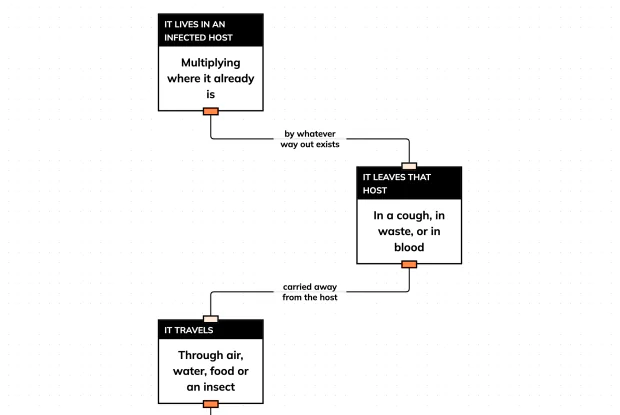
A pathogen has to leave one host, travel, arrive at another, get past its defences and multiply. Follow the whole chain in an interactive playground and see why every control measure targets one link.
What Happens When a Pathogen Gets In? Trace It
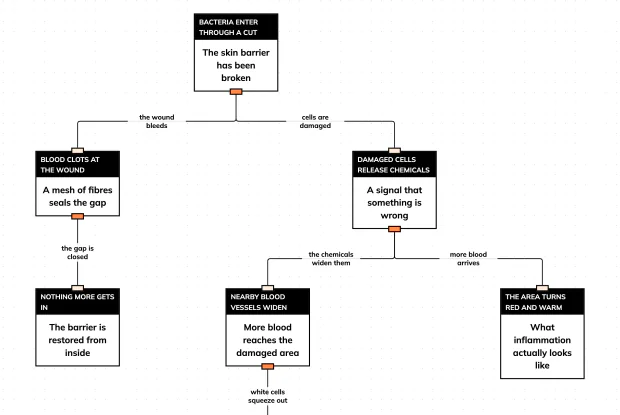
A cut lets bacteria past the skin, and the body does several things at once — sealing the gap, widening vessels and bringing white cells in. Trace the whole web of consequences in an interactive playground.
Two Ways to Fight an Infection — Eat or Mark
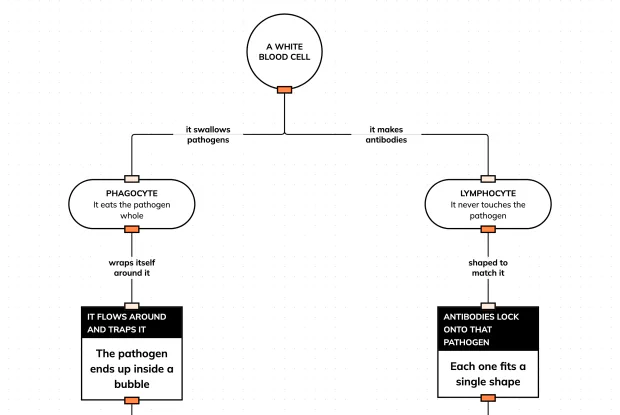
White blood cells are not one thing. Phagocytes swallow pathogens whole; lymphocytes never touch them and make antibodies instead. Follow both routes from one starting point in an interactive playground.
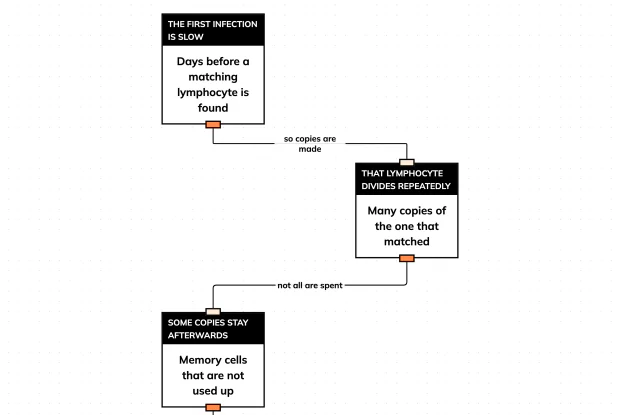
Why Do You Only Get Chickenpox Once? Memory Cells
The first infection takes days to clear and the second never happens at all. Follow the reasoning step by step in an interactive playground, and see what a vaccine actually does.