What Happens When a Pathogen Gets In? Trace It
Root Concept
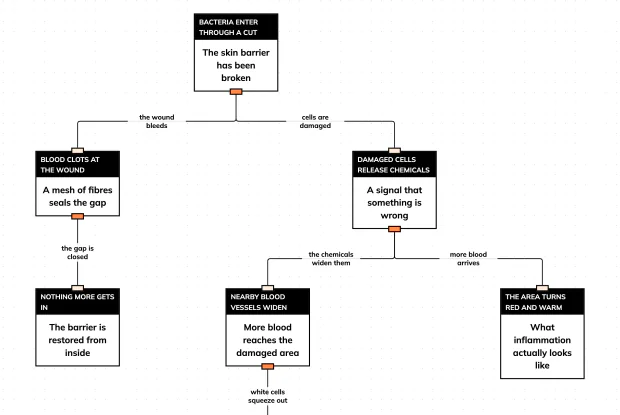
When a pathogen breaches the skin, damaged cells release chemical signals that widen nearby blood vessels so that white blood cells can leave the bloodstream and reach the site, and the redness, warmth and swelling of inflammation are consequences of that increased blood flow.
CodePLU Goal
Upgrading Human Mental Models
Learn how to think in Workflows

Concept Development By codeplu.com
Nothing here is damage. Every branch is a consequence of the body responding.
Why a Cut Goes Red Before It Gets Better
The last tutorial ended at the step where a pathogen gets past the body's defences, and treated that step as a single event. It is not. The moment bacteria cross the skin through a cut, several different things begin at once, and they do not run one after another in a tidy line.
That is why this playground is a web rather than a chain. One event — the skin being broken and bacteria entering — sets off two separate responses immediately. The wound bleeds, and blood clotting closes the gap so that nothing more can follow the first arrivals in. At the same time, cells damaged by the injury release chemical signals, and those signals do something quite different: they make nearby blood vessels widen, which brings far more blood through the area than usual.
The widened vessels have two consequences of their own. One is useful and invisible: white blood cells can squeeze out through the vessel walls and reach the bacteria. The other is visible and is the reason this response is so often misread. Extra blood close to the surface is what makes a cut go red, feel warm, swell slightly and hurt. Those four signs together are called inflammation, and the thing worth taking away is that they are not the infection damaging the body. They are what it looks like when the body is dealing with one.
Following Each Branch
What does clotting actually do?
It closes the hole, and it does so from the inside rather than by anything being applied. When a blood vessel is cut, platelets in the blood stick to the damaged edges and to each other, and a chain of reactions converts a soluble protein in the plasma into long insoluble fibres of fibrin. Those fibres form a mesh across the gap, red blood cells are caught in it, and the mesh dries into a scab. Two jobs are done at once. The obvious one is stopping blood escaping. The one that matters here is stopping anything else getting in, because until the gap is sealed every bacterium on the skin around the wound has an open route into tissue that has no covering of its own.
Why do blood vessels widen?
Because the signal to widen them is released by the damage itself. Cells injured at the site, and specialised cells already present in the tissue, release chemicals — histamine is the one usually named — which act on the small blood vessels nearby and make them both wider and leakier. Wider vessels carry more blood, so more of everything the blood contains arrives per minute. Leakier vessel walls let fluid and cells pass out into the tissue, which would normally be prevented. Neither of these is incidental: a white blood cell travelling in the bloodstream has no way of reaching bacteria sitting in tissue unless the vessel wall it is inside becomes passable.
Why is inflammation so often misunderstood?
Because every one of its signs is unpleasant, and unpleasant is easily read as harmful. Redness and warmth come from the extra blood near the surface. Swelling comes from the fluid that has leaked out of the widened vessels into the tissue. Pain comes partly from that swelling pressing on nerve endings and partly from the chemicals themselves. None of these is the bacteria doing something. They are consequences of the blood supply being increased on purpose, and a cut that goes slightly red and warm for a day is showing a response that is working. This is also why inflammation appears in conditions where there is no infection at all — the same machinery runs whenever tissue is damaged.
Which defences were in place before any of this?
Several, and they are the reason most contact with pathogens never reaches this stage. Unbroken skin is a thick layer of dead keratin-filled cells that almost nothing crosses. The airways are lined with sticky mucus that traps particles, and with tiny beating hairs that sweep the mucus steadily up and out. The stomach holds acid strong enough to destroy most of what is swallowed. Tears contain an enzyme that breaks down bacterial cell walls. All of these work on anything at all, without recognising it, which is why they are called non-specific. The web in the playground only starts once one of them has been bypassed, which is why a splinter matters and a whole arm of intact skin carrying the same bacteria does not.
Real World Example
A Splinter in a Finger
A splinter is a small enough breach to watch the whole response run its course, and each stage of the playground shows up as something you can see or feel.
Step 1
The breach happens in a moment
A splinter pushes through the outer layer of dead cells and into living tissue below, carrying with it whatever was on its surface — soil bacteria, usually, and often fungal spores. The skin barrier that the previous tutorial described as nearly impassable has been bypassed completely, not by anything the bacteria did but by an object pushing them through. This is the single most common way pathogens get past intact skin, and it is why a very small wound can matter when a much larger area of unbroken skin carrying the same bacteria does not.
Step 2
Within hours the finger is red and sore
Bleeding seals the entry point fairly quickly, and meanwhile the damaged tissue has been releasing its chemical signals. The area around the splinter becomes pink, feels slightly warm compared with the finger next to it, and is tender to press. All three are the same cause seen three ways: blood vessels in that patch of tissue have widened and are carrying more blood than usual. Nothing visible is happening to the bacteria yet, but white blood cells are already leaving those widened vessels and moving through the tissue towards them, guided by the same chemicals that raised the alarm.
Step 3
Pus is the record of what happened
If enough bacteria got in, a small amount of thick pale fluid collects at the site. Pus is made of white blood cells that have engulfed bacteria and died doing it, together with tissue fluid and the remains of the bacteria themselves. It is unpleasant and it is also evidence: it means large numbers of phagocytes reached the site and did what they arrived to do. Once the bacteria are gone the signals stop, the vessels return to their normal width, the redness and swelling subside, and the tissue underneath repairs itself over the following days.
FAQs
Final Words
One breach, and several things happen at once rather than in a line. The wound bleeds and clots, which closes the route in. Damaged cells release signals, which widen the blood vessels nearby. The widened vessels bring white blood cells out into the tissue, and they also bring the redness, warmth and swelling that make the response so visible.
Reading those signs as the infection doing harm gets the biology backwards. They are what an increased blood supply looks like from outside, and the increased blood supply is the point of the whole arrangement. What arrives along it has so far been described only as "white blood cells", as though they were all one thing. They are not, and the difference between the two kinds is the subject of the next tutorial.
Continue This Track
This concept is part 3 of Why We Fall Ill.
What Actually Makes You Ill? Not Always Germs
Not every disease is caught. Some are caused by a pathogen that arrived from somewhere else, and some by a missing nutrient or an inherited gene. Sort four of them in an interactive playground.
How Does a Pathogen Reach a New Host? Six Steps
A pathogen has to leave one host, travel, arrive at another, get past its defences and multiply. Follow the whole chain in an interactive playground and see why every control measure targets one link.
What Happens When a Pathogen Gets In? Trace It
A cut lets bacteria past the skin, and the body does several things at once — sealing the gap, widening vessels and bringing white cells in. Trace the whole web of consequences in an interactive playground.
Two Ways to Fight an Infection — Eat or Mark
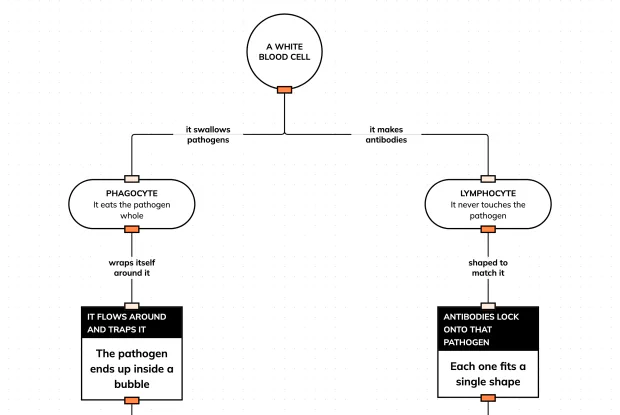
White blood cells are not one thing. Phagocytes swallow pathogens whole; lymphocytes never touch them and make antibodies instead. Follow both routes from one starting point in an interactive playground.
Why Do You Only Get Chickenpox Once? Memory Cells
The first infection takes days to clear and the second never happens at all. Follow the reasoning step by step in an interactive playground, and see what a vaccine actually does.