Two Ways to Fight an Infection — Eat or Mark
Root Concept
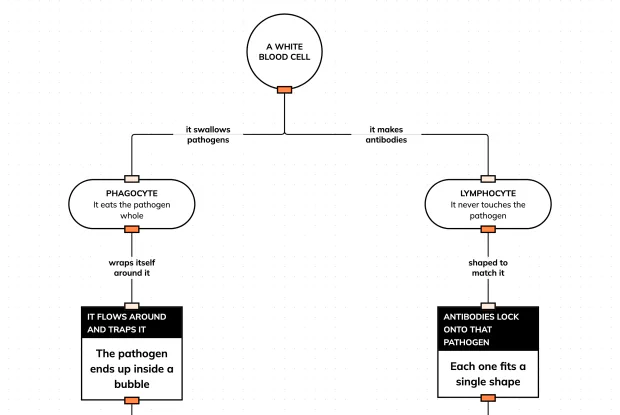
Phagocytes defend non-specifically by engulfing and digesting any pathogen they encounter, while lymphocytes defend specifically by producing antibodies whose shape matches one particular pathogen, marking it for destruction.
CodePLU Goal
Upgrading Human Mental Models
Learn how to think in Workflows

Concept Development By codeplu.com
One is fast and works on anything. One is slow and works on exactly one thing. Both are needed.
Not One Kind of Cell, and Not One Strategy
The previous tutorial brought white blood cells out of widened vessels and into the tissue around a cut, and left them there as a single description. That was a simplification. White blood cells come in several kinds, and two of them matter here because they solve the same problem in completely different ways.
A phagocyte attacks directly. It moves through tissue, meets a pathogen, flows around it until the pathogen is enclosed inside a bubble within the cell, and then releases digestive enzymes into that bubble. The pathogen is broken down. What makes this approach powerful is that it needs no preparation: a phagocyte will engulf essentially anything it recognises as foreign, including a pathogen the body has never met before. It is ready immediately, and it is why most pathogens that get in are dealt with before anybody notices.
A lymphocyte never touches the pathogen at all. Instead it produces antibodies — proteins with a shape that matches one specific feature on the surface of one specific pathogen, the way a key matches one lock. Those antibodies lock onto the pathogen, stick it together with others into clumps that cannot spread, and mark it so that phagocytes destroy it far more easily. The cost is that this takes days to get going and works against that one pathogen and nothing else. The benefit is what the next tutorial is about.
Comparing the Two Routes
How does a phagocyte engulf something?
By flowing around it, in a way that would be familiar from the amoeba in the microbes track. The cell changes shape, pushing out extensions that reach past the pathogen on both sides until they meet and fuse behind it. The pathogen is now inside the phagocyte, enclosed in a bubble of membrane rather than loose in the cytoplasm, which matters because what happens next would damage the phagocyte itself. Small sacs of digestive enzymes then fuse with that bubble and empty into it, and the pathogen is broken down inside a sealed compartment. The process costs the phagocyte something — many die after dealing with a number of pathogens, and pus is largely made of the ones that did.
What is an antibody and why does shape matter?
An antibody is a protein with a region whose shape fits one particular feature on the surface of one particular pathogen. The fit has to be close, in the same way an enzyme fits its substrate, and that is the whole basis of the method: recognition is done by shape rather than by anything the pathogen does. Once attached, antibodies help in several ways at once. They stick pathogens together into clumps too large to move through tissue, they cover the surfaces pathogens use to attach to body cells, and they make phagocytes far more likely to engulf whatever they are stuck to. The antibody is a label as much as a weapon.
Why is the lymphocyte route so slow the first time?
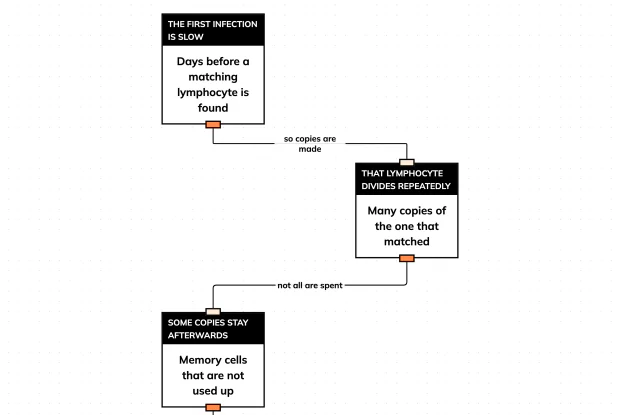
Because the matching antibody has to be found before any of it can be made. The body carries an enormous variety of lymphocytes, each already able to produce one shape of antibody, which means that for almost any pathogen some lymphocyte somewhere is already a match. But there may be very few of that particular one, and it has to encounter the pathogen before anything begins. Once it does, it divides repeatedly to produce large numbers of identical cells all making that antibody. Finding the match and then building the population takes days, which is why a first infection usually produces symptoms — the pathogen has a head start it never gets again.
Why does the body need both?
Because each covers the other's weakness exactly. Phagocytes are ready at once and work against anything, which handles the enormous number of pathogens that get in every day and never amount to anything. But they have no way of improving, and against a pathogen that multiplies faster than they can engulf it, being non-specific is not enough. Lymphocytes are useless in the first days of a new infection and then become decisive, because antibodies are produced in enormous quantity and target that pathogen precisely. The two also work together rather than separately: an antibody-coated pathogen is much easier for a phagocyte to engulf, so the specific route makes the non-specific one better.
Real World Example
A Throat Infection Over Ten Days
The timing of a common infection shows the division of labour clearly, because the two kinds of cell become important at noticeably different points.
Step 1
Days one and two: phagocytes only
Bacteria that got past the mucus lining the throat begin multiplying, and the inflammation from the previous tutorial brings phagocytes into the tissue within hours. They engulf bacteria immediately and without any preparation, and in most such episodes that is the end of it — the great majority of infections are stopped here and never produce any symptoms worth noticing. When they are not, it is because the bacteria are multiplying faster than the phagocytes can clear them, and the numbers climb despite everything the non-specific response can do. Nothing about this stage is tailored to these particular bacteria; the same cells would be doing the same thing to any other kind.
Step 2
Days three to five: feeling worst
This is the stretch where the infection is at its height, and it is also the stretch where the specific response is still being assembled. A lymphocyte matching these particular bacteria has to encounter them, and then divide repeatedly to build a population large enough to matter. Meanwhile bacterial numbers are high and phagocytes alone are not keeping up. Much of how ill a person feels during these days comes from the body's own response — the inflammation and the raised temperature — rather than directly from the bacteria. The specific response is being built during exactly the days it is least able to help, which is the cost of recognising something by shape rather than attacking anything foreign.
Step 3
Days six to ten: antibodies take over
Antibody levels in the blood rise steeply as the multiplied lymphocytes produce them in quantity. The bacteria are clumped together, prevented from attaching to throat cells, and coated in a way that makes phagocytes engulf them far more readily than before. Numbers fall quickly, symptoms ease, and within a few days the infection is cleared. The two responses have not competed; the specific one has made the non-specific one dramatically more effective, and both were needed to finish it. The same bacteria arriving a year later would meet antibodies within hours rather than days, which is what the next tutorial explains, and the infection would most likely never be noticed at all.
FAQs
Final Words
Two cells, one origin, two strategies that fail in opposite directions. A phagocyte is ready immediately and engulfs anything foreign it meets, which handles the constant traffic of pathogens that get in and come to nothing. A lymphocyte touches nothing and makes antibodies shaped to fit one pathogen, which takes days to assemble and then becomes decisive.
Neither would be sufficient on its own, and they are not in competition — an antibody sticking to a bacterium is largely a label that makes a phagocyte's job easier. What is still unexplained is why the slow route is worth having at all, given that an infection is usually over by the time it finishes working. The answer is that it does not start from scratch the second time, and that is the last tutorial in this track.
Continue This Track
This concept is part 4 of Why We Fall Ill.
What Actually Makes You Ill? Not Always Germs
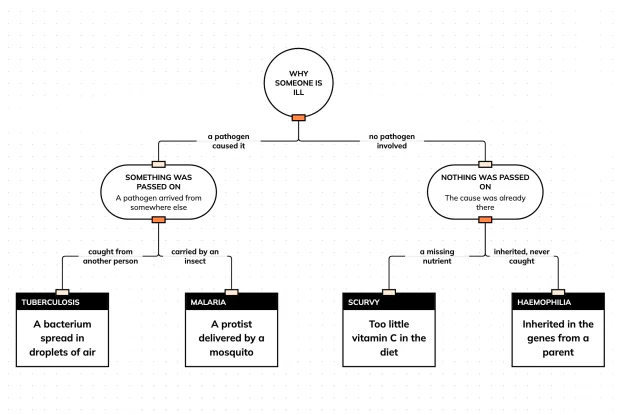
Not every disease is caught. Some are caused by a pathogen that arrived from somewhere else, and some by a missing nutrient or an inherited gene. Sort four of them in an interactive playground.
How Does a Pathogen Reach a New Host? Six Steps
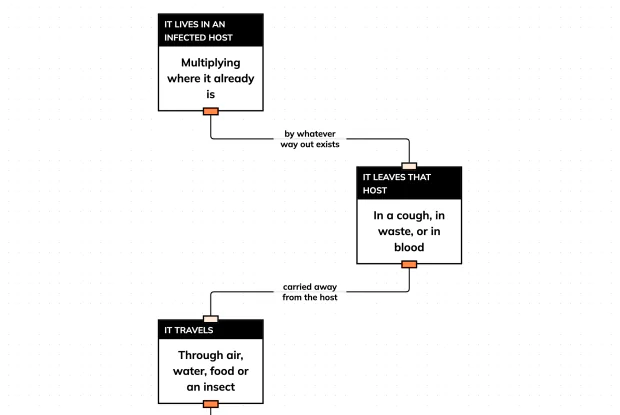
A pathogen has to leave one host, travel, arrive at another, get past its defences and multiply. Follow the whole chain in an interactive playground and see why every control measure targets one link.
What Happens When a Pathogen Gets In? Trace It
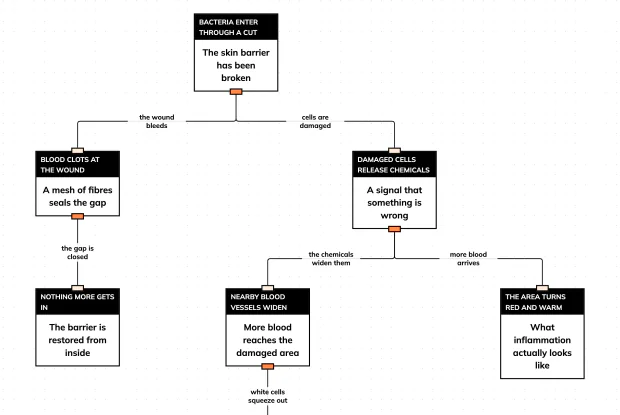
A cut lets bacteria past the skin, and the body does several things at once — sealing the gap, widening vessels and bringing white cells in. Trace the whole web of consequences in an interactive playground.
Two Ways to Fight an Infection — Eat or Mark
White blood cells are not one thing. Phagocytes swallow pathogens whole; lymphocytes never touch them and make antibodies instead. Follow both routes from one starting point in an interactive playground.
Why Do You Only Get Chickenpox Once? Memory Cells
The first infection takes days to clear and the second never happens at all. Follow the reasoning step by step in an interactive playground, and see what a vaccine actually does.