Why We Fall Ill
Having spent a track on microbes, it would be easy to leave with the impression that being ill and being infected are the same thing, so this track starts by separating them: a disease is infectious only when its cause can travel from one host to another, which scurvy and an inherited condition never can, and which says nothing at all about how serious the disease is. What follows is the journey that makes the other half infectious, drawn as six steps — leaving a host, surviving the outside, reaching somebody, getting past a defence, multiplying — because a chain with six links is a chain with six places to break it, and almost every control measure ever devised attacks one named link. The last three tutorials go inside. A cut lets bacteria past the skin and several consequences start at once rather than in a line, which is why the redness and swelling of inflammation are the response rather than the damage. The white cells that arrive turn out to be two kinds with opposite weaknesses: one ready immediately and effective against anything, one useless for days and then decisive against exactly one pathogen. And the track closes on why the slow route is worth having, which is that it is slow only the first time — the fact a vaccine exists to exploit.
CodePLU Goal
Upgrading Human Mental Models
Learn how to think in Workflows
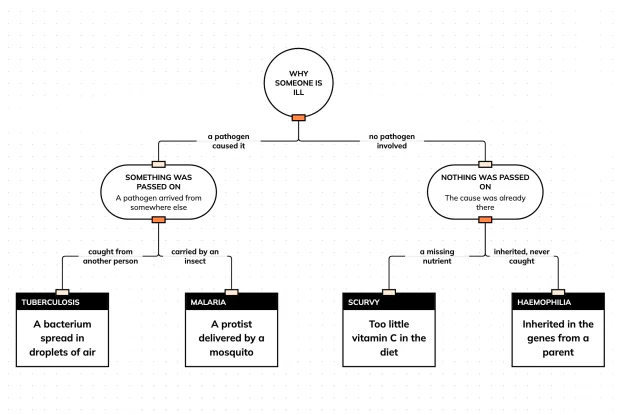
What Actually Makes You Ill? Not Always Germs
Not every disease is caught. Some are caused by a pathogen that arrived from somewhere else, and some by a missing nutrient or an inherited gene. Sort four of them in an interactive playground.
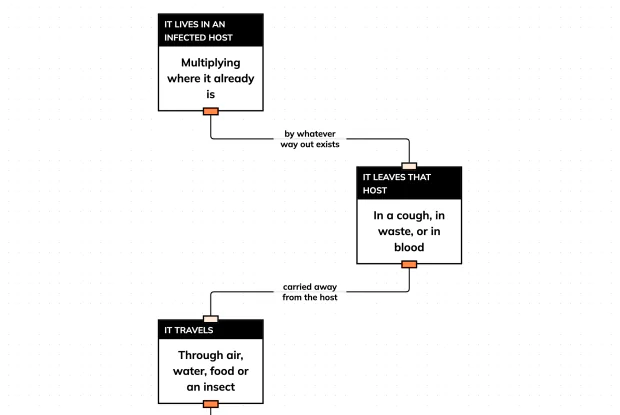
How Does a Pathogen Reach a New Host? Six Steps
A pathogen has to leave one host, travel, arrive at another, get past its defences and multiply. Follow the whole chain in an interactive playground and see why every control measure targets one link.
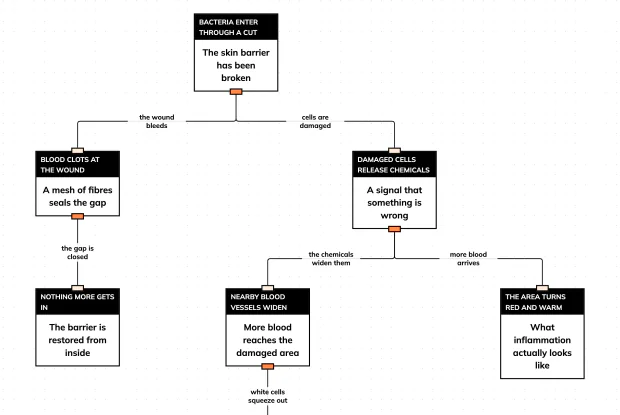
What Happens When a Pathogen Gets In? Trace It
A cut lets bacteria past the skin, and the body does several things at once — sealing the gap, widening vessels and bringing white cells in. Trace the whole web of consequences in an interactive playground.
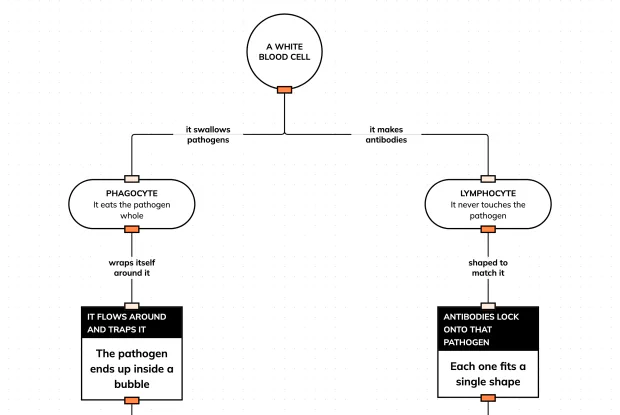
Two Ways to Fight an Infection — Eat or Mark
White blood cells are not one thing. Phagocytes swallow pathogens whole; lymphocytes never touch them and make antibodies instead. Follow both routes from one starting point in an interactive playground.
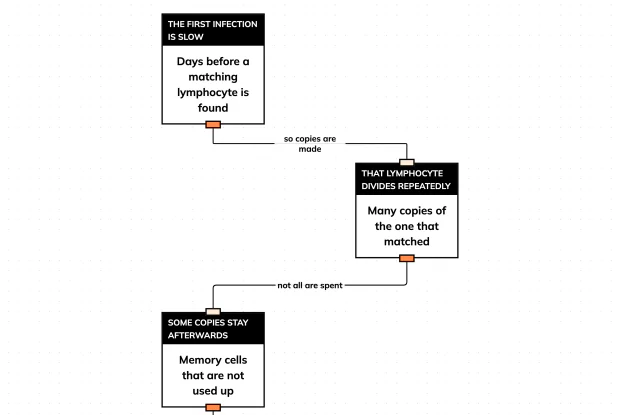
Why Do You Only Get Chickenpox Once? Memory Cells
The first infection takes days to clear and the second never happens at all. Follow the reasoning step by step in an interactive playground, and see what a vaccine actually does.