Why Do You Never Get What the Equation Says?
Root Concept
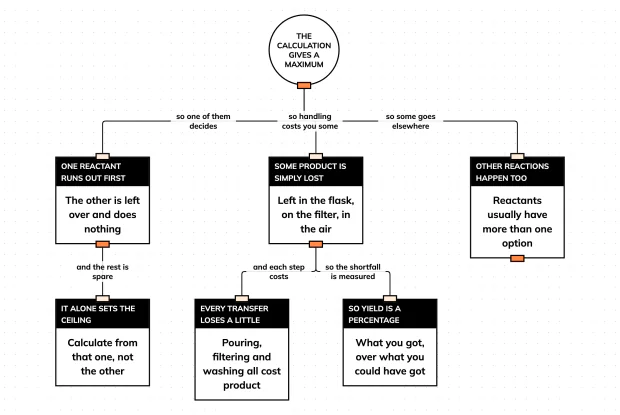
A calculation from a balanced equation gives the theoretical maximum yield, and a real reaction falls short of it for three separate reasons — one reactant runs out before the others, product is lost at every transfer, and competing reactions use some of the reactants — which is why yield is quoted as a percentage of what was possible.
CodePLU Goal
Upgrading Human Mental Models
Learn how to think in Workflows

Concept Development By codeplu.com
Three independent reasons. Fixing one does nothing about the other two.
A Ceiling, Not a Prediction
The previous tutorial worked out that 50 g of limestone should give 28 g of lime. Run the reaction and you will get less — reliably, every time, in a school laboratory and in a factory alike. That is not a failure of the calculation. The calculation answers a different question from the one it looks like it answers.
What it gives is the theoretical yield: the most you could possibly get, if every particle reacted, nothing was lost on the way, and no other reaction took place. It is a ceiling rather than a prediction, and the useful thing about a ceiling is that it lets you measure how far below it you are.
Three separate things pull a real yield down, and they are worth keeping apart because they have different remedies. One reactant runs out before the others, so the surplus never reacts at all. Product is lost at every physical step — left clinging to a flask, caught in filter paper, carried off in a wash. And reactants often have more than one thing they can do, so some of them go into products nobody wanted.
Only the second of those is carelessness, and even that one cannot be reduced to zero. The playground separates all three, and the figure quoted in the end — the percentage yield — is the comparison between what came out and what the calculation said was possible.
The Three Reasons
What is a limiting reactant?
The one that runs out first, and therefore the only one that matters to the calculation. If a reaction needs two moles of A for every one of B, and you supply three moles of each, the A runs out when one and a half moles of B have been used — and the remaining B sits there doing nothing. Working the calculation from the leftover reactant gives an answer that is simply too big. The rate-graph tutorial met this as the reactant that sets the height the curve levels off at; this is the same idea with a number attached. Identifying which one is limiting is usually the first step of a real calculation, and it is done by converting both to moles and comparing against the equation’s ratio.
Why is an excess of one reactant often deliberate?
Because it pushes more of the expensive one to react. If one reactant costs far more than the other, supplying a surplus of the cheap one makes it likelier that every particle of the expensive one finds a partner — and the leftover cheap material can often be recovered or tolerated. So an excess is a design decision rather than a mistake, and it means the limiting reactant is usually chosen rather than discovered. It also explains a result that otherwise looks odd: a yield quoted against the expensive reactant can be very high while a great deal of the other one is left over. Which reactant a yield is quoted against therefore matters as much as the figure itself.
Where does product actually get lost?
Everywhere it is moved. Solid stays behind on filter paper and inside the flask it was made in, crystals dissolve slightly in the water used to wash them, liquid clings to every surface it touches, and transfers between containers never move quite everything. The salt preparation in the acids track has four separate stages, and each one takes its cut. None of this is avoidable in principle — it is reduced by technique and by designing out steps, never eliminated — which is why industrial processes are judged partly on how few transfers they need. A process with fewer stages usually beats a cleverer one with more. The losses are physical rather than chemical, which is why they are the same whatever the reaction is.
What is a side reaction?
A different reaction happening at the same time, consuming the same reactants and producing something else. Reactants frequently have more than one thing they can do, and the conditions decide which dominates rather than which is possible. Burning a fuel in too little air is the clearest example from earlier in this category: the intended product is carbon dioxide and the competing one is carbon monoxide. Side reactions are the hardest of the three to reduce, because doing so means changing conditions or adding a catalyst that favours one route — and the catalyst tutorial explained exactly how a route can be favoured. Of the three causes this is the only one that is genuinely chemistry rather than housekeeping or arithmetic.
Real World Example
What Percentage Yield Is Actually Used For
Quoting a yield as a percentage turns an isolated mass into something that can be compared across runs, methods and scales.
Step 1
The sum is simply one mass over another
Percentage yield is the actual mass obtained divided by the theoretical mass, multiplied by a hundred. If the calculation said 28 g and the crucible held 21 g, that is 75%. Both numbers have to be masses of the same substance, which sounds obvious and is a common slip. The figure cannot exceed 100% for a correctly done calculation, so a yield above that is a signal rather than a triumph — usually the product is still wet, or some impurity has been weighed along with it. Either way the number is telling you to go back and check something.
Step 2
Industry optimises the expensive step, not the yield
A process with a 60% yield can be better business than one with 90% if it runs faster, at a lower temperature, or on a cheaper starting material. Unreacted material can often be separated and fed back to the start, which turns a modest yield per pass into a high yield overall. The rate track made the same point from the other direction — a plant often stops a reaction early rather than waiting for the curve to flatten, deliberately accepting a lower yield per pass. The yield is one input to a decision rather than the decision itself.
Step 3
Atom economy asks a different question entirely
Percentage yield asks how much of the possible product you got. Atom economy asks what proportion of the atoms you put in ended up in the product you wanted rather than in by-products. A reaction can have a yield near 100% and a poor atom economy, if the equation itself produces a large unwanted by-product — and that waste is built into the chemistry and cannot be improved by better technique. The two numbers measure different failures, which is why modern process design quotes both. One is a measure of how well the process was run, the other of how well the reaction was chosen.
FAQs
Final Words
A calculation from a balanced equation gives a ceiling rather than a prediction. It assumes every particle reacts, nothing is lost in handling, and no competing reaction takes place — and none of those three is ever quite true. That is what makes it useful: knowing the maximum is what lets you say how far below it a real result sits.
The three causes are separate and have separate remedies. One reactant runs out before the others, so only that one sets the ceiling and the rest is spare — often deliberately, because an excess of something cheap pushes more of something expensive to react. Product is lost at every transfer, which technique reduces and never eliminates. And reactants usually have more than one thing they can do, so some goes elsewhere, which is changed by conditions or a catalyst rather than by care. Percentage yield is what came out over what could have, and it is a comparison rather than a mark.
Continue This Track
This concept is part 5 of Counting Atoms by Weighing.
Why Are a Compound’s Proportions Always the Same?
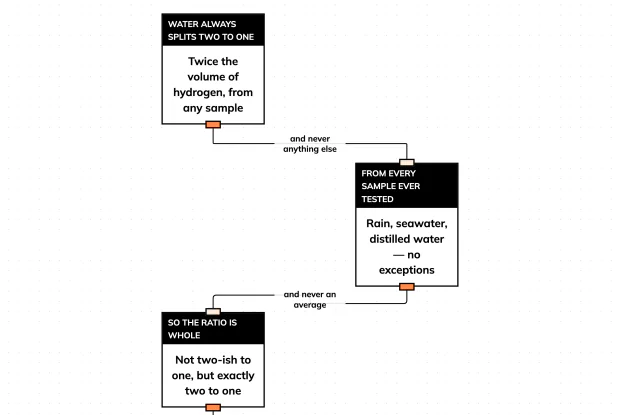
Every sample of water ever split has given exactly twice the volume of hydrogen. Follow what that forces you to conclude about atoms, in an interactive playground.
What Is a Mole, and Why Does Chemistry Need One?
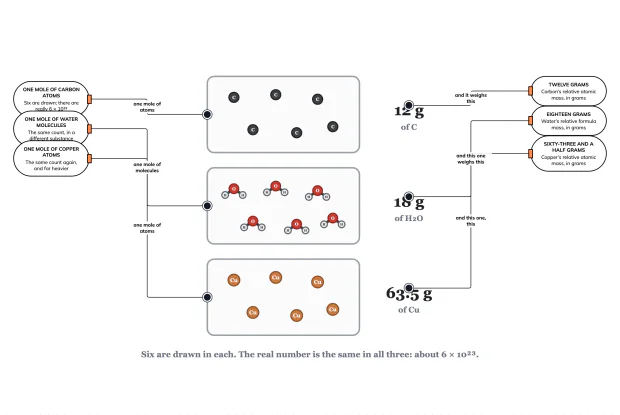
Reactions happen in ratios of particles, and particles cannot be counted. The mole is how chemistry counts by weighing instead. Match three equal-sized samples to their masses in an interactive playground.
How Do You Work Out a Relative Formula Mass?
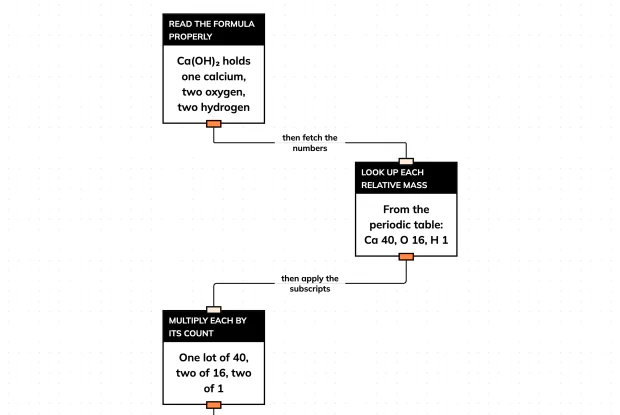
A relative formula mass is four steps of arithmetic, and almost every mistake is made in the first one. Work through a formula with brackets in an interactive playground.
How Much Product Will a Reaction Give? Use Moles
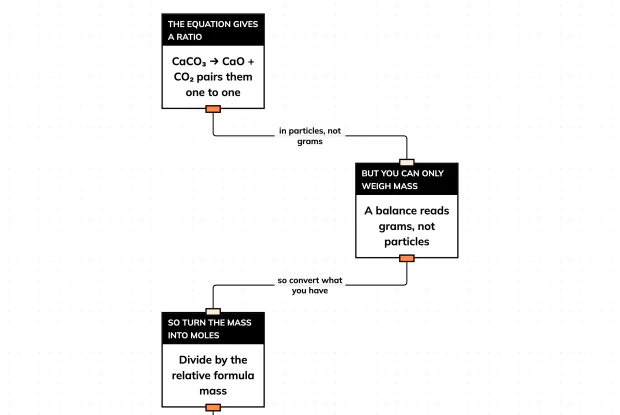
A balanced equation tells you a ratio of particles, and a balance reads grams. Converting between them is the whole calculation. Follow it step by step in an interactive playground.
Why Do You Never Get What the Equation Says?
A mass calculation gives the theoretical maximum, and real reactions always fall short. Three separate reasons, only one of which is carelessness. Trace them in an interactive playground.