How Do You Work Out a Relative Formula Mass?
Root Concept
The relative formula mass of a substance is found by counting how many atoms of each element its formula contains, multiplying each element’s relative atomic mass by that count and adding the results — and that number in grams is one mole of the substance.
CodePLU Goal
Upgrading Human Mental Models
Learn how to think in Workflows

Concept Development By codeplu.com
The order is load-bearing. Adding before multiplying, which is the usual slip, gives a number that means nothing.
Four Steps, and the First One Is the Hard One
The previous tutorial established that one mole of a substance weighs its relative formula mass in grams. That is only useful if you can work out the relative formula mass, and doing so is four steps of arithmetic that nobody finds difficult.
What people do find difficult is the step before the arithmetic. Reading a formula correctly is where almost every wrong answer comes from, and it is not a calculation at all — it is a question of what the notation means, which the equations tutorial in the reactions track set out. A subscript counts the atoms of the symbol it follows. A bracket with a subscript applies that number to everything inside it.
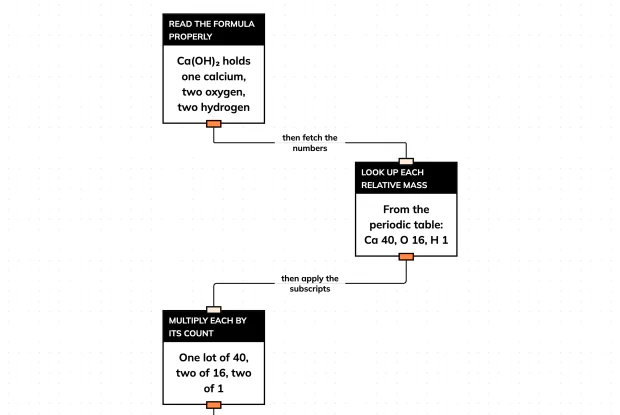
So Ca(OH)₂ is not one calcium, one oxygen and two hydrogen. The 2 outside the bracket multiplies both the O and the H, giving one calcium, two oxygen and two hydrogen. Getting that wrong produces a number that is wrong by a fixed amount and wrong in every calculation it is then used in, which is why it is worth slowing down for.
After that it is mechanical: look up each relative atomic mass, multiply each by how many of that atom there are, and add. The order matters — multiplying before adding is the whole of it — and the playground walks through a formula chosen because it has a bracket in it.
Working Through It
How do you read a formula with brackets?
The subscript after a closing bracket multiplies everything inside. In Ca(OH)₂ the bracket contains one oxygen and one hydrogen, and the 2 applies to both, so the compound holds one calcium, two oxygens and two hydrogens. In Al₂(SO₄)₃ the bracket contains one sulfur and four oxygens, and the 3 multiplies both: three sulfurs and twelve oxygens, alongside two aluminiums. The brackets are there because the group inside behaves as a unit — a sulfate ion in this case — and writing AlSO₄₃ would be ambiguous about what the 3 applied to. Count the contents first, then apply the outside number, and the ambiguity never arises. Writing the counts out as a short list before calculating anything is the habit that makes this reliable.
Where do the relative atomic masses come from?
The periodic table, where each element carries two numbers. The smaller one is the atomic number, the proton count that decides which element it is; the larger is the relative atomic mass, which the isotopes tutorial explained as a weighted average across an element’s isotopes. That is why chlorine is 35.5 rather than a whole number. For most school calculations the masses are rounded — carbon 12, oxygen 16, hydrogen 1 — and chlorine is usually kept as 35.5 precisely because rounding it would be noticeably wrong. Reading the wrong number off the table is a surprisingly common error, and the giveaway is an answer that comes out far too small.
Why does the order of the steps matter?
Because multiplying and adding do not commute, and the usual slip is to add the relative masses and then multiply by something. For Ca(OH)₂ the correct route is (1 × 40) + (2 × 16) + (2 × 1) = 74. Adding first — 40 + 16 + 1 = 57 and then doubling to 114 — gives a number that corresponds to no substance at all, because it has doubled the calcium as well. Each element has its own count and has to be multiplied by its own count before anything is totalled. That is the sense in which this sequence is a workflow rather than a list: carrying out the steps in a different order does not slow you down, it gives the wrong answer.
What is the number actually for?
Converting between a mass you can weigh and a number of particles you need. Once you know that calcium hydroxide has a relative formula mass of 74, you know that 74 g of it is one mole, 37 g is half a mole, and 740 g is ten moles. The relationship is the one everything in the rest of this track runs on: moles equal mass divided by relative formula mass. Everything else — how much product a reaction gives, how concentrated a solution is, what percentage of a compound is one element — is that relationship used in a particular direction. One formula, read forwards or backwards, answers most quantitative questions in school chemistry.
Real World Example
Three Formulae, One Method
The method does not change; what changes is how carefully the formula has to be read before the arithmetic starts.
Step 1
Water, H₂O, comes to 18
Two hydrogens at 1 each and one oxygen at 16: (2 × 1) + (1 × 16) = 18. It is the simplest case and worth doing deliberately, because the habit of writing the multiplication out is what protects you on the harder ones. A mole of water is therefore 18 g, which is about a tablespoon — the figure from the previous tutorial. It is also a useful check on the method: anyone who gets 17 has added instead of multiplying, and anyone who gets 34 has doubled the oxygen as well as the hydrogen.
Step 2
Calcium hydroxide, Ca(OH)₂, comes to 74
The bracket is the point of this one. Calcium is 40, and the subscript 2 applies to both atoms inside the bracket, so there are two oxygens at 16 and two hydrogens at 1: 40 + 32 + 2 = 74. This is the compound sold as slaked lime and spread on acidic fields, which is the neutralisation reaction from the acids track at agricultural scale. A farmer ordering it by the tonne is relying on exactly this number to know how much neutralising power is being delivered. Order the wrong tonnage and the field is either still acidic or has been overtreated, and both cost money.
Step 3
Aluminium sulfate, Al₂(SO₄)₃, comes to 342
The hardest of the three and entirely a reading problem. Two aluminiums at 27 give 54. Inside the bracket is one sulfur and four oxygens, and the 3 multiplies both — so three sulfurs at 32 give 96, and twelve oxygens at 16 give 192. Adding: 54 + 96 + 192 = 342. Every error in this calculation happens before any arithmetic, in deciding how many oxygens there are. Writing out the counts as a list before touching a calculator is what makes it reliable. The arithmetic afterwards is the easy part and always was.
FAQs
Final Words
A relative formula mass is four steps and only one of them is hard. Read the formula, counting how many atoms of each element it actually contains — which is where a bracket catches people, because the subscript after it multiplies everything inside. Look up each relative atomic mass. Multiply each by its count. Add the results. For Ca(OH)₂ that is 40 plus 32 plus 2, giving 74.
The order is load-bearing rather than conventional: adding the masses first and multiplying afterwards applies one count to every element, which is wrong for all but one of them and produces a number corresponding to no substance. And the number earns its place by converting between the two things this track is about — 74 g of calcium hydroxide is one mole of it, 37 g is half a mole, and moles equal mass divided by relative formula mass. The next tutorial uses that to work out how much product a reaction will actually give.
Continue This Track
This concept is part 3 of Counting Atoms by Weighing.
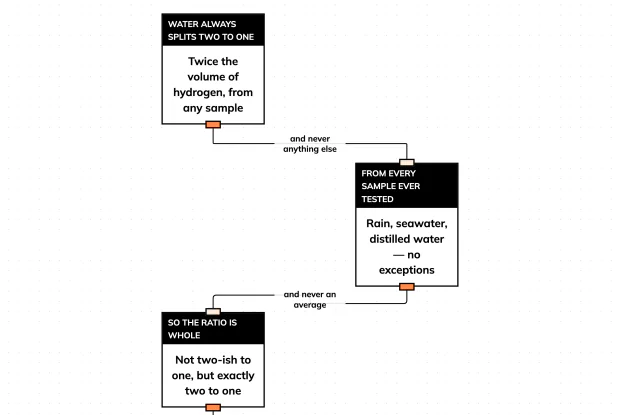
Why Are a Compound’s Proportions Always the Same?
Every sample of water ever split has given exactly twice the volume of hydrogen. Follow what that forces you to conclude about atoms, in an interactive playground.
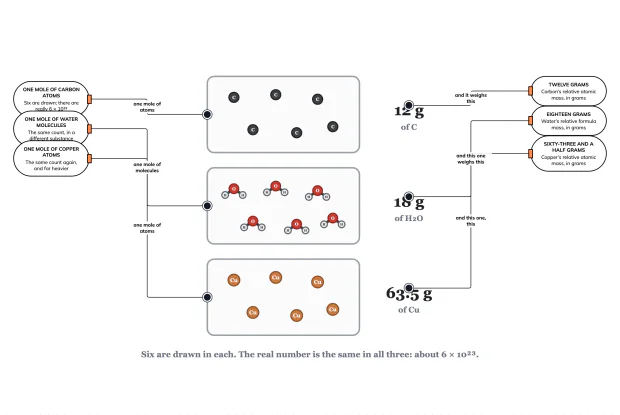
What Is a Mole, and Why Does Chemistry Need One?
Reactions happen in ratios of particles, and particles cannot be counted. The mole is how chemistry counts by weighing instead. Match three equal-sized samples to their masses in an interactive playground.
How Do You Work Out a Relative Formula Mass?
A relative formula mass is four steps of arithmetic, and almost every mistake is made in the first one. Work through a formula with brackets in an interactive playground.
How Much Product Will a Reaction Give? Use Moles
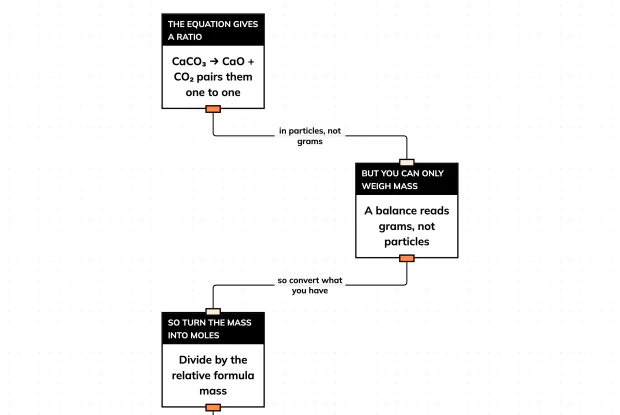
A balanced equation tells you a ratio of particles, and a balance reads grams. Converting between them is the whole calculation. Follow it step by step in an interactive playground.
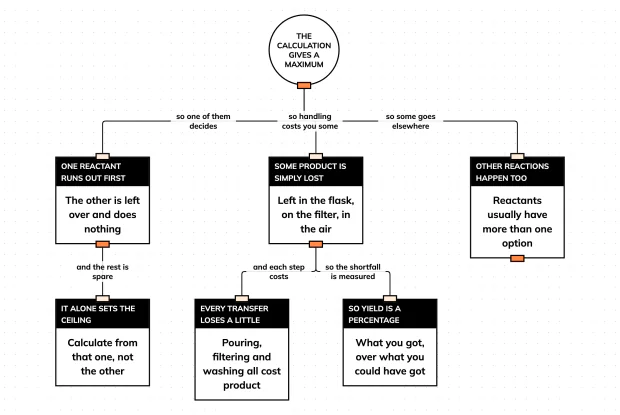
Why Do You Never Get What the Equation Says?
A mass calculation gives the theoretical maximum, and real reactions always fall short. Three separate reasons, only one of which is carelessness. Trace them in an interactive playground.