Why Are a Compound’s Proportions Always the Same?
Root Concept
A compound always contains its elements in the same proportions because atoms combine in fixed whole-number ratios, and since every atom of an element has the same mass, a fixed count gives a fixed ratio by mass as well — which is what makes chemistry quantitative at all.
CodePLU Goal
Upgrading Human Mental Models
Learn how to think in Workflows

Concept Development By codeplu.com
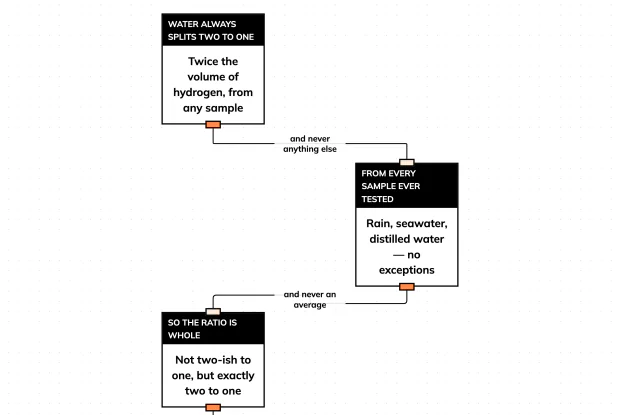
The conclusion is forced by the word "exactly". An approximate ratio would prove nothing.
A Promise From Two Tracks Ago
When water was first split by an electric current in 1800, the experimenters collected twice the volume of hydrogen as oxygen. The tutorial that described it noted that the volumes were telling — "twice as much of the burning gas as the other, every time" — and said the fixed proportions were something a later track would take up. This is that track.
The observation to explain is not that the ratio is two to one. It is that it is **always** two to one. Water from a tap, water from the sea once purified, water condensed out of the air, water made by burning hydrogen — every sample gives the same answer, and no sample has ever given two and a bit.
A ratio that exact rules out a great deal. If substances combined in whatever proportions happened to be available, you would expect a spread of results, and water from different sources would differ. Instead the answer is a whole number, reproducible to whatever precision anyone has ever measured it.
Something is being counted rather than merely mixed, and the only candidate is atoms — which cannot be halved. That is the conclusion the playground works towards, and once it is in place the rest of this track follows: if atoms combine in fixed counts, and each kind of atom has its own fixed mass, then a compound has fixed proportions by mass too, and chemistry becomes something you can calculate with.
What the Measurement Forces
Why does "always" matter more than "two to one"?
Because a single measurement is just a measurement, and a repeated one is evidence about the world. If water split two to one on Tuesday and two and a half to one on Wednesday, the sensible conclusion would be that the proportions depend on conditions, and there would be nothing to explain. The force of the result is in its stubbornness: every sample, every source, every laboratory, the same answer. That kind of constancy is what a law in science is, and it is the sort of thing that needs a cause rather than a description. The cause turns out to be that something discrete is being counted, and discrete things do not come in fractions.
How does a whole-number ratio point at atoms?
Because whole numbers are what you get when you count objects rather than measure quantities. You can have 2.37 litres of anything, but you cannot have 2.37 chairs. When a measurement keeps coming out as a simple whole-number ratio, the natural explanation is that the thing being measured is made of units that cannot be subdivided. Water gives two to one because each water molecule holds two hydrogen atoms and one oxygen atom, and half an atom is not available to anyone. This is the argument that persuaded chemistry to take atoms seriously, and it ran more than a century before anyone could see evidence of an atom directly. The ratio was the evidence, long before the particle was.
Does it work by mass as well as by volume?
Yes, and the mass version is the one chemistry actually uses. Every oxygen atom has the same mass as every other oxygen atom, give or take the isotope question from the atom track, and the same is true for hydrogen. So if a water molecule always holds two hydrogens to one oxygen, and those atoms always weigh the same, the ratio by mass is fixed as well: water is always about 11% hydrogen and 89% oxygen by mass. Measure a sample of a compound, find its proportions by mass, and you learn the ratio of atoms in it — which is how formulae were worked out before anyone could look.
What about a mixture?
A mixture has no fixed proportions at all, which is exactly the distinction the second track in this category was built around. Air can be any proportion of nitrogen and oxygen and is still air; salt water can be slightly salty or very salty. Nothing is being counted in a mixture, because nothing is joined — the particles are simply sharing the space. So the fixed-proportion test is not just a fact about compounds; it is a way of telling a compound from a mixture without looking at a single particle. A variable recipe means nothing was bonded It is the same test from the other direction, and it needs no equipment beyond a balance and some patience.
Real World Example
Three Compounds, Measured Rather Than Assumed
These proportions were measured by weighing, repeatedly, by people who had no way of seeing what they were weighing.
Step 1
Water: always about 11% hydrogen by mass
Split any sample of water and the hydrogen collected accounts for roughly an ninth of the original mass, with oxygen making up the rest. The proportion does not depend on where the water came from or how much of it you start with — doubling the sample doubles both products and leaves the ratio untouched. That independence from quantity is the signature of a ratio rather than an amount, and it is what allows a formula to be written at all: H₂O describes any sample of water, not a particular one. That is what makes the symbol worth writing down.
Step 2
Two oxides of copper, and both are fixed
Copper forms two different oxides, and at first glance that looks like a counter-example. It is not: each one has its own fixed proportions, and in the second the copper is combined with exactly twice as much oxygen as in the first. Small whole-number ratios again, and the doubling is the giveaway — it is what you would expect if one compound pairs one oxygen atom per copper atom and the other pairs two. Two compounds, not one compound with a variable recipe. Finding two compounds where one holds exactly twice the oxygen of the other is stronger evidence for atoms than one compound could ever be.
Step 3
Iron sulfide, and the leftover that proves the point
Heating iron with sulfur gives iron sulfide, as the second track demonstrated, and the ratio is one to one by atoms. Use more sulfur than that and the surplus does not join in — it stays as unreacted sulfur and can be separated afterwards. The compound will not take extra, however much is offered, which is the most direct evidence there is that a fixed number of atoms is being combined rather than some available quantity being absorbed. The compound has a capacity rather than an appetite, and the capacity is set by counting A magnet confirms the leftover sulfur never joined in.
FAQs
Final Words
Every sample of water ever split has given twice the volume of hydrogen as oxygen, and the force of that is in the word every. A single ratio is a measurement; a ratio that never varies, from any source, to any precision anyone has managed, is something that needs a cause. If proportions depended on what was available, results would be spread out and water from different places would differ. They are not.
Whole numbers are what you get when you count objects rather than measure quantities, and the objects here are atoms, which cannot be halved. That fixes the proportions by mass as well, because every atom of an element has the same mass — so a fixed count of fixed masses gives a fixed ratio, and a formula describes the substance rather than one sample of it. The next tutorial takes the obvious next problem: atoms are far too small to count and far too light to weigh one at a time.
Continue This Track
This concept is part 1 of Counting Atoms by Weighing.
Why Are a Compound’s Proportions Always the Same?
Every sample of water ever split has given exactly twice the volume of hydrogen. Follow what that forces you to conclude about atoms, in an interactive playground.
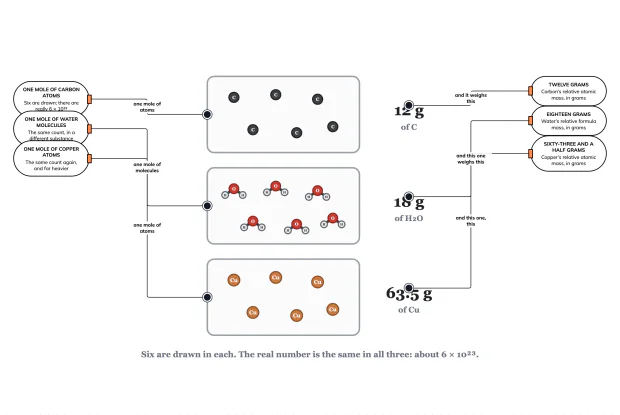
What Is a Mole, and Why Does Chemistry Need One?
Reactions happen in ratios of particles, and particles cannot be counted. The mole is how chemistry counts by weighing instead. Match three equal-sized samples to their masses in an interactive playground.
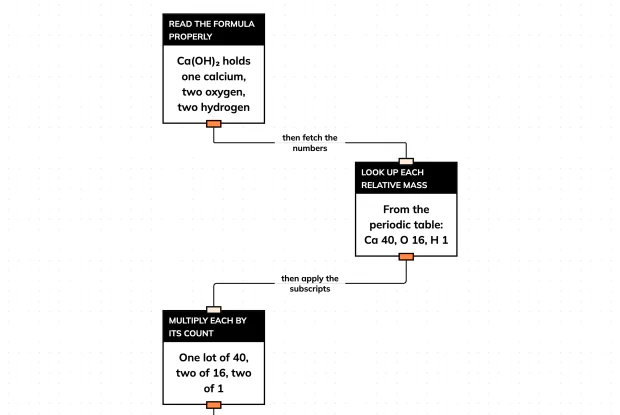
How Do You Work Out a Relative Formula Mass?
A relative formula mass is four steps of arithmetic, and almost every mistake is made in the first one. Work through a formula with brackets in an interactive playground.
How Much Product Will a Reaction Give? Use Moles
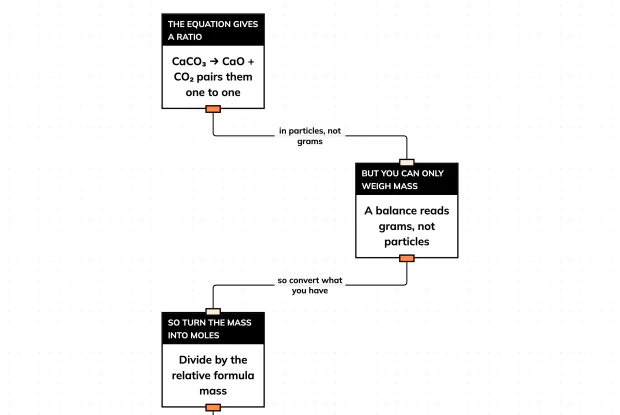
A balanced equation tells you a ratio of particles, and a balance reads grams. Converting between them is the whole calculation. Follow it step by step in an interactive playground.
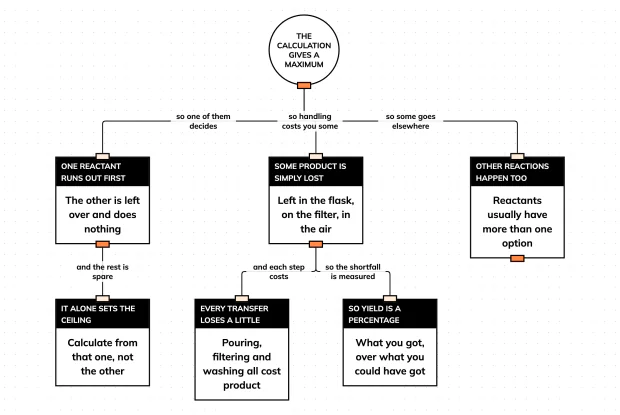
Why Do You Never Get What the Equation Says?
A mass calculation gives the theoretical maximum, and real reactions always fall short. Three separate reasons, only one of which is carelessness. Trace them in an interactive playground.