What Is a Mole, and Why Does Chemistry Need One?
Root Concept
A mole is a fixed number of particles, about 6.02 × 10²³, chosen so that one mole of a substance has a mass in grams equal to its relative formula mass — which lets chemistry count particles by weighing them, since reactions happen in ratios of particles and particles cannot be counted directly.
CodePLU Goal
Upgrading Human Mental Models
Learn how to think in Workflows

Concept Development By codeplu.com
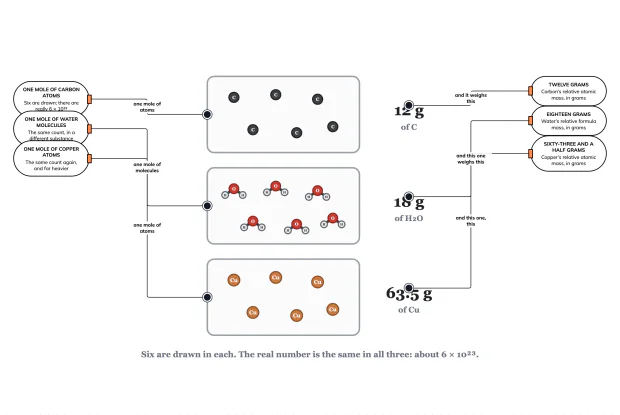
Equal numbers of particles, three very different masses. The masses differ because the particles do.
A Counting Problem With No Way to Count
The previous tutorial established that compounds have fixed proportions because atoms combine in whole-number ratios. A balanced equation says the same thing: 2H₂ + O₂ → 2H₂O means two hydrogen molecules for every one of oxygen. Chemistry, at the level that matters, is about counting particles.
And particles cannot be counted. They are far too small to see, far too numerous to tally, and a single one is far too light to weigh — a carbon atom is around two thousand-billion-billionths of a gram. Yet a balance in a laboratory is accurate, cheap and easy to use. So chemistry has a problem of the most practical kind: the thing it needs to know is a number, and the thing it can measure is a mass.
The mole solves it by connecting the two. A mole is simply a fixed, very large count of particles — about 6.02 × 10²³ of them — chosen so that one mole of any substance has a mass in grams equal to that substance’s relative formula mass. Carbon is 12, so a mole of carbon atoms weighs 12 g. Water is 18, so a mole of water molecules weighs 18 g.
That is the whole trick, and the figure shows it: three samples holding exactly the same number of particles and weighing 12 g, 18 g and 63.5 g. Weigh out the right mass and you have counted out the right number, without ever counting anything.
Counting by Weighing
Why is a count the thing chemistry needs?
Because reactions pair particles up, not masses. When hydrogen burns, each oxygen molecule reacts with two hydrogen molecules — that is what the balanced equation records, and it is a statement about numbers of particles. Mixing equal masses of the two would be completely wrong, because a hydrogen molecule is sixteen times lighter than an oxygen one, so equal masses would give you sixteen times as many hydrogen molecules as the reaction can use. Nearly all of it would be left over. To combine things in the ratio an equation specifies, you have to know how many particles you are putting in, and that means a count. Mass is what the balance offers and is not what the reaction asks for.
Why is the number that particular size?
Because it was chosen to make the arithmetic disappear. The relative masses of atoms were known long before anybody could count particles — carbon 12, oxygen 16, copper 63.5 — and they are ratios rather than weights, telling you that an oxygen atom is sixteen twelfths as heavy as a carbon atom. The mole is defined so that taking that relative mass in grams always gives you the same number of particles. Had a different number been chosen, counting by weighing would still work but every calculation would carry a conversion factor. The size of the number is a convenience; the existence of a fixed count is the idea. Any fixed count would have worked; this one was picked to be invisible.
Why do equal counts weigh different amounts?
Because the particles themselves have different masses, which is the point the figure makes in one look. A copper atom is heavier than a carbon atom, so a mole of copper outweighs a mole of carbon even though both boxes hold the same number of particles. This is worth stating plainly because the reverse error is common: equal masses do not contain equal numbers, and 12 g of carbon holds far more atoms than 12 g of copper does. A mass tells you nothing about a count until you know what the substance is A balance reading is an observable, and the particle count is what the chemistry runs on. Converting between them is the whole business of this track.
How big is the number, really?
Large enough that comparisons mostly fail. A mole of grains of sand would bury the United Kingdom to a depth of several hundred metres. A mole of seconds is about twenty million times the age of the universe. And a mole of water is 18 g — a tablespoon. That last comparison is the one worth holding onto, because it says something true about scale: ordinary amounts of ordinary substances contain numbers of particles that have no everyday counterpart. The number is not large because chemists wanted a big one; it is large because particles are very small. Holding both ends of that in mind at once — a tablespoon, and a number past imagining — is most of what understanding the mole amounts to.
Real World Example
Counting by Weighing, Inside and Outside Chemistry
The idea behind the mole is not exotic. It is what anybody does when the thing they need to count is too numerous to count.
Step 1
A hardware shop sells screws by weight
Nobody counts out two thousand screws. They are weighed, because the shop knows what one screw weighs and division does the rest. The method needs exactly two things: all the screws must be the same, and their individual mass must be known. Both are true of atoms as well — every carbon-12 atom has the same mass, and relative masses have been known for a long time. The mole is this method, applied to things far too small and far too many to count by hand. Nobody calls it a deep idea in a hardware shop.
Step 2
A paper mill works in mass and sells in sheets
Paper is made, moved and priced by the tonne, and bought by the ream. Converting between the two needs one number: the mass of a single sheet, which depends on both its size and its thickness. The parallel with chemistry is close — the conversion factor depends on what the thing is, exactly as the mass of a mole depends on the substance. Nobody finds this confusing on a loading bay, and it is the same arithmetic that makes the mole look difficult on paper. The unfamiliarity is in the size of the number, not in the method.
Step 3
A pharmacist cannot weigh out a dose by eye
Medicines are prescribed by mass and act by molecules — a dose is effective because a certain number of molecules reach a certain number of receptors. A drug with heavy molecules needs more grams to deliver the same count than one with light molecules, which is part of why doses differ so widely between medicines that do similar things. The relationship between mass and number is not a classroom abstraction there; getting it wrong is the difference between a dose and an overdose. Which is a reminder that the mole is a practical unit rather than a notational one.
FAQs
Final Words
Chemistry needs a count and can only measure a mass. Reactions pair particles up — a balanced equation is a statement about numbers — and particles are far too small to see, too numerous to tally and far too light to weigh one at a time. The mole bridges the gap: a fixed number of particles, about 6.02 × 10²³, chosen so that one mole of any substance weighs its relative formula mass in grams.
That choice is what makes counting by weighing possible. Carbon is 12, so a mole of carbon atoms is 12 g; water is 18, so a mole of water molecules is 18 g; copper is 63.5. Three samples holding exactly the same number of particles, weighing three different amounts, because the particles themselves differ in mass. The corollary is the one to guard against: equal masses do not hold equal numbers. The next tutorial works out how to find that relative formula mass for any substance you are given.
Continue This Track
This concept is part 2 of Counting Atoms by Weighing.
Why Are a Compound’s Proportions Always the Same?
Every sample of water ever split has given exactly twice the volume of hydrogen. Follow what that forces you to conclude about atoms, in an interactive playground.
What Is a Mole, and Why Does Chemistry Need One?
Reactions happen in ratios of particles, and particles cannot be counted. The mole is how chemistry counts by weighing instead. Match three equal-sized samples to their masses in an interactive playground.
How Do You Work Out a Relative Formula Mass?
A relative formula mass is four steps of arithmetic, and almost every mistake is made in the first one. Work through a formula with brackets in an interactive playground.
How Much Product Will a Reaction Give? Use Moles
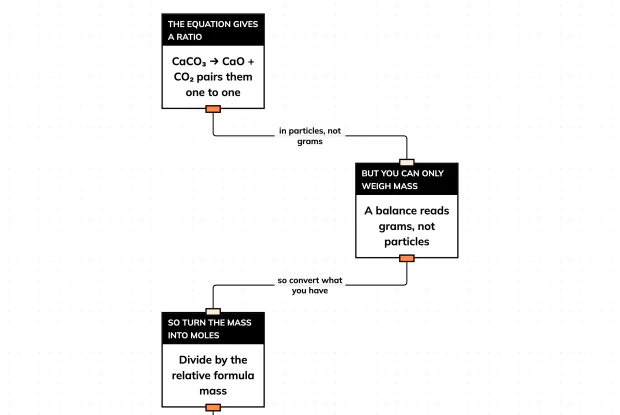
A balanced equation tells you a ratio of particles, and a balance reads grams. Converting between them is the whole calculation. Follow it step by step in an interactive playground.
Why Do You Never Get What the Equation Says?
A mass calculation gives the theoretical maximum, and real reactions always fall short. Three separate reasons, only one of which is carelessness. Trace them in an interactive playground.