Counting Atoms by Weighing
Five parts paying off a promise made seven tracks earlier. When water was first split by electricity it gave twice the volume of hydrogen as oxygen, and the tutorial that described it noted the fixed proportions were something a later track would take up. This is it. The force of that observation is not the ratio but its stubbornness — every sample, every source, to any precision anyone has managed — and whole numbers are what you get when you count objects rather than measure quantities. The objects are atoms, which cannot be halved. That fixes the proportions by mass too, and immediately creates the problem the rest of the track solves: reactions pair particles up, and particles are far too small to count and far too light to weigh one at a time. The mole bridges it, a fixed count chosen so that one mole of anything weighs its relative formula mass in grams — three samples holding the same number of particles and weighing twelve, eighteen and sixty-three and a half grams. The third part works that mass out for any formula, including the brackets where almost every error happens. The fourth finally makes a balanced equation quantitative, which the reactions track set up and could not cash: grams in, moles in the middle, grams out, because the equation only understands counts. And the last asks why a real reaction never gives what the calculation says, which turns out to be three separate reasons with three separate remedies.
CodePLU Goal
Upgrading Human Mental Models
Learn how to think in Workflows
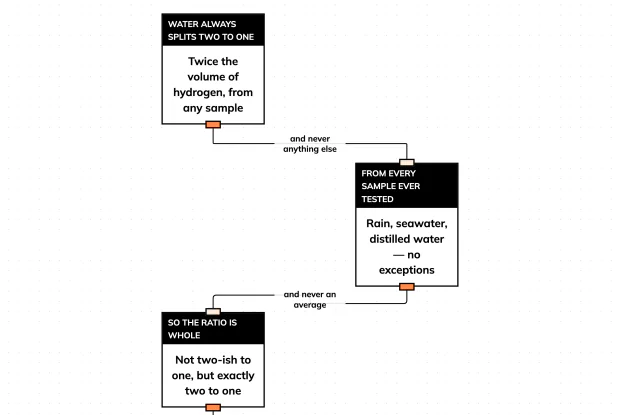
Why Are a Compound’s Proportions Always the Same?
Every sample of water ever split has given exactly twice the volume of hydrogen. Follow what that forces you to conclude about atoms, in an interactive playground.
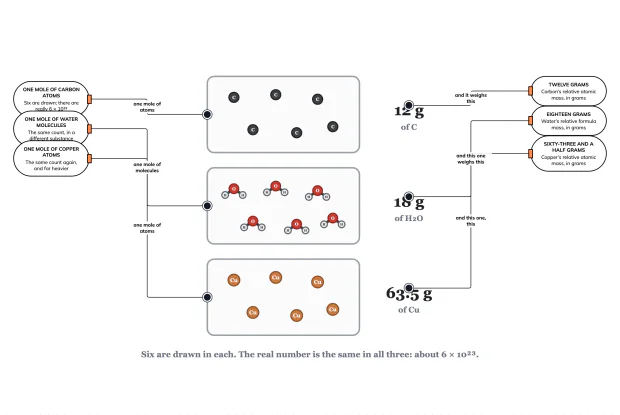
What Is a Mole, and Why Does Chemistry Need One?
Reactions happen in ratios of particles, and particles cannot be counted. The mole is how chemistry counts by weighing instead. Match three equal-sized samples to their masses in an interactive playground.
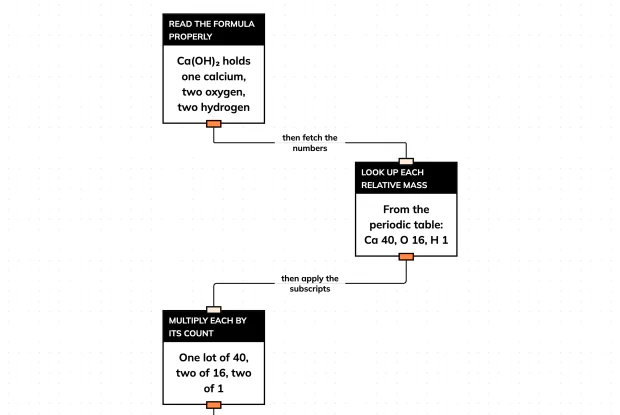
How Do You Work Out a Relative Formula Mass?
A relative formula mass is four steps of arithmetic, and almost every mistake is made in the first one. Work through a formula with brackets in an interactive playground.
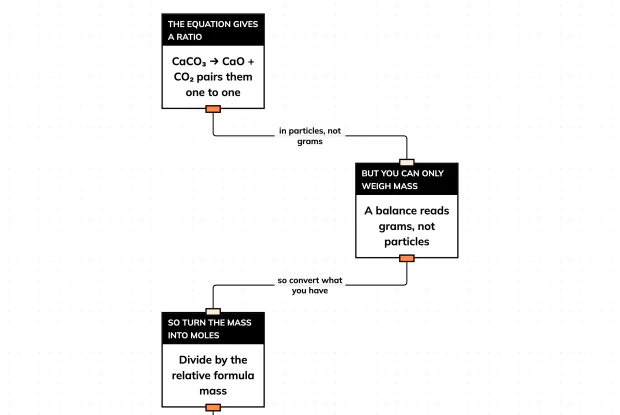
How Much Product Will a Reaction Give? Use Moles
A balanced equation tells you a ratio of particles, and a balance reads grams. Converting between them is the whole calculation. Follow it step by step in an interactive playground.
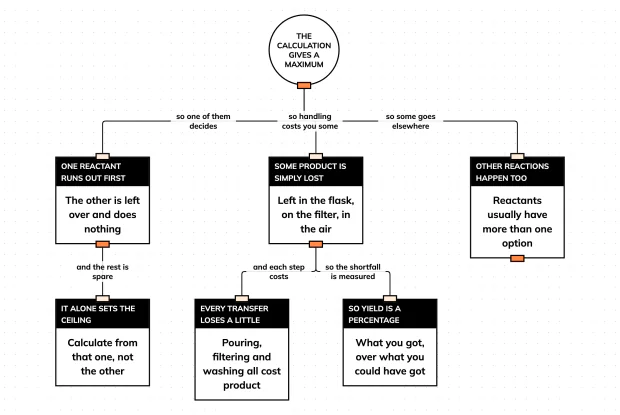
Why Do You Never Get What the Equation Says?
A mass calculation gives the theoretical maximum, and real reactions always fall short. Three separate reasons, only one of which is carelessness. Trace them in an interactive playground.