How Much Product Will a Reaction Give? Use Moles
Root Concept
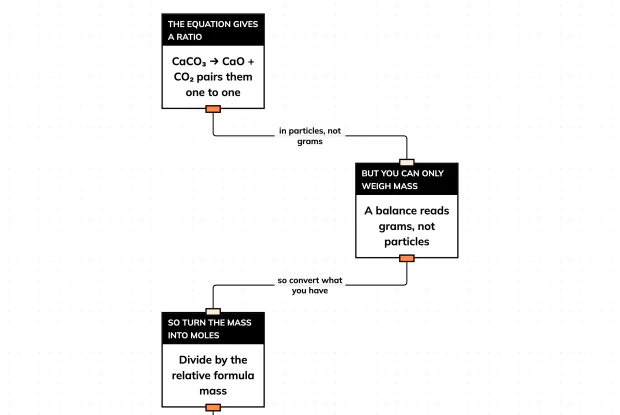
A balanced equation states a ratio of particles rather than of masses, so working out how much product a reaction gives means converting the mass you have into moles, applying the equation’s ratio to those moles, and converting the answer back into grams.
CodePLU Goal
Upgrading Human Mental Models
Learn how to think in Workflows

Concept Development By codeplu.com
The ratio is applied in the middle, to moles. Applying it to grams directly is the one mistake that matters.
The Equation Finally Becomes Useful
The reactions track established that an equation must balance because atoms are rearranged rather than created, and that the numbers in front of the formulae count whole units of a substance. What it could not do at the time was use those numbers for anything, because counting units of a substance is not something a laboratory can do directly. With the mole in place, it can.
Here is the problem in one line. CaCO₃ → CaO + CO₂ says that one unit of calcium carbonate gives one unit of calcium oxide and one of carbon dioxide — a ratio of particles. Put 50 g of limestone in a kiln and the equation does not tell you you will get 50 g of calcium oxide, because the particles are not the same mass. It tells you nothing about grams at all.
So the calculation has a shape, and it is the same shape every time. Convert the mass you have into moles, because moles are what the equation understands. Apply the ratio from the equation to those moles. Convert the answer back into grams, because grams are what you can weigh.
Grams in, moles in the middle, grams out. The only mistake that really matters is applying the equation’s ratio directly to a mass, and the playground is built so that the conversion happens on both sides of it.
Running the Calculation
Why can the ratio not be applied to masses?
Because the ratio counts particles and particles have different masses, which is the point the mole tutorial made with three boxes. In CaCO₃ → CaO + CO₂ the ratio is one to one to one, and yet 100 g of calcium carbonate gives 56 g of calcium oxide rather than 100 g. The missing 44 g left as carbon dioxide, which the state symbols in that equation warned about. Nothing has been destroyed — the masses balance exactly, as the conservation tutorial insisted — but the one-to-one relationship is between counts, not weights. Treating a coefficient as a mass ratio is the single most expensive error in this topic, because it looks right and is wrong by a different amount every time.
What does the first conversion actually do?
It turns something you can measure into something the equation can use. Moles equal mass divided by relative formula mass, so 50 g of calcium carbonate, whose formula mass is 100, is 0.5 moles. That number is now a count — half a mole of formula units — and a count is what the equation is written in. The division is doing real conceptual work rather than being arithmetic housekeeping: it is the step that moves from the observable world of balances to the particle world the chemistry happens in, which is the join this subject is built on. Every quantitative question in chemistry crosses that join twice. Starting in grams and ending in grams is not a convenience; it is what makes the answer actable.
How does the ratio get applied?
By multiplying the moles you have by the ratio of the coefficients. For a one-to-one equation the ratio is 1, so 0.5 moles of calcium carbonate gives 0.5 moles of calcium oxide — the easiest possible case and worth doing carefully anyway, because the habit is what carries you through the others. In 2H₂ + O₂ → 2H₂O the ratio of hydrogen to water is two to two, so moles of water equal moles of hydrogen; but the ratio of oxygen to water is one to two, so moles of water are twice the moles of oxygen. Reading the right pair of coefficients off the equation is the step to slow down for.
Why convert back at the end?
Because nobody can act on an answer in moles. A kiln operator needs tonnes, a laboratory needs grams, and a mole is a count that no instrument reads. Multiplying the moles of product by its relative formula mass completes the round trip: 0.5 moles of calcium oxide, whose formula mass is 56, is 28 g. The calculation starts and ends in the observable world and spends its middle in the particle one, which is a fair description of quantitative chemistry generally. Leaving an answer in moles is not wrong, but it is unfinished. The round trip is also a check: an answer in grams can be compared with what went in, and an answer in moles cannot.
Real World Example
The Same Three Steps at Three Scales
The shape of the calculation does not change with the size of the reaction or the direction you run it in.
Step 1
Heating 50 g of limestone gives 28 g of lime
Calcium carbonate has a formula mass of 100, so 50 g is 0.5 moles. The equation CaCO₃ → CaO + CO₂ is one to one, so 0.5 moles of calcium oxide is produced. Calcium oxide has a formula mass of 56, so that is 28 g. The remaining 22 g left as carbon dioxide, and the two products together account for the 50 g exactly. Running the check that the masses balance is worth doing every time, because it catches most arithmetic slips immediately. Note that nothing was weighed to get any of this — the masses came out of formula masses and an equation.
Step 2
A cement works runs the same sum in tonnes
Cement manufacture begins with exactly this reaction at enormous scale, and the arithmetic is identical with different units. A kiln processing a thousand tonnes of limestone produces about 560 tonnes of lime and releases about 440 tonnes of carbon dioxide — which is why cement production is one of the largest industrial sources of it, and why the figure comes straight out of a formula mass rather than from any measurement. The chemistry sets the emissions before anyone designs the plant No efficiency improvement touches that 440 tonnes, because it is not a loss but a product.
Step 3
Running it backwards to find what you need
The calculation works in either direction, which is usually the more useful one. If a process needs 112 g of calcium oxide, that is 2 moles, so 2 moles of calcium carbonate are required, which is 200 g. Industry asks this question far more often than the forward one, because the output is specified and the input has to be bought. The three steps are the same three steps, read from the other end. Specify the output, work the conversions in the opposite order, and the purchase order writes itself. Industry almost always runs the calculation this way round.
FAQs
Final Words
A balanced equation states a ratio of particles, and a balance reads grams — so the two cannot be put together without a conversion. That is the whole of this calculation, and it has the same shape every time: turn the mass you have into moles by dividing by the relative formula mass, apply the equation’s ratio to those moles, then turn the answer back into grams by multiplying.
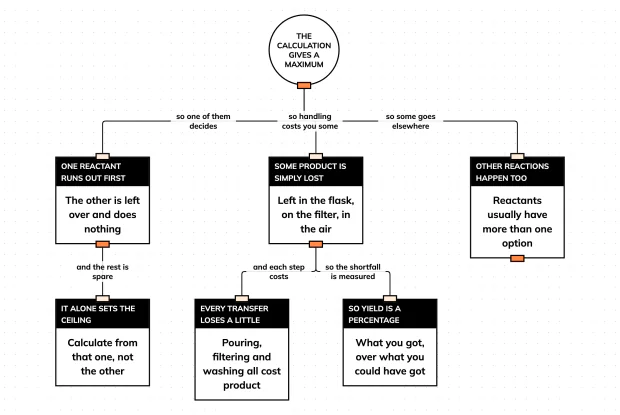
The mistake that matters is applying a coefficient directly to a mass. A one-to-one equation does not mean equal masses, because the particles differ in weight: 100 g of calcium carbonate gives 56 g of calcium oxide and loses 44 g as carbon dioxide, and those figures come from formula masses rather than from a measurement. Checking that the products add back up to the reactants catches most errors in seconds. What this gives is the theoretical maximum — and the next tutorial is about why a real reaction almost never reaches it.
Continue This Track
This concept is part 4 of Counting Atoms by Weighing.
Why Are a Compound’s Proportions Always the Same?
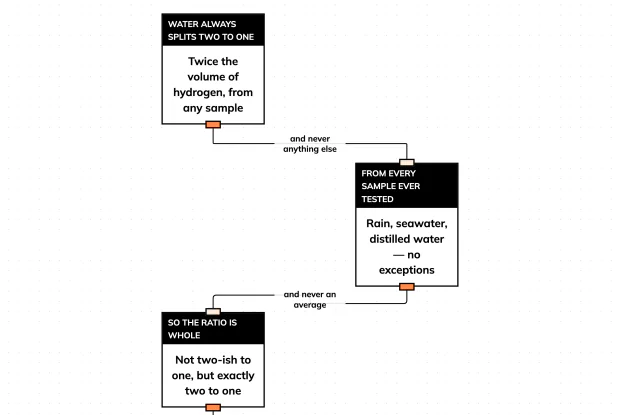
Every sample of water ever split has given exactly twice the volume of hydrogen. Follow what that forces you to conclude about atoms, in an interactive playground.
What Is a Mole, and Why Does Chemistry Need One?
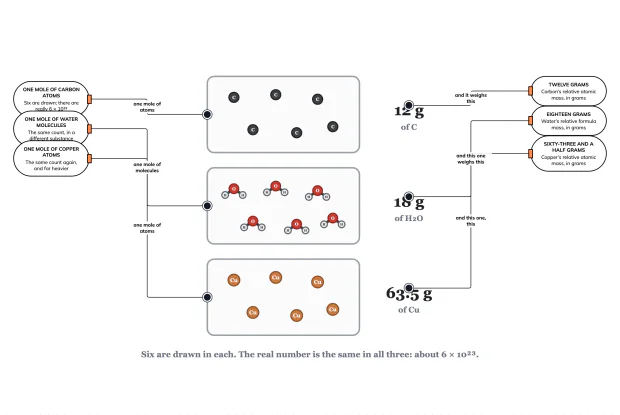
Reactions happen in ratios of particles, and particles cannot be counted. The mole is how chemistry counts by weighing instead. Match three equal-sized samples to their masses in an interactive playground.
How Do You Work Out a Relative Formula Mass?
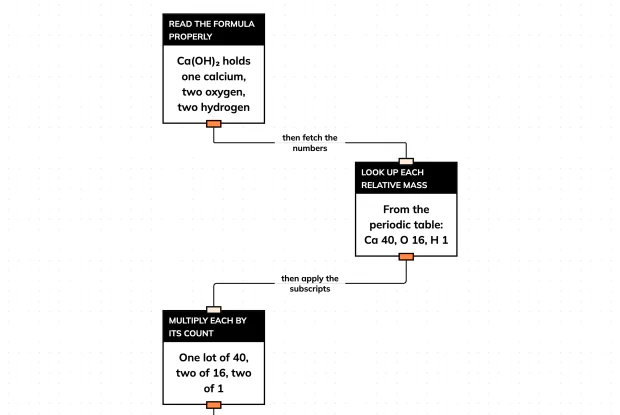
A relative formula mass is four steps of arithmetic, and almost every mistake is made in the first one. Work through a formula with brackets in an interactive playground.
How Much Product Will a Reaction Give? Use Moles
A balanced equation tells you a ratio of particles, and a balance reads grams. Converting between them is the whole calculation. Follow it step by step in an interactive playground.
Why Do You Never Get What the Equation Says?
A mass calculation gives the theoretical maximum, and real reactions always fall short. Three separate reasons, only one of which is carelessness. Trace them in an interactive playground.