Why Can You Not Separate a Compound That Way?
Root Concept
Every physical separation method works by exploiting a property the parts of a mixture do not share, and bonding the parts into a compound replaces their separate properties with a single new set — so no physical method can work on a compound, and the elements can only be recovered by a chemical reaction that breaks the bonds.
CodePLU Goal
Upgrading Human Mental Models
Learn how to think in Workflows

Concept Development By codeplu.com
The conclusion is not a rule to accept. It follows from the first two claims, which the previous tutorials established.
The Rule Nobody Explains, Derived Instead
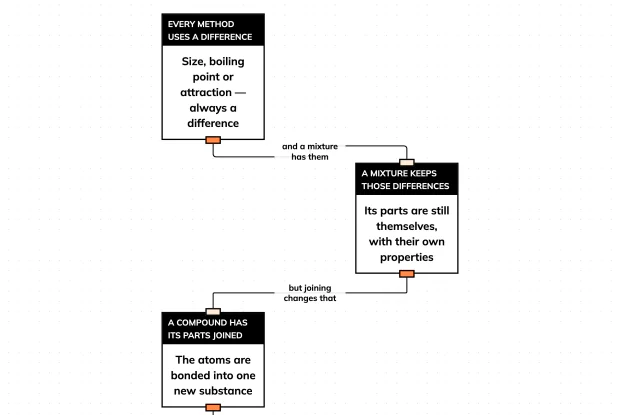
School chemistry states it flatly: a mixture can be separated by physical means and a compound cannot. Learned as a rule it is just a thing to remember, and it sounds arbitrary — why should joining two elements make them permanently unavailable? Reasoned through, it is not arbitrary at all. It follows in four steps from what separating actually requires.
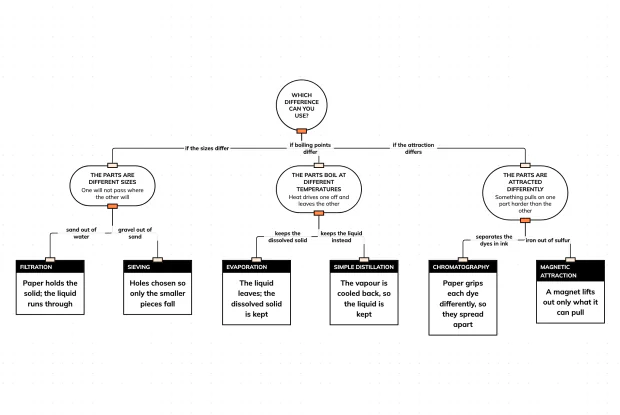
The previous tutorial established the first step. Every physical method, without exception, exploits a property the parts do not share: a difference in size for filtering, in boiling point for distilling, in how strongly something pulls on them for chromatography. No difference, no method. That is not a limitation of our equipment; it is what separating means.
The second step is what a mixture gives you. Because nothing in it is joined, each part is still itself and still has its own properties, so the differences are sitting there waiting to be used. The third step is what a bond does. The atoms in a compound are held together as one new substance, and that substance has one set of properties — iron sulfide has a single boiling point, not iron’s and sulfur’s.
The conclusion then arrives on its own. There is no difference left to exploit, so nothing physical can work, and the only way back to the elements is a change that breaks the bonds — a chemical reaction.
Following the Argument to the End
Why is "no difference" fatal rather than merely awkward?
Because a separation method is not a machine that pulls things apart by force — it is an arrangement that treats two things unequally. Filter paper does not push sand backwards; it offers holes that one thing fits through and the other does not. A condenser does not grab water; it offers a cold surface to whatever has turned to vapour. If both parts respond identically to the arrangement, the arrangement does nothing to them, however long you run it. A compound is a single substance: every bit of it boils at the same temperature, is the same size, and is gripped by paper with the same strength. There is nothing for an unequal treatment to act on.
Does that mean the elements have disappeared?
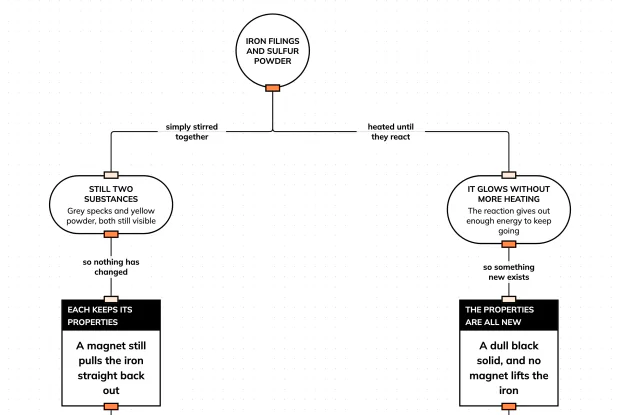
Not at all, and this is where the conservation rule matters. Every atom is still present and can be counted. Water is hydrogen and oxygen in a fixed two to one ratio, and the atoms are all in the sample. What has gone is not the atoms but their separateness: there is no longer a hydrogen part and an oxygen part of the sample that could be dealt with differently. Properties belong to substances and to the way their particles are arranged, which the iron and sulfur tutorial demonstrated when the magnet stopped working. The iron was all there. The thing that made it magnetic was not. This is worth holding on to, because the usual mental picture of a compound is two elements sitting inside it like ingredients in a jar, waiting to be picked out. They are not in it. They are it.
So what does work?
A chemical change — something that breaks the bonds and builds different ones. Passing a direct current through a compound is the most general answer, and it is called electrolysis: this is what split water in 1800, giving hydrogen at one electrode and oxygen at the other in a two to one volume ratio, and it is how aluminium is still obtained today. The other common route is to react the compound with something that holds one of its elements more tightly. Iron is won from its ore by heating it with carbon, which takes the oxygen away as carbon dioxide and leaves the iron. Both are reactions, and both cost a great deal of energy, because bonds have to be broken.
Why does breaking a compound cost so much energy?
Because breaking a bond always costs energy — it never releases any, which is the single most useful thing to get straight in this subject. Making a bond releases energy, and a compound exists because that arrangement is lower in energy than the separate elements were. Taking the compound apart means putting that energy back in. This is why extracting a reactive metal from its ore is expensive enough to shape whole economies: aluminium was once more valuable than gold, not because it is rare, but because nobody could afford to separate it from the oxygen it is bonded to. It also explains why some compounds give their elements up far more easily than others. The stronger the bonds holding a compound together, the more has to be put back in to break them, and the more drastic the method has to be.
Real World Example
Two Compounds Taken Apart, and What It Cost
The argument has a price tag attached. Each of these elements was out of reach until somebody found a reaction strong enough to free it.
Step 1
Water held out until there was electricity
Water had passed every available test for two thousand years, as the first tutorial in this track described, because every available test was physical. Boiling, freezing, filtering and distilling all return water, exactly as this argument predicts they must. Within weeks of the first battery being built in 1800, a current was passed through water and gas collected at each wire — hydrogen at one, oxygen at the other, in a reliable two to one volume ratio. The substance had not changed in all that time. What had arrived was a chemical method where before there had only been physical ones.
Step 2
Aluminium was a precious metal until 1886
Aluminium is the commonest metal in the Earth’s crust and is never found as the metal, because it is bonded to oxygen in its ore and bonded tightly. For most of the nineteenth century it was extracted in tiny quantities at enormous cost, and it was displayed beside the crown jewels. The problem was never finding it. It was that no physical method could touch the compound and the chemical route demanded more energy than anyone could supply cheaply. An electrolysis process worked out in 1886 brought the price down by orders of magnitude, and aluminium went from a treasure to a drinks can.
Step 3
Iron is freed by giving its oxygen to carbon
Not every compound needs electricity. Iron ore is iron bonded to oxygen, and in a blast furnace it is heated with carbon, which holds oxygen more tightly than iron does and takes it away as carbon dioxide, leaving molten iron behind. That is a reaction rather than a separation: bonds are broken and different bonds are made, and the products are not the things that went in. It is also the reason iron became common thousands of years before aluminium, despite being less abundant — its compound gives the element up far more easily, and a furnace full of burning charcoal was within reach of the ancient world in a way that a power station was not.
FAQs
Final Words
Four claims, and the fifth follows. Every physical separation method exploits a property the parts do not share. A mixture supplies those differences, because nothing in it is joined. A compound does not, because its atoms are bonded into one new substance with a single set of properties. So there is nothing for a physical method to act on, and only a chemical change gets the elements back — electrolysis, or a reaction that holds an element more tightly.
That is the track in one line. Elements are what nothing breaks down; compounds and mixtures are the two ways elements can be put together; and the difference between those two ways is a bond, which decides whether a magnet works and whether a metal was affordable in 1850. What a bond actually is depends on something this track has deliberately left closed: the inside of the atom. The next track opens it, and finds the single number that makes one element different from another.
Continue This Track
This concept is part 5 of Elements, Compounds and Mixtures.
What Makes Something an Element? Try to Break It
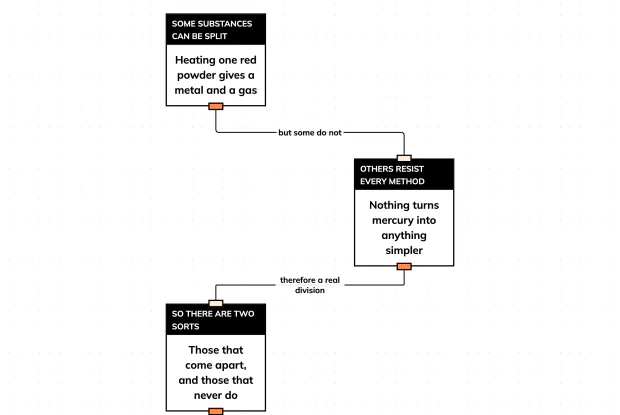
An element is not defined by how it looks or behaves — it is defined by the fact that nothing breaks it down into anything simpler. Follow the reasoning step by step in an interactive playground.
Element, Compound or Mixture? Sort Six Jars
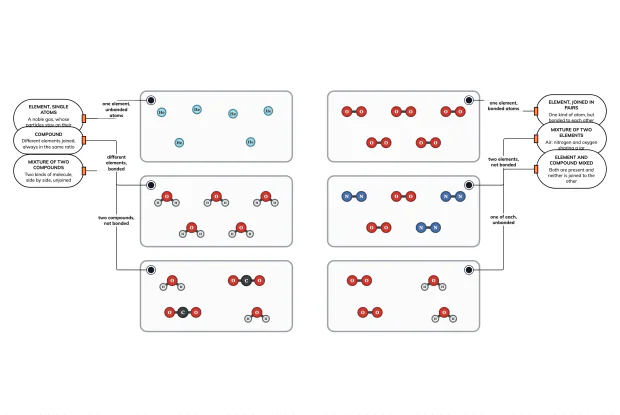
Every substance is an element, a compound or a mixture, and the jar tells you nothing. Sort six sealed samples by what their particles are doing, in an interactive playground.
Why a Compound Is Nothing Like Its Elements
Stir iron and sulfur together and you still have iron and sulfur. Heat them until they react and the magnet stops working. Follow both routes from the same starting point in an interactive playground.
How Do You Separate a Mixture? Find the Difference
There is no list of separation methods to memorise. Find the one property the parts of a mixture do not share, and the method chooses itself. Sort six techniques by the difference each one uses.
Why Can You Not Separate a Compound That Way?
Filtering, boiling and chromatography all need the parts to differ in something. A compound has one set of properties, so there is nothing to exploit. Follow the reasoning step by step in an interactive playground.