Why a Compound Is Nothing Like Its Elements
Root Concept
Mixing two elements leaves both of them unchanged and still separable, but reacting them produces a compound whose properties belong to the new substance alone — so a compound cannot be predicted from the elements in it and cannot be separated without another chemical change.
CodePLU Goal
Upgrading Human Mental Models
Learn how to think in Workflows

Concept Development By codeplu.com
Both routes start from the same jar of iron and sulfur. Only one of them produces something that was not there before.
One Starting Point, Two Very Different Endings
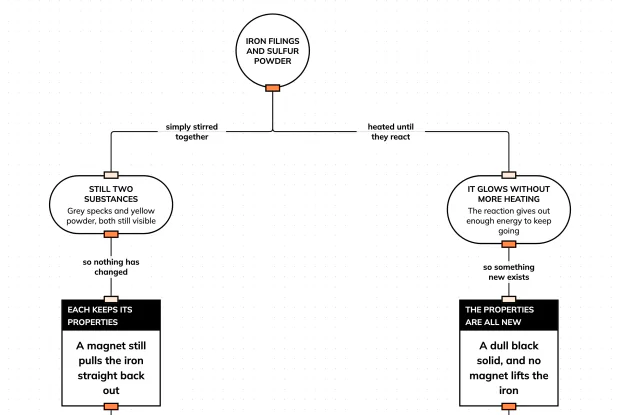
Put iron filings and powdered sulfur in a dish and stir them. The result looks like what it is: grey specks among yellow powder. Hold a magnet over the dish and the iron jumps out, leaving the sulfur behind. Nothing has happened to either element — they are simply in the same place.
Now take the same two powders and heat them strongly. Something quite different happens. The mixture begins to glow, and then it keeps glowing after the heat is taken away, because the reaction itself is giving out energy. What is left when it cools is a dull black solid. Hold the magnet over it and nothing moves. The iron is still in there, atom for atom, and the magnet cannot find it.
That is the difference a chemical bond makes, and it is bigger than most people expect. A compound is not its elements standing next to each other. It is a new substance with its own properties, and those properties cannot be worked out by looking at what went in. Sodium is a metal that reacts violently with water; chlorine is a poisonous green gas; sodium chloride is table salt.
The playground runs both routes side by side from the same starting point. Crossing the two branches is the mistake worth making once.
What the Bond Actually Changes
Why does the magnet stop working?
Because there is no longer any iron in the sample in the sense the magnet cares about. Being attracted to a magnet is a property of iron atoms arranged as iron metal, with their electrons free to move through the lattice. In iron sulfide each iron atom is bonded to sulfur, that arrangement no longer exists, and the new arrangement is not magnetic. The iron atoms have not gone anywhere — count them and they are all present, which is the conservation rule this subject keeps returning to. What has gone is the structure that made the sample behave like iron. This is the clearest demonstration there is that properties belong to substances rather than to the atoms inside them.
How do you know a reaction happened at all?
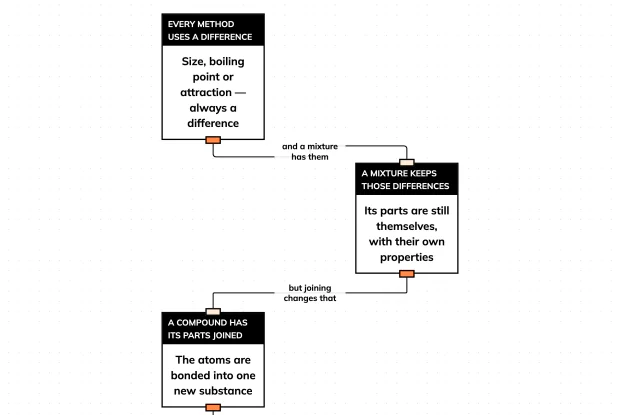
Three signs, and the glow is the most telling. Once the heating stops the glow continues and spreads through the dish, which means the reaction is releasing energy of its own — it is exothermic. A change that needed constant heating would just be heating. Second, the product does not look, behave or respond like either starting material: it is a black solid where one element was yellow and the other grey. Third, and decisively, the change will not reverse. Cooling the black solid gives black solid. Melting is undone by cooling and dissolving is undone by evaporating, which Track 1 of this category covers; a reaction is not undone by reversing the conditions.
Why is the ratio fixed in one route and not the other?
Because bonding happens atom to atom. In iron sulfide each iron atom is joined to one sulfur atom, so the formula is FeS — read aloud as "one iron, one sulfur". Any sulfur left over when the iron runs out simply stays as unreacted sulfur; it cannot squeeze into the compound, because there is nothing for it to bond to. A mixture has no such constraint. You may stir in as much or as little sulfur as you like and the result is still a mixture of iron and sulfur. That is why a fixed ratio is such a reliable signal: it is the fingerprint of atoms being joined in particular numbers rather than merely sharing a dish.
Does this work for every compound?
Yes, and the examples get more startling rather than less. Water is made of two gases, one of which burns explosively and the other of which makes things burn, and the compound is what you put the fire out with. Table salt is made from a metal that fizzes across the surface of water and a gas that was once used as a weapon. In every case the compound has properties of its own, and in every case the elements are still in there and can in principle be got back — but only by another chemical change, never by filtering, boiling or stirring. The last tutorial in this track is about exactly why.
Real World Example
The Iron and Sulfur Demonstration, Step by Step
This is a standard demonstration carried out by a teacher in a laboratory, behind a fume cupboard, because the reaction produces an unpleasant gas if any moisture is present.
Step 1
Mixed, and still two things
The two powders are stirred together in a dish and the class is invited to look closely. Grey and yellow are both clearly visible, and under a hand lens the separate specks are obvious. A magnet held just above the surface lifts the iron out cleanly, leaving a dish of yellow powder. Nothing chemical has taken place at any point. The iron is iron, the sulfur is sulfur, and the proportions were whatever the teacher happened to use. Every one of those facts is a property of mixtures rather than of this particular mixture, which is the point being set up.
Step 2
Heated, and it takes over
A fresh portion is heated strongly at one spot. After a short while a red glow appears, and then the heat source is taken away and the glow does not stop — it travels slowly through the rest of the mixture until the whole lot has reacted. That self-sustaining glow is the detail worth watching for. It means the reaction is giving out more energy than it needs to keep going, which is what exothermic means, and it is the moment at which a physical change can be ruled out. Nothing that is only melting carries on melting after the flame is removed.
Step 3
The magnet is tried again, and fails
When the dish has cooled it holds a dull, brittle, dark grey-black solid that can be tipped out in one piece. The magnet is passed over it and nothing is attracted, which is usually the moment the class goes quiet. The iron has not been destroyed and is not hiding: the same number of iron atoms sits in the dish as went into it. They are now bonded to sulfur, in a one to one ratio, as iron sulfide — a substance that is neither magnetic nor yellow and that nothing physical will take apart again.
FAQs
Final Words
The same two powders, treated two ways, end up as substances with almost nothing in common. Stirred together they stay iron and sulfur: both visible, both behaving as themselves, present in whatever proportion was used, and separable with a magnet in a few seconds. Heated until they react they become iron sulfide, a black solid that is not magnetic, holds its two elements in a fixed one to one ratio, and will not come apart by any physical means at all.
Nothing was lost on the way. Every atom that went into the dish is still in it, which is why the product weighs what the ingredients weighed. What changed is the arrangement, and the arrangement is where properties come from. That is also why a compound cannot be separated the way a mixture can — the next tutorial takes that one step further and shows why no amount of filtering or boiling will ever work.
Continue This Track
This concept is part 3 of Elements, Compounds and Mixtures.
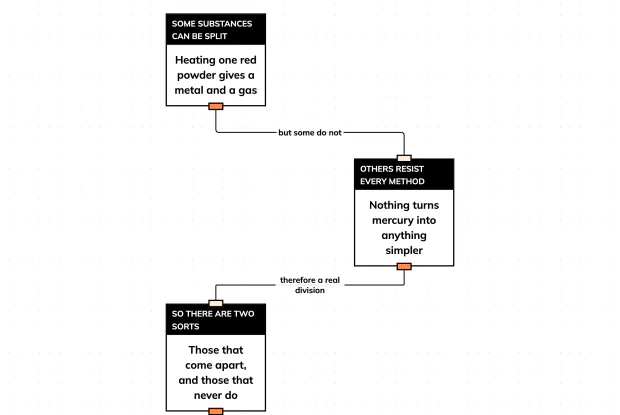
What Makes Something an Element? Try to Break It
An element is not defined by how it looks or behaves — it is defined by the fact that nothing breaks it down into anything simpler. Follow the reasoning step by step in an interactive playground.
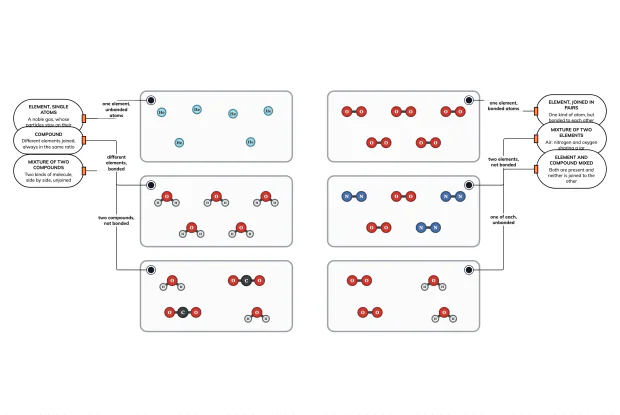
Element, Compound or Mixture? Sort Six Jars
Every substance is an element, a compound or a mixture, and the jar tells you nothing. Sort six sealed samples by what their particles are doing, in an interactive playground.
Why a Compound Is Nothing Like Its Elements
Stir iron and sulfur together and you still have iron and sulfur. Heat them until they react and the magnet stops working. Follow both routes from the same starting point in an interactive playground.
How Do You Separate a Mixture? Find the Difference
There is no list of separation methods to memorise. Find the one property the parts of a mixture do not share, and the method chooses itself. Sort six techniques by the difference each one uses.
Why Can You Not Separate a Compound That Way?
Filtering, boiling and chromatography all need the parts to differ in something. A compound has one set of properties, so there is nothing to exploit. Follow the reasoning step by step in an interactive playground.