What Makes Something an Element? Try to Break It
Root Concept
An element is a substance that cannot be broken down into anything simpler by chemical means, so it is defined by what it resists rather than by any property you can observe, and every other substance is a combination of elements.
CodePLU Goal
Upgrading Human Mental Models
Learn how to think in Workflows

Concept Development By codeplu.com
Nothing in the chain is a definition handed down. The last step is forced by the first two.
A Word You Cannot Define by Looking
Look at a lump of copper, a jar of sulfur and a spoonful of sugar. All three are solids, two of them are coloured, one of them is shiny. Nothing you can see, weigh or smell tells you that the first two are elements and the third is not.
That is the problem the word has to solve, and the way it was solved is unusual: an element is defined by what it **resists**. Take a substance and try everything you can think of to break it into something simpler — heat it hard, pass electricity through it, react it with other things. If two different substances come out, then what you started with was a combination of them, and it was never one thing. If nothing you do produces anything simpler, you have an element.
This is not a definition somebody decided on. It is what you are left with once you notice that substances genuinely fall into two groups when you try to take them apart, and that the division holds however hard you push. Water always gives hydrogen and oxygen; hydrogen gives nothing but hydrogen, no matter what is done to it. About ninety elements occur naturally, and every other substance in the world — every rock, every gas, every living thing — is those ninety combined.
The playground works that reasoning through one step at a time, and the definition arrives at the end rather than being announced at the start.
Working Through the Argument
What does it mean to break something down?
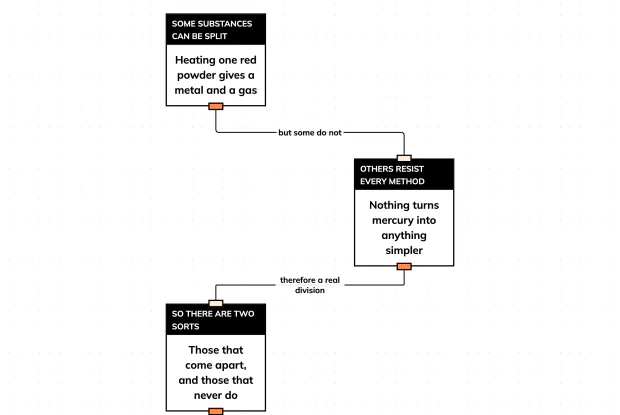
It means getting two or more different substances out of one, where each one is simpler than what you began with. Mercury oxide is the historic example and still the clearest: an orange-red powder that, when heated strongly, produces a silvery liquid metal and an invisible gas. Neither of those was visible in the powder, and neither can be got back to the powder by cooling it. That is quite different from melting or dissolving, where the substance is still there and can be recovered unchanged — an earlier tutorial in this track makes that distinction. Breaking down is a chemical change: what comes out is genuinely not what went in.
Why can you not simply keep going?
You can, and that is exactly the test. Take the silvery metal that came out of the powder and heat it, electrify it, react it with everything available: it stays mercury. Take the gas and do the same: it stays oxygen. The splitting stops, and it stops in the same place every time and for everybody. That reliable stopping point is the whole of the evidence. It is also why the list of elements was built up slowly and argued over — a substance belongs on it only until somebody finds a way to split it, and several things once thought to be elements came off the list when somebody did.
What is happening to the particles?
At the particle level the two groups look quite different, and this is where the definition stops being a rule and starts being a description. A sample of an element contains only one kind of atom. A sample of anything else contains more than one kind, joined together or merely mixed. Breaking a substance down means separating those different atoms from each other, and an element cannot be broken down because there is nothing to separate — the atoms in it are all the same. Nothing is ever created or destroyed in the process. The atoms that come out were in there to begin with, which is a fact this subject returns to constantly.
So what makes one element different from another?
Something inside the atom, and this tutorial deliberately stops short of it. For now the useful statement is that copper atoms are all alike, sulfur atoms are all alike, and a copper atom differs from a sulfur atom in a way that no chemical process can change — you cannot turn one element into another by reacting it with anything. That is why the list of ninety is a fixed list rather than a convenient grouping. What actually makes a copper atom a copper atom is the subject of the next track, and the answer turns out to be a single number — one that also explains why the elements can be laid out in a table rather than simply listed.
Real World Example
The Two Substances That Fooled Everyone Longest
The test sounds obvious until you try to apply it without modern equipment. The two substances that held out longest are the two nobody could find a way to break.
Step 1
Water looked like the purest thing there was
The classical scheme had four elements — earth, air, fire and water — and water was the least questionable of them. It can be boiled, frozen, filtered and distilled, and every one of those gives back water. By the only test available for two thousand years it passed perfectly. What nobody could do was pass an electric current through it, because there was no current to pass. The substance was not hiding anything subtle; the method simply did not exist yet, which is worth remembering before judging anyone for the error. Every test that could be applied had been applied, and water had passed all of them.
Step 2
Electricity split it in 1800
Within weeks of the first battery being built, two English chemists passed a current through water and collected gas at each wire. One gas burned explosively; the other made a glowing splint flare up. Two substances had come out of one, and neither could be turned back into water by any ordinary means. Water was off the list, and hydrogen and oxygen were on it. The volumes were telling too: twice as much of the burning gas as the other, every time, which is the first hint of the fixed proportions a later track takes up.
Step 3
Air turned out not even to be one substance
Air failed the test in a different and more embarrassing way. It is not a compound at all but a mixture, and it can be separated by cooling it until it liquefies and then letting it boil off in stages — the nitrogen leaves first, then the argon, then the oxygen. No chemistry is needed, only a temperature difference, which is the sign of a mixture rather than a compound. So one of the four classical elements was a compound and another was a mixture, and the test that exposed both is the one in the playground.
FAQs
Final Words
The reasoning runs in five steps and the definition is the last of them, not the first. Some substances come apart when you work at them: one red powder gives a metal and a gas. Others resist everything, in the same place, every time. That is a real division rather than a convenience, so the substances on the resisting side get a name — elements — and everything else is those elements combined.
What makes the definition work is that it never appeals to how anything looks. Copper is not an element because it is shiny, and sugar is not disqualified because it is sweet. At the particle level the division is simply whether a sample holds one kind of atom or several, and nothing is created or destroyed when a substance is split — the atoms were in there all along. The next tutorial takes that idea to a jar of particles and asks what you can tell just by looking at them.
Continue This Track
This concept is part 1 of Elements, Compounds and Mixtures.
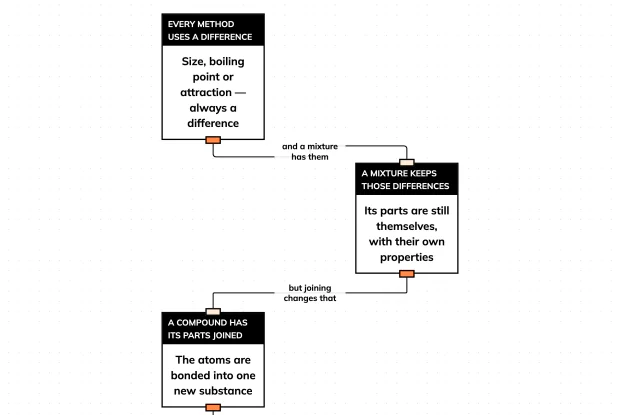
What Makes Something an Element? Try to Break It
An element is not defined by how it looks or behaves — it is defined by the fact that nothing breaks it down into anything simpler. Follow the reasoning step by step in an interactive playground.
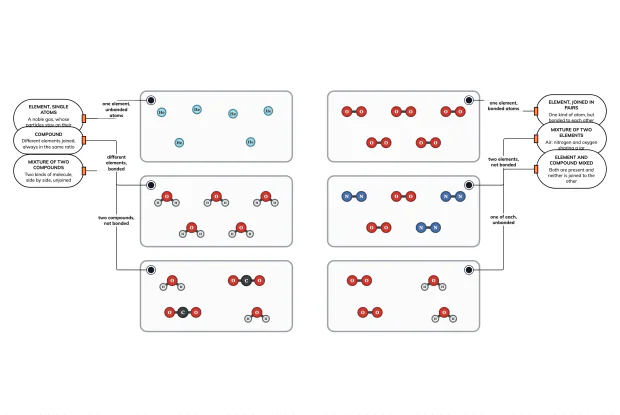
Element, Compound or Mixture? Sort Six Jars
Every substance is an element, a compound or a mixture, and the jar tells you nothing. Sort six sealed samples by what their particles are doing, in an interactive playground.
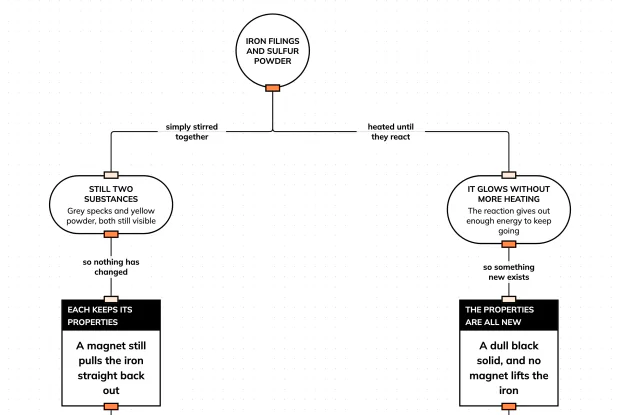
Why a Compound Is Nothing Like Its Elements
Stir iron and sulfur together and you still have iron and sulfur. Heat them until they react and the magnet stops working. Follow both routes from the same starting point in an interactive playground.
How Do You Separate a Mixture? Find the Difference
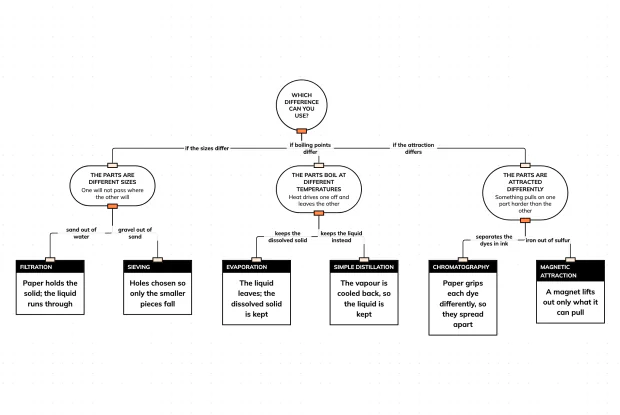
There is no list of separation methods to memorise. Find the one property the parts of a mixture do not share, and the method chooses itself. Sort six techniques by the difference each one uses.
Why Can You Not Separate a Compound That Way?
Filtering, boiling and chromatography all need the parts to differ in something. A compound has one set of properties, so there is nothing to exploit. Follow the reasoning step by step in an interactive playground.