How Do You Separate a Mixture? Find the Difference
Root Concept
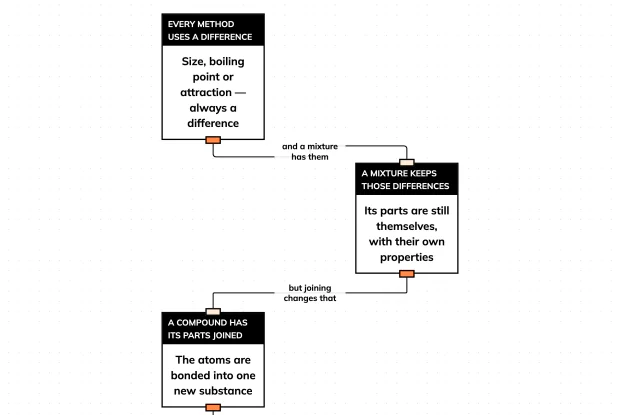
A mixture can be separated without any chemical reaction because its parts keep their own properties, so every separation method works by exploiting one property the parts do not share — size, boiling point, or how strongly something pulls on them — and choosing a method means identifying that difference first.
CodePLU Goal
Upgrading Human Mental Models
Learn how to think in Workflows

Concept Development By codeplu.com
The methods are the easy part. The question at the top is the one that decides which of them will work.
Stop Memorising Methods and Ask One Question
Separation techniques are usually handed over as a list to learn: filtration, evaporation, distillation, chromatography, and so on, each with a diagram. Learned that way they are almost useless, because an exam question gives you a mixture and not a method, and a list offers no way of choosing.
There is a much shorter route. A mixture can be separated at all only because nothing in it is chemically joined, so each part has kept its own properties. That means there is some property the parts do not share — and every separation method ever invented is a way of exploiting one such difference. Find the difference first and the method follows almost automatically.
Sand and water differ in size: the sand grains will not fit through filter paper and the water will. Salt water does not differ in size at all, since dissolved salt particles pass straight through paper, but it differs enormously in boiling point, so heat separates it. The dyes in a felt-tip pen differ in neither, but they cling to paper with different strengths, which is what chromatography uses.
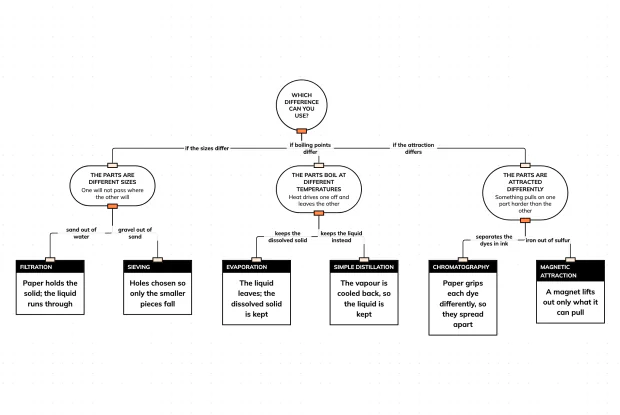
The playground sorts six techniques under the three differences they exploit. Getting a method under the wrong difference is the useful mistake, because it is exactly the mistake that picks the wrong apparatus.
The Three Differences Worth Knowing
When does a difference in size work?
When one part is made of pieces big enough to be held back by a barrier that the other passes through. Filter paper has holes far too small to see, but they are enormous compared with a water molecule, so water goes through while grains of sand stay behind as the residue and the liquid collected underneath is the filtrate. The limit is important and often missed: filtering does nothing at all to a solution. Dissolved salt exists as separate particles mixed in among the water particles, as the first track of this category showed, so it is no bigger than the water and sails through the paper. A sieve is the same idea at a coarser scale, with holes you can see.
When does a difference in boiling point work?
Whenever one part turns to vapour at a temperature the other will not. This is the difference that handles solutions, and there are two versions of it depending on which part you want to keep. Evaporation drives the liquid off and abandons it, leaving the dissolved solid behind — the method for getting salt out of salt water. Distillation catches the vapour instead and cools it back to a liquid in a condenser, so the pure liquid is what you collect. Both exploit the same difference and differ only in what is thrown away. Sea water can give you either the salt or the drinking water, and the choice of method is the choice of which you want.
What if two liquids both boil?
Then simple distillation is not enough, because both of them vapourise and both end up in the collecting flask. Fractional distillation solves it with a tall column packed with glass beads or shaped into plates. Vapour rising through the column condenses and re-evaporates many times on the way up, and each cycle enriches the vapour in the substance with the lower boiling point, so what reaches the top is almost pure. This is how crude oil is split into petrol, kerosene and diesel, and how liquid air is split into nitrogen, argon and oxygen. The difference being used is still boiling point; the column simply uses it over and over.
And when the parts differ in neither?
Then something has to pull on them unequally. Chromatography puts a spot of the mixture on paper and lets a solvent travel up through it. Each substance in the spot is caught between two pulls — the paper holding it and the moving solvent carrying it — and whichever is held least strongly travels furthest. A single black ink spot separates into several coloured bands at different heights, which is why the technique is used to test food colourings and to identify substances in forensic work. A magnet is the blunt version of the same principle: it pulls on iron and ignores everything else, which is how iron is recovered from a mixture with sulfur.
Real World Example
Three Industries Built on One of These Methods
None of these techniques stays in a school laboratory. Each of the three differences supports an industry that would not exist without it.
Step 1
Crude oil is split by boiling point, continuously
Crude oil is a mixture of hundreds of compounds that are chemically similar and differ mainly in the size of their molecules, which sets how easily each boils. A refinery heats the oil until most of it is vapour and feeds it into a fractionating column that is hot at the bottom and much cooler at the top. Each compound condenses at the height where the temperature matches its boiling point, so the column is tapped at different levels for bitumen, diesel, kerosene and petrol. No chemistry takes place anywhere in it — the mixture is only being sorted.
Step 2
Drinking water is made by filtering, then more
A water treatment works runs the size difference first and hardest. Large debris is screened out, then the water passes through beds of sand and gravel that hold back particles far too small to see. What filtering cannot remove is anything dissolved, which is why the treatment does not stop there: the water is also treated chemically to deal with microbes. In places where the only water available is sea water, the size difference is useless altogether and a boiling point difference is used instead, which is why desalination costs so much more energy than filtration.
Step 3
Chromatography checks what is actually in things
Forensic laboratories, food inspectors and drug testers all rely on the attraction difference, usually in a more sophisticated form than paper. A sample is carried past a material that grips each substance in it by a different amount, so the substances arrive at the far end at different times and can be identified by when they appear. The principle is exactly the one visible when a black ink spot splits into coloured bands on wet filter paper: nothing is changed by the process, only spread out. That is what makes the result trustworthy as evidence. A method that altered the sample would leave you identifying your own handiwork, whereas chromatography returns the substances that were there, merely moved apart, and the distance each one travelled is itself the identification.
FAQs
Final Words
There is no list to memorise here, only one question to ask: what do the parts of this mixture not have in common? If they differ in size, a barrier will do it — filter paper for sand in water, a sieve for gravel in sand. If they differ in boiling point, heat will do it, and the only remaining choice is whether to keep what boils off, by distilling, or what stays behind, by evaporating. If neither, then something must pull on them unequally, which is chromatography for dyes and a magnet for iron.
All of this works for one reason. Nothing in a mixture is chemically joined, so every part has kept the properties that make these differences available at all. Take that away — bond the parts into a compound — and every method on this board stops working at once. The last tutorial explains why, and what is needed instead.
Continue This Track
This concept is part 4 of Elements, Compounds and Mixtures.
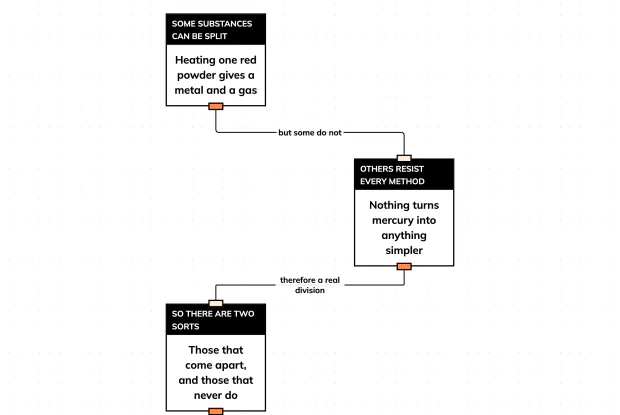
What Makes Something an Element? Try to Break It
An element is not defined by how it looks or behaves — it is defined by the fact that nothing breaks it down into anything simpler. Follow the reasoning step by step in an interactive playground.
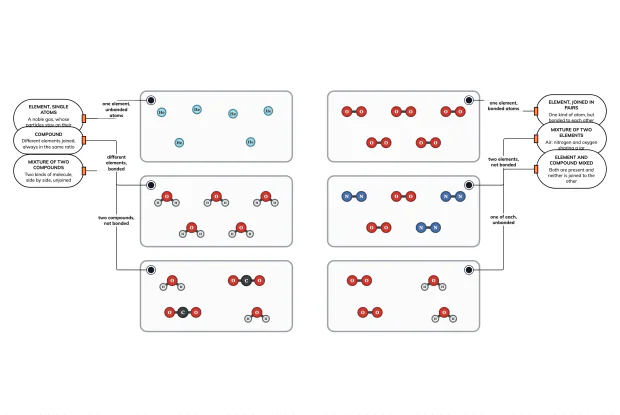
Element, Compound or Mixture? Sort Six Jars
Every substance is an element, a compound or a mixture, and the jar tells you nothing. Sort six sealed samples by what their particles are doing, in an interactive playground.
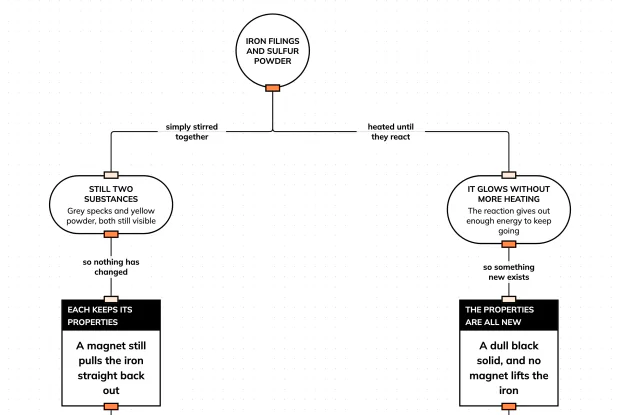
Why a Compound Is Nothing Like Its Elements
Stir iron and sulfur together and you still have iron and sulfur. Heat them until they react and the magnet stops working. Follow both routes from the same starting point in an interactive playground.
How Do You Separate a Mixture? Find the Difference
There is no list of separation methods to memorise. Find the one property the parts of a mixture do not share, and the method chooses itself. Sort six techniques by the difference each one uses.
Why Can You Not Separate a Compound That Way?
Filtering, boiling and chromatography all need the parts to differ in something. A compound has one set of properties, so there is nothing to exploit. Follow the reasoning step by step in an interactive playground.