Element, Compound or Mixture? Sort Six Jars
Root Concept
Every substance is an element, a compound or a mixture, and the three are told apart only at the particle level: an element contains one kind of atom, a compound contains different atoms chemically joined in a fixed ratio, and a mixture contains more than one substance that is not joined at all and can be separated without a reaction.
CodePLU Goal
Upgrading Human Mental Models
Learn how to think in Workflows

Concept Development By codeplu.com
Two of the six are elements. Deciding which two is the whole exercise, and colour will not do it for you.
Six Jars That All Look the Same
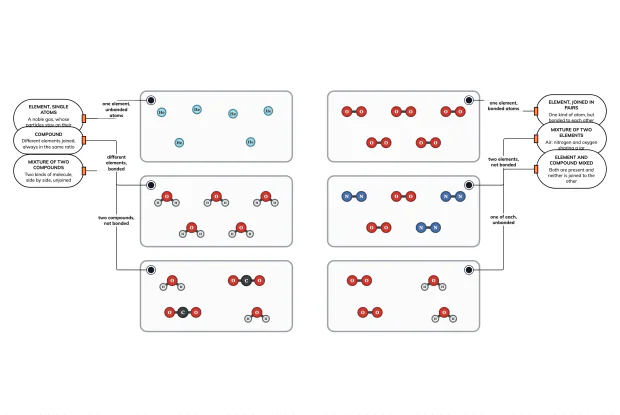
Imagine six sealed jars on a bench, every one of them holding a colourless gas. You may pick them up, shake them, weigh them and hold them to the light. Nothing you do will tell you that one holds an element, another holds a compound, and a third holds two substances that have never touched each other chemically. The answer is not in the jar. It is in what the particles are and whether they are joined.
That is why this tutorial is a picture of particles rather than a list of definitions. Every substance in the world belongs to one of three groups, and the test for which group is always the same two questions: how many different kinds of atom are in there, and are they bonded to each other or merely sharing the space?
Three groups would suggest three jars, and six is deliberate. The three-way answer hides two things that catch almost everybody out. An element does not have to be loose single atoms — oxygen gas is an element and its atoms come in bonded pairs. And a mixture does not have to be of elements: it can be two compounds, or one of each, and it is still a mixture because nothing in it is joined to anything else.
Drag each label to the jar it describes. The reason goes on the connection, because the reason is the part worth remembering.
How the Three Groups Are Told Apart
Why can you not tell by looking at the jar?
Because every property you can observe — colour, smell, density, boiling point — belongs to the substance as a whole and says nothing about how its particles are arranged. Oxygen and nitrogen are both colourless gases. So is a jar of the two mixed, and so is carbon dioxide, which is a compound. The observable level genuinely cannot settle the question, and that is not a failure of your eyes: it is the reason the particle model had to be invented at all. What the observable level can do is give you a clue, and there is one good one. If a sample can be taken apart without any chemical reaction — by filtering it, boiling it off in stages, or letting it settle — then it was a mixture. If the only way in is a reaction, it was a compound.
What is the difference between joined and merely mixed?
A chemical bond, and the difference it makes is enormous. In a compound the atoms are held to each other, so the sample behaves as one new substance with properties of its own, and the ratio of atoms is fixed: every water molecule anywhere is two hydrogen atoms to one oxygen, never two and a bit. In a mixture the particles are simply in the same place. Each substance keeps its own properties, and the proportions can be anything you like — slightly salty water and very salty water are both perfectly good salt solutions. That one test, fixed ratio against any ratio, is often the fastest way to decide, and it follows directly from whether a bond was made.
Can an element be a molecule?
Yes, and this is the trap the figure is built around. The word molecule means two or more atoms bonded together; it does not mean the atoms have to be different. Oxygen gas is O₂ — two oxygen atoms bonded — and it is still an element, because only one kind of atom is present and no amount of chemistry will give you anything simpler than oxygen out of it. Nitrogen, hydrogen and chlorine are the same. The elements that really do go about as lone atoms are the noble gases, which is why the single-atom jar holds helium. So "element" is about how many kinds of atom, and "molecule" is about whether atoms are bonded. The two words answer different questions and a substance can be both at once.
What does a mixture let you do that a compound does not?
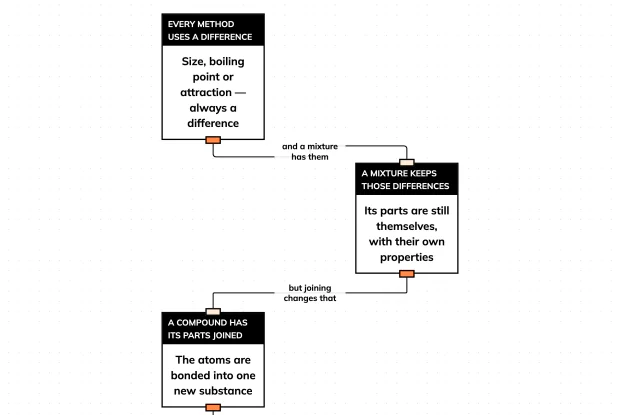
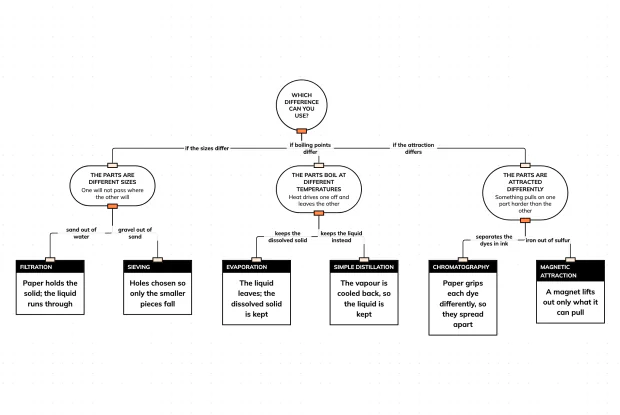
Separate it without a reaction. Because nothing in a mixture is joined, any difference between its parts can be used to pull them apart: a difference in particle size lets you filter, a difference in boiling point lets you distil, a difference in attraction to paper lets you run a chromatogram. Air is separated into nitrogen, oxygen and argon purely by cooling it to a liquid and letting it boil off in stages, with no chemistry involved anywhere. A compound offers no such handle, because its parts are no longer separate things with separate properties. Getting hydrogen out of water needs an electric current, which is a chemical change. The last two tutorials in this track are about exactly that difference.
Real World Example
Three Everyday Samples and What They Really Are
Away from the jars, the quickest honest test is whether the recipe is fixed. A compound has one; a mixture never does.
Step 1
Air is a mixture, and the proof is the proportion
Air is roughly seventy-eight per cent nitrogen, twenty-one per cent oxygen and one per cent argon, with carbon dioxide and water vapour making up the rest. Roughly is the important word. Air at the top of a mountain, air in a crowded room and air over a forest all differ, and all of them are still air. No compound behaves like that. If air were a compound of nitrogen and oxygen, every sample would hold them in one exact ratio, and a sample that did not would simply be a different substance. The variable recipe is the giveaway, and it is why air can be separated by boiling point alone.
Step 2
Sea water is a mixture; the salt in it is a compound
One sample can hold both, which is where the three groups stop feeling like tidy boxes. Sea water is a mixture: the amount of salt varies from one sea to another, and evaporating the water leaves the salt behind unchanged, with no reaction anywhere. The salt itself is a compound, and a strict one — sodium and chlorine in a fixed one to one ratio, joined, and nothing like either element on its own. Sodium is a soft metal that reacts violently with water and chlorine is a poisonous green gas, yet the compound they make is sprinkled on food. The next tutorial is about why that is not a coincidence.
Step 3
Stainless steel is a mixture you cannot see into
A mixture does not have to look mixed. Stainless steel is iron with chromium and a little carbon stirred through it while molten, and the result is a single smooth grey surface with no visible parts at all. It is still a mixture: the proportions are chosen by whoever is making it, different grades hold different amounts, and the iron in it is still iron, still magnetic, still rusting if the chromium layer is scratched away. Being uniform to the eye says nothing. The question is always whether the atoms are bonded into something new or simply sharing the space.
FAQs
Final Words
Six jars, three answers, and the jar itself tells you nothing. Every substance is sorted by two questions asked about its particles: how many kinds of atom are present, and are they bonded or simply sharing the space. One kind of atom makes it an element, whether those atoms go about alone like helium or in bonded pairs like oxygen. More than one kind, chemically joined in a fixed ratio, makes it a compound. More than one substance, not joined at all, makes it a mixture — and the parts of a mixture can be elements, compounds, or one of each.
The useful consequence is the one to carry forward. Because nothing in a mixture is joined, any difference between its parts can be used to separate them, with no reaction involved. A compound gives you no such handle. The next tutorial takes two elements that are easy to tell apart, joins them, and shows how completely that handle disappears.
Continue This Track
This concept is part 2 of Elements, Compounds and Mixtures.
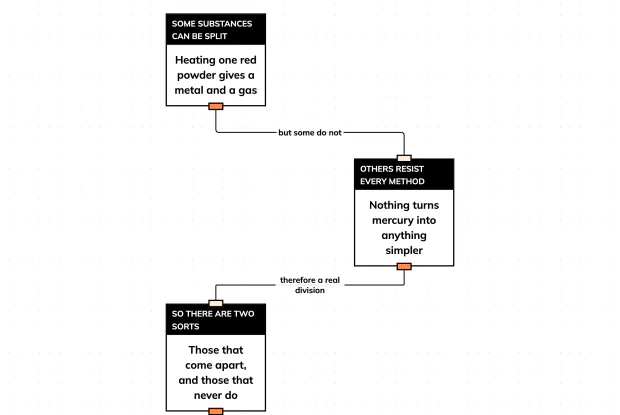
What Makes Something an Element? Try to Break It
An element is not defined by how it looks or behaves — it is defined by the fact that nothing breaks it down into anything simpler. Follow the reasoning step by step in an interactive playground.
Element, Compound or Mixture? Sort Six Jars
Every substance is an element, a compound or a mixture, and the jar tells you nothing. Sort six sealed samples by what their particles are doing, in an interactive playground.
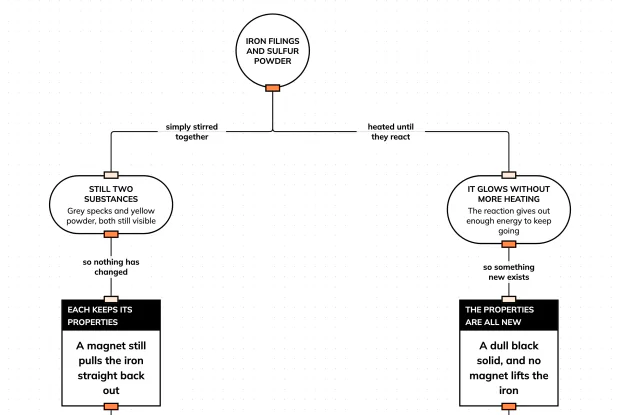
Why a Compound Is Nothing Like Its Elements
Stir iron and sulfur together and you still have iron and sulfur. Heat them until they react and the magnet stops working. Follow both routes from the same starting point in an interactive playground.
How Do You Separate a Mixture? Find the Difference
There is no list of separation methods to memorise. Find the one property the parts of a mixture do not share, and the method chooses itself. Sort six techniques by the difference each one uses.
Why Can You Not Separate a Compound That Way?
Filtering, boiling and chromatography all need the parts to differ in something. A compound has one set of properties, so there is nothing to exploit. Follow the reasoning step by step in an interactive playground.