Elements, Compounds and Mixtures
Five parts on the question of what counts as one substance, which sounds like vocabulary and is not. The track opens by refusing to define an element by any property you can observe, because none of them work — an element is defined by what it resists, and water passed every available test for two thousand years before electricity existed to split it. It then moves to the particle level and stays there, sorting six sealed jars that all look identical into element, compound and mixture, with six jars rather than three because the three-way answer hides the two cases that catch people out: an element whose atoms come in bonded pairs is still an element, and a mixture can be made of compounds. The middle part is the iron and sulfur demonstration, where the same two powders stirred together stay magnetic and separable, and heated until they react become a black solid no magnet will touch — the clearest evidence there is that properties belong to substances rather than to the atoms inside them. The last two parts turn that into something usable. Separation methods are not a list to memorise: every one of them exploits a property the parts do not share, so finding the difference chooses the method. And once that is clear, the rule nobody explains explains itself — a compound has one set of properties, so there is no difference left to exploit, and only a chemical reaction gets the elements back.
CodePLU Goal
Upgrading Human Mental Models
Learn how to think in Workflows
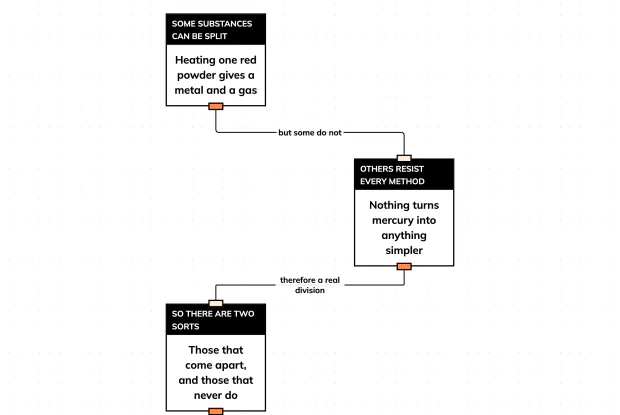
What Makes Something an Element? Try to Break It
An element is not defined by how it looks or behaves — it is defined by the fact that nothing breaks it down into anything simpler. Follow the reasoning step by step in an interactive playground.
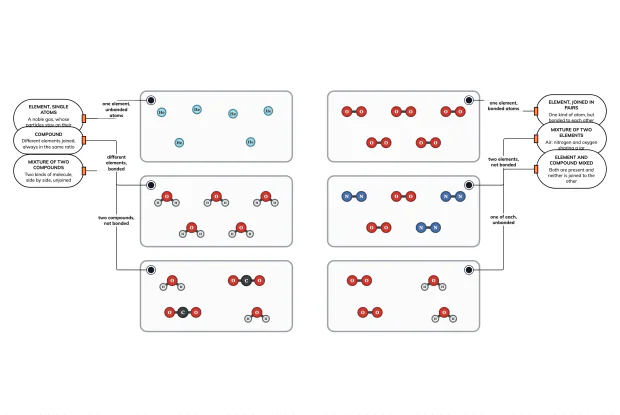
Element, Compound or Mixture? Sort Six Jars
Every substance is an element, a compound or a mixture, and the jar tells you nothing. Sort six sealed samples by what their particles are doing, in an interactive playground.
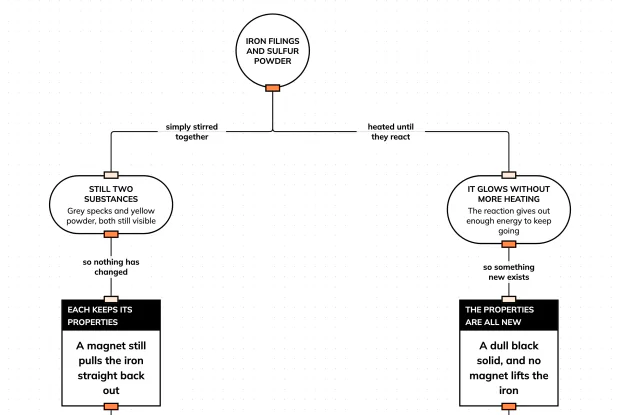
Why a Compound Is Nothing Like Its Elements
Stir iron and sulfur together and you still have iron and sulfur. Heat them until they react and the magnet stops working. Follow both routes from the same starting point in an interactive playground.
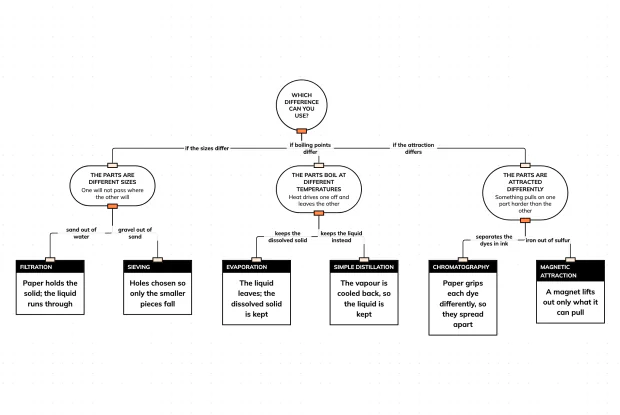
How Do You Separate a Mixture? Find the Difference
There is no list of separation methods to memorise. Find the one property the parts of a mixture do not share, and the method chooses itself. Sort six techniques by the difference each one uses.
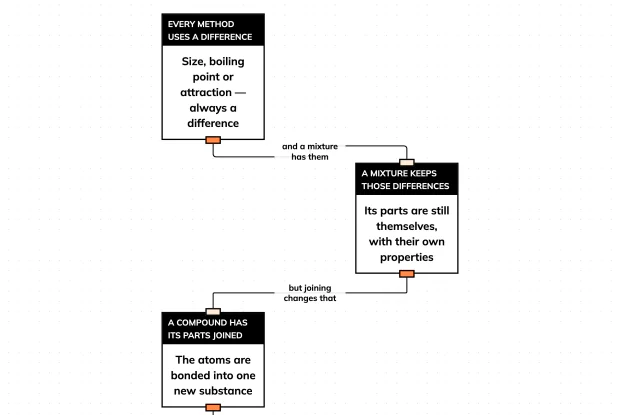
Why Can You Not Separate a Compound That Way?
Filtering, boiling and chromatography all need the parts to differ in something. A compound has one set of properties, so there is nothing to exploit. Follow the reasoning step by step in an interactive playground.