Why Were the Noble Gases Found Last?
Root Concept
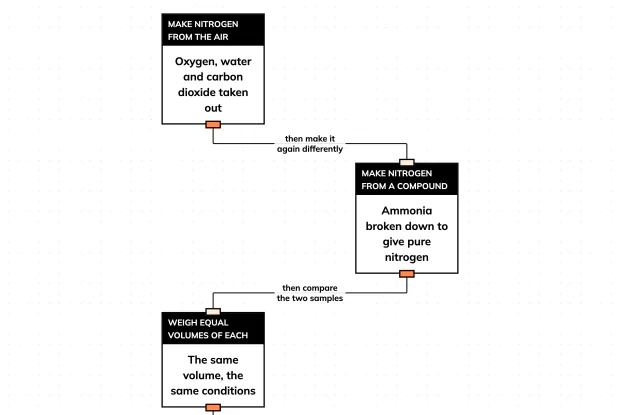
Every other family of elements was discovered through the compounds it forms, so the noble gases — which form almost none — left no chemical trace, and argon was found only when nitrogen prepared from air was weighed against nitrogen prepared from a compound and turned out to be half a per cent heavier.
CodePLU Goal
Upgrading Human Mental Models
Learn how to think in Workflows

Concept Development By codeplu.com
Nothing after the fourth step could have been done without it. The whole discovery rests on somebody refusing to round a half of one per cent away.
The Family Nobody Could Find
Group 0 sits at the right-hand edge of the periodic table — helium, neon, argon, krypton, xenon — and it is the one family this track has not yet looked at. Its defining feature is that its members have a full outer shell already, so there is nothing to give away and no room to take anything in. They react with almost nothing at all.
That makes them easy to describe and extremely hard to find. Every other element known by the middle of the nineteenth century had been found through something it did: a metal pulled out of an ore, a gas given off by an acid, a colour in a flame. An element that enters no reactions produces no ore, no salt and no precipitate. It is present and chemically silent.
Argon makes up a little under one per cent of the air you are breathing — more than twenty times as much as carbon dioxide — and nobody noticed it until 1894. It was not hiding in some rare mineral. It was in every sample of air anybody had ever worked with, and it had been quietly ignored.
What gave it away was not a reaction but a weighing, and a refusal to dismiss a discrepancy of half of one per cent. The board above is the procedure that found it, and the order genuinely matters: nothing after the fourth step makes sense without the step before it.
How the Discovery Actually Ran
Why make the same gas twice?
Because comparing two routes to what should be the identical substance is a way of testing both. Nitrogen can be got out of air by removing everything else — burn away the oxygen, absorb the water vapour and the carbon dioxide, and what remains should be nitrogen. It can also be made from a compound, by breaking down ammonia, where every nitrogen atom came out of a known molecule. Those two samples ought to be indistinguishable, and checking that they are is ordinary careful work rather than a hunt for anything. Lord Rayleigh was measuring the densities of gases accurately, not looking for a new element, which is worth remembering about how discoveries often arrive.
What did the weighing show?
That the two samples were not the same. Nitrogen obtained from air was consistently about half of one per cent denser than nitrogen made from ammonia, measured as equal volumes at the same temperature and pressure. Half a per cent is small, but it was far larger than the uncertainty of the measurement and it did not go away when the apparatus was cleaned, rebuilt or run by somebody else. That is the distinction that matters: an error wanders about and shrinks when you improve the method, while a real effect sits there at the same size however many times you repeat it. This one sat there for two years.
How do you chase a discrepancy like that?
By assuming the heavier sample contains something the lighter one does not, and then removing everything you can name. William Ramsay took air and stripped it systematically: oxygen first, then water and carbon dioxide, and finally the nitrogen itself, by passing it over hot magnesium, which combines with nitrogen to give a solid nitride. Each step removes a known gas, so whatever survives all of them is by definition something unknown. A small volume of gas did survive, a little under one per cent of the original air, and it would not react with the magnesium or with anything else that was tried on it. Removing the known is a slow way to find the unknown, but against something that will not react it is the only way there is.
How do you identify a gas that will not react?
You cannot use chemistry, because chemistry is reactions and this gas has none, so you use physics instead. The new gas was passed through an electric discharge and the light it gave off was spread into a spectrum, which showed a pattern of lines matching no known element. That pattern is a fingerprint, produced by the arrangement of electrons rather than by any reaction, so it works on a substance that refuses to do anything. The gas was named argon, from the Greek for idle, and the unreactivity that had hidden it became the thing it was named after. A spectrum is the standard tool for exactly this situation, and it had already found caesium and rubidium the same way.
Real World Example
What Being Useless Is Useful For
The noble gases are used in quantity, and almost always for the same reason: something nearby must be protected from reacting.
Step 1
Argon fills the space around a weld
Molten metal reacts readily with the oxygen and nitrogen in air, and a weld that has done so is weak and brittle. So a stream of argon is played over the joint to push the air away while the metal is hot. Nitrogen would be cheaper still, but it is not inert enough at those temperatures and attacks some metals. Argon is chosen because it does nothing whatsoever to the weld, which is the same property that kept it hidden in the air for a century. It is separated from air by cooling until it liquefies, which is the same air it was overlooked in.
Step 2
Helium keeps a hospital scanner cold
An MRI scanner uses a magnet cooled to within a few degrees of absolute zero, and liquid helium is what holds it there, because helium stays liquid at lower temperatures than anything else known. It is also the only coolant that can be trusted not to react with the apparatus it is immersed in. The familiar party balloon is the trivial use of a gas whose serious use is cooling, and helium is scarce enough on Earth that the difference matters. Once released it escapes the atmosphere entirely, so a balloon full of it is gone for good.
Step 3
Neon glows because of its electron arrangement
Pass a current through neon at low pressure and it emits a strong orange-red light, which is the same spectral fingerprint that identified argon put to work as a sign. Each noble gas gives its own colour, which is why the tubes come in different shades without any coating or dye. The gas is not burning and nothing is being consumed; the electrons are being pushed up and falling back, and the colour is the size of that step. A neon tube that has been running for decades contains exactly as much neon as the day it was sealed.
FAQs
Final Words
A full outer shell is the whole of group 0. There is nothing to give away and no room to take anything in, so they enter almost no reactions — and because every other family was found through the compounds it forms, that left nothing to find them by. Argon was nearly one per cent of every sample of air ever studied and was never noticed, because nothing in any test responded to it.
What exposed it was a weighing, not a reaction: nitrogen from air came out half a per cent heavier than nitrogen from ammonia, and the difference stayed put through every attempt to remove it. Stripping air of every gas that could be named left a residue that reacted with nothing, and a spectrum identified it where chemistry could not. The whole family followed within four years.
This track has been about reading the table. The next takes up what earlier tracks leaned on without explaining: pulling a compound apart with electricity.
Continue This Track
This concept is part 5 of Families in the Periodic Table.
Why Does Group 1 Get More Reactive Down the Group?
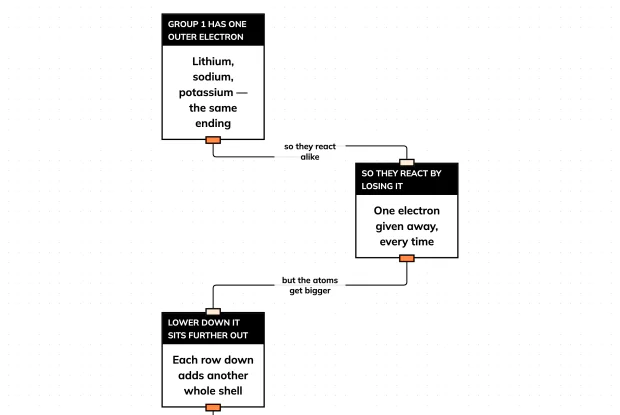
Lithium fizzes, sodium darts about, potassium bursts into flame — and all three have exactly one outer electron. Follow the argument that explains the difference, in an interactive playground.
Why Does Group 7 Get Less Reactive Down the Group?
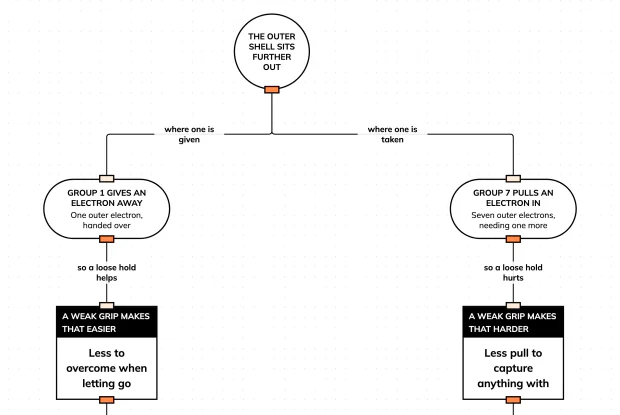
Group 1 gets more reactive going down and group 7 gets less, for exactly the same reason. Work out why one trend runs backwards, in an interactive playground.
What Makes a Transition Metal Different?
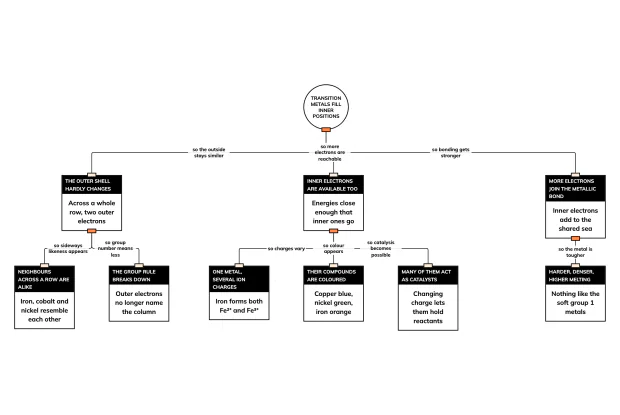
Iron is nothing like sodium, and the periodic table’s simple group rule does not work on the middle block. Find the one fact that explains all of it, in an interactive playground.
Which Family Does an Element Belong To?
Given how an unknown element behaves, work out which part of the periodic table it came from — and why "it is coloured" is the one clue that means two different things. An interactive playground.
Why Were the Noble Gases Found Last?
Argon makes up almost one per cent of the air and nobody noticed it until 1894. Follow the weighing that gave it away, in an interactive playground.