What Makes a Transition Metal Different?
Root Concept
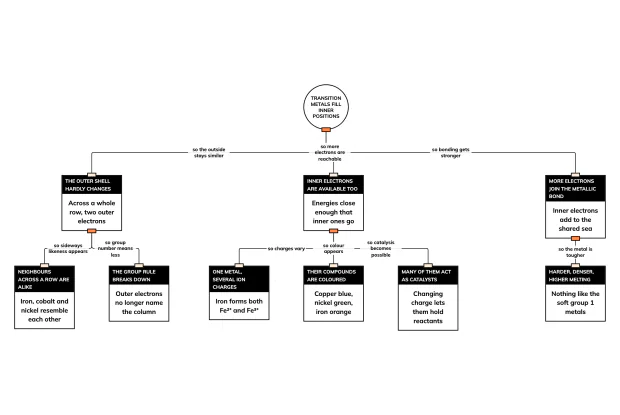
Transition metals fill an inner set of electron positions rather than the outer shell, so their outer arrangement barely changes across a row and inner electrons are also available — which is why they form ions of several different charges, make coloured compounds, act as catalysts, and are far harder and denser than group 1 metals.
CodePLU Goal
Upgrading Human Mental Models
Learn how to think in Workflows

Concept Development By codeplu.com
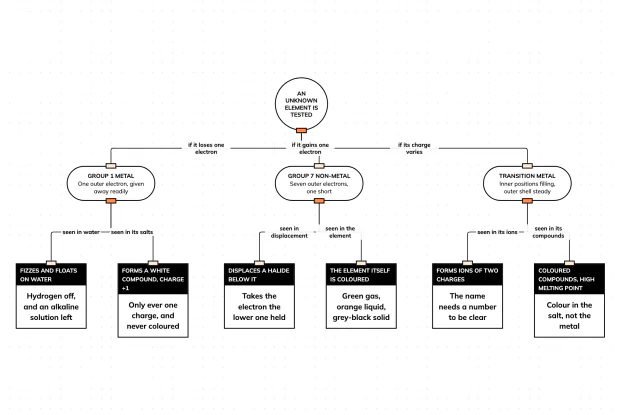
None of the five results leads to any of the others. They are separate consequences of one structural fact, which is why they are drawn side by side rather than in a line.
The Block the Simple Rule Misses
The periodic table tutorial set out a clean rule: an element’s group number tells you how many electrons are in its outer shell, and that is why elements in a column behave alike. Then it admitted the rule has a hole in it. The wide block in the middle of the table — iron, copper, nickel, chromium, and the rest — does not obey it, and the tutorial said so rather than stretching the rule to cover them. This is the tutorial that was promised.
That these elements are different is obvious before any theory. Iron is hard, dense and melts at over 1500 °C; sodium is soft enough to cut with a knife and melts in hot water. Copper compounds are blue, nickel compounds green, chromium compounds can be orange or green depending on what you have done to them, while almost every group 1 compound is white. Iron forms two different ions, Fe²⁺ and Fe³⁺, where sodium only ever forms Na⁺.
Four oddities, and it would be reasonable to expect four separate explanations. There is one. All of it follows from where the electrons are going as you move across the block: into an inner set of positions rather than into the outer shell.
That is why the board above fans out instead of running in a line. Nothing here causes anything else on the same level — the colour does not cause the catalysis and neither causes the hardness. They are parallel consequences of one fact.
Following Each Consequence
Where do the electrons actually go?
Into a set of positions that sits beneath the outer shell rather than in it. Going across the middle block from scandium to zinc, each successive element adds one more electron, but those electrons are filling an inner level while the outer shell stays at two electrons for nearly the whole row. Compare that with going across the top of the table, where each step adds an electron to the outer shell itself and the element’s behaviour changes completely from one to the next. In the middle block the outside of the atom is barely changing, so the chemistry barely changes either — which is exactly backwards from how the rest of the table works.
Why do they form ions with different charges?
Because the inner level being filled is close enough in energy to the outer shell that electrons from it can also be lost. Sodium can only lose its single outer electron; going any further would mean breaking into a full shell, which takes far more energy than any ordinary reaction supplies. An iron atom can lose two outer electrons to give Fe²⁺, or two outer and one inner to give Fe³⁺, and the difference between those two is small enough that both happen readily. That is why iron compounds have to be named with the charge stated — iron(II) sulfate and iron(III) sulfate are genuinely different substances. A name without the number does not say which one you have.
Why are the compounds coloured?
Because a partly filled inner level gives electrons somewhere to move to that costs only a small amount of energy, and the amounts involved happen to match visible light. When white light passes through a copper sulfate solution, the energy that matches that small gap is absorbed and the rest comes through, which is why the solution looks blue. Scandium and zinc sit at the two ends of the block and their common ions have either no electrons or a completely full set in that level, with no partly filled arrangement available — and their compounds are white, which is the test the explanation has to pass. An explanation that predicted colour for every element in the block would be describing a coincidence rather than a cause.
Why are they so much harder than group 1 metals?
Because more electrons are contributed to the metallic bonding. The metals tutorial described a metal as positive ions sitting in a sea of electrons that are free to move, with the attraction between the two holding the structure together. A sodium atom contributes one electron to that sea; a transition metal atom can contribute several, because the inner level is available. More shared electrons and more highly charged ions mean a much stronger attraction, which is what hardness, density and a high melting point are all measuring. It is also why these are the metals civilisation builds with, and why no group 1 metal has ever been used for anything structural. The difference is not small: iron melts at over 1500 °C and sodium at under a hundred.
Real World Example
Three Things Only This Block Does
The uses that transition metals are chosen for are almost all traceable to one of the branches on the board above.
Step 1
Iron catalyses the Haber process; sodium catalyses nothing
A catalyst has to hold reactant molecules on its surface firmly enough to weaken their bonds and loosely enough to let the product go, and an element that can shift between charges can do exactly that. The equilibrium track described iron weakening the nitrogen triple bond in an ammonia reactor. Nickel does the same job for hydrogen added to vegetable oils, and vanadium for sulfuric acid manufacture. All three are transition metals, and that is not a coincidence about those particular elements. The ability to shift charge is what a catalytic surface needs, and this block is where it is found.
Step 2
Rust is orange, verdigris is green, and that tells you something
The colour of a corroded metal is a usable clue to what has happened to it. Iron gives an orange-brown oxide, copper weathers to a distinctive green, and a chromium compound changing from orange to green in a test tube is a standard sign that its charge has been reduced. Colour in a transition metal compound is a readout of the inner level, which is why analytical chemistry leans on it so heavily and why group 1 compounds, being white, tell you nothing this way. A white powder gives up far less about its own history.
Step 3
Bridges are built from iron, not from potassium
The structural metals of the modern world — iron and its alloys, titanium, chromium in stainless steel, tungsten in a drill bit — are all from the middle block, and none of the group 1 metals could hold up anything at all. Potassium is soft, melts below the temperature of a hot drink and reacts with the moisture in air. The difference is the number of electrons each atom puts into the metallic bonding, which is the third branch of the board and has nothing to do with the first two. Hardness, colour and catalysis are three independent consequences, not three faces of one property.
FAQs
Final Words
The group rule works because, across the main blocks, each step adds an electron to the outer shell and changes the element’s behaviour with it. Across the middle block that is not what happens. The electrons go into an inner set of positions while the outer shell stays almost constant, and everything unusual here comes from that.
The outer shell barely changing is why neighbours across a row resemble each other and why the column number stops meaning much. The inner level being reachable is why one metal forms ions of several charges, why its compounds are coloured, and why so many work as catalysts. And the extra electrons available for metallic bonding are why these are the hard, dense metals everything structural is built from. Four oddities, one cause — and the test of it is scandium and zinc, which form white compounds like any ordinary metal.
The next tutorial turns the track round: given how something behaves, which family does it belong to?
Continue This Track
This concept is part 3 of Families in the Periodic Table.
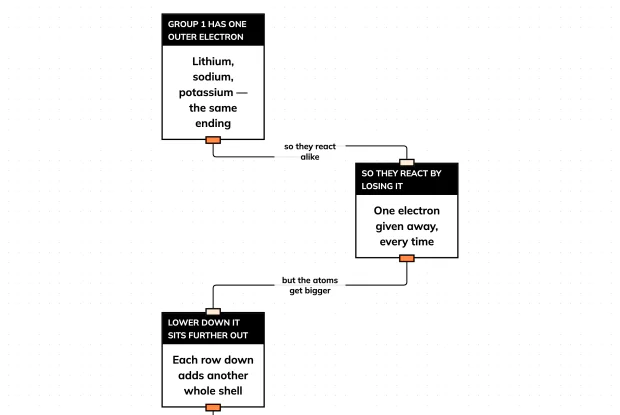
Why Does Group 1 Get More Reactive Down the Group?
Lithium fizzes, sodium darts about, potassium bursts into flame — and all three have exactly one outer electron. Follow the argument that explains the difference, in an interactive playground.
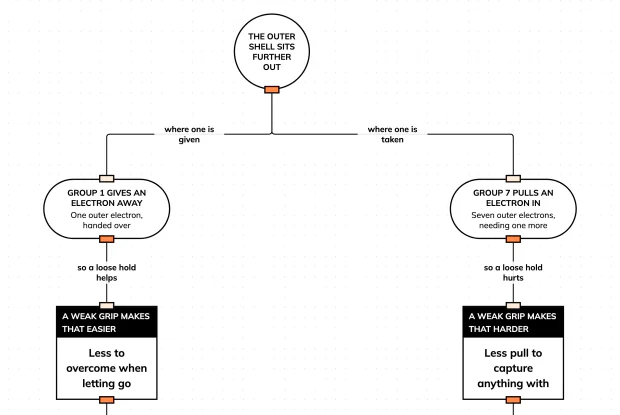
Why Does Group 7 Get Less Reactive Down the Group?
Group 1 gets more reactive going down and group 7 gets less, for exactly the same reason. Work out why one trend runs backwards, in an interactive playground.
What Makes a Transition Metal Different?
Iron is nothing like sodium, and the periodic table’s simple group rule does not work on the middle block. Find the one fact that explains all of it, in an interactive playground.
Which Family Does an Element Belong To?
Given how an unknown element behaves, work out which part of the periodic table it came from — and why "it is coloured" is the one clue that means two different things. An interactive playground.
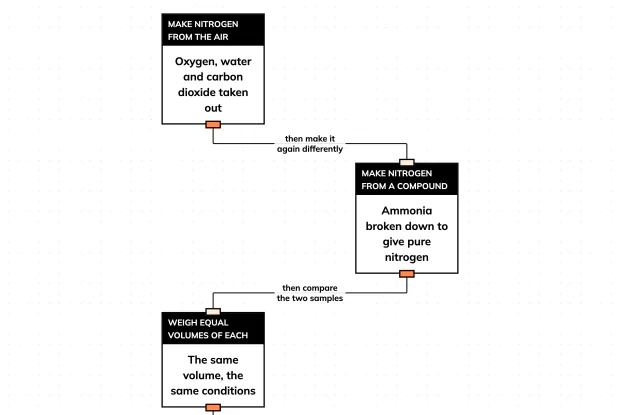
Why Were the Noble Gases Found Last?
Argon makes up almost one per cent of the air and nobody noticed it until 1894. Follow the weighing that gave it away, in an interactive playground.