Which Family Does an Element Belong To?
Root Concept
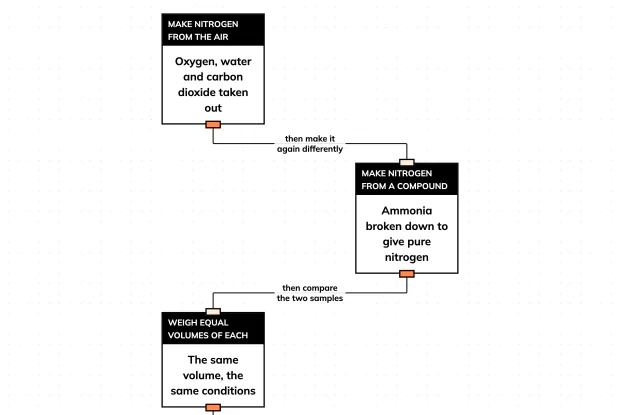
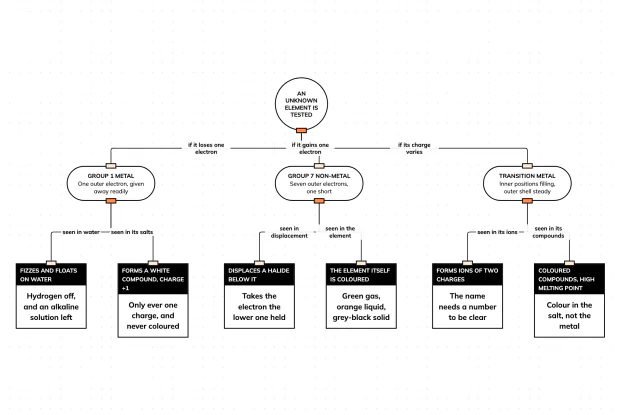
An element can be placed in its family from its behaviour: reacting with water and forming a single positive charge points to group 1, displacing a halide below it points to group 7, and forming ions of more than one charge with coloured compounds points to the transition metals.
CodePLU Goal
Upgrading Human Mental Models
Learn how to think in Workflows

Concept Development By codeplu.com
Two of the six boxes mention colour, under different families. Reading only the word and not what is coloured is the trap this board sets.
Working Backwards From Behaviour
Everything so far in this track has run forwards: start from where an element sits in the table, and work out how it will behave. That is the useful direction for predicting. It is not the direction a chemist actually works in, because what arrives on the bench is a substance, and the question is what it is.
So this tutorial runs the argument the other way. Given a set of observations — it fizzes in water, it is a coloured gas, its compounds need a number in their names — which family does the element come from? Each of the three families met in this track leaves a distinctive mark, and the marks are distinctive precisely because the families differ in what they do with electrons.
Group 1 gives an electron away, so it reacts eagerly with water and always ends up with a single positive charge. Group 7 takes an electron in, so it can strip one from a halide lower down the group and the elements themselves are coloured. Transition metals have inner electrons available as well, so they form more than one charge and their compounds are coloured.
That last pair is where the sorting gets interesting. Both group 7 and the transition metals can be described as "coloured", and a learner who records only that word has thrown away the distinction. One is a coloured element; the other is a colourless-looking metal with coloured compounds. The board above puts both on it deliberately.
Reading Each Kind of Clue
What does a reaction with water tell you?
A great deal, because very few elements react with cold water at all. If a metal fizzes on the surface of water, releases hydrogen and leaves a solution that turns an indicator blue or purple, it is almost certainly from group 1. A transition metal will not do this — iron needs water and oxygen together and takes weeks, and copper does nothing at all. The violence of the reaction then places it within the group: a gentle fizz points to the top, and a reaction that sets its own hydrogen alight points to potassium or below. So one observation gives both the family and a rough position inside it.
How does the charge on the ion narrow it down?
Sharply, because the number of available charges is a direct readout of where the electrons are. An element that only ever forms a 1+ ion is from group 1, since it has one outer electron to lose and no realistic way to reach any further. An element that forms a 1− ion is from group 7, having taken one in to complete its shell. And an element that forms ions of more than one charge is from the middle block, because that is the only place where an inner level sits close enough in energy to be reached as well. A compound whose name carries a Roman numeral is announcing its family.
Why is "it is coloured" an ambiguous clue?
Because it does not say what is coloured, and the two families it could mean are coloured in different places. Chlorine is a green gas, bromine a red-brown liquid and iodine a grey-black solid — the group 7 elements themselves carry the colour, while their compounds with group 1 metals are white powders. The transition metals are the exact reverse: the metal looks like any other metal, silvery or in copper’s case reddish, and the colour appears in the compounds. So the clue has to be recorded as "the element is coloured" or "the compound is coloured", and those point in opposite directions. Where the colour sits is the whole clue, and the word on its own is nearly useless.
What does a displacement test establish?
It places an element relative to another one rather than naming it outright, which is often more useful. If adding an unknown solution to potassium bromide releases bromine, the unknown must be a halogen above bromine, so chlorine or fluorine. If adding an unknown metal to copper sulfate coats it in copper, the unknown is a metal above copper in the reactivity series. Neither test identifies the element on its own, but each puts a firm boundary around it, and two boundaries from two directions usually leave only one candidate standing. This is how the reactivity series was built in the first place: not by measuring anything absolute, but by running enough pairs against each other that only one order fitted them all.
Real World Example
Three Unknowns on the Bench
In each case the element is never named until the end, and every step is an observation anybody could make.
Step 1
A soft metal that floats and fizzes
A sample is soft enough to cut with a knife and the cut surface is bright before dulling within seconds. A small piece placed on water floats, fizzes steadily and dissolves away, and the water afterwards turns universal indicator purple. The compound it forms with chlorine is a white solid in which it carries a charge of plus one. Floating, fizzing, a single positive charge and a white compound together place it in group 1, and the gentleness of the fizz places it near the top — this is lithium. Nothing in that sequence required knowing the element in advance; the name arrives at the end as a conclusion.
Step 2
A red-brown liquid that attacks a colourless salt
The element is a dense red-brown liquid that gives off a choking vapour, which already says it is not a metal. Added to a colourless potassium iodide solution it turns the solution brown, so it has taken electrons from the iodide ions and set iodine free. Added to potassium chloride it does nothing. Being coloured as an element, and displacing one halide while failing against another, places it in group 7 between chlorine and iodine — this is bromine. The failure against chloride is as informative as the success against iodide, because it sets the upper bound the other test could not.
Step 3
A hard metal whose two salts are different colours
The metal is hard, dense and melts far too high to measure on a school burner, and it does nothing in cold water. Two different sulfates can be made from it: one pale green, the other yellow-brown, and the second can be made from the first. Forming more than one charge rules out both group 1 and group 7, and coloured compounds from a colourless-looking metal is the signature of the middle block — this is iron, as iron(II) and iron(III). The two sulfates being interconvertible is the detail that clinches it, since a group 1 metal has no second charge to convert to.
FAQs
Final Words
Running the periodic table backwards is the direction it gets used in. A substance arrives without a label, and each family leaves distinctive marks, because families differ in what they do with electrons. Fizzing on cold water and a single positive charge means group 1. Stripping a halide of its electrons means group 7. Ions of more than one charge means the middle block, which a Roman numeral in a compound’s name announces outright.
The clue needing care is colour, because it belongs to two families in two different places. The group 7 elements are coloured themselves and form white compounds; the transition metals look ordinary and put the colour in their compounds. Recording only "coloured" throws the distinction away. And the real reason these tests work is that each tests what the element does with an electron, which is the fact the family is defined by.
The last part asks the hardest version: can the table describe an element nobody has ever seen?
Continue This Track
This concept is part 4 of Families in the Periodic Table.
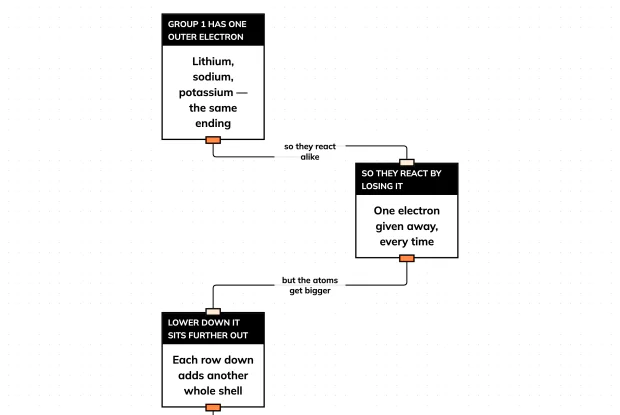
Why Does Group 1 Get More Reactive Down the Group?
Lithium fizzes, sodium darts about, potassium bursts into flame — and all three have exactly one outer electron. Follow the argument that explains the difference, in an interactive playground.
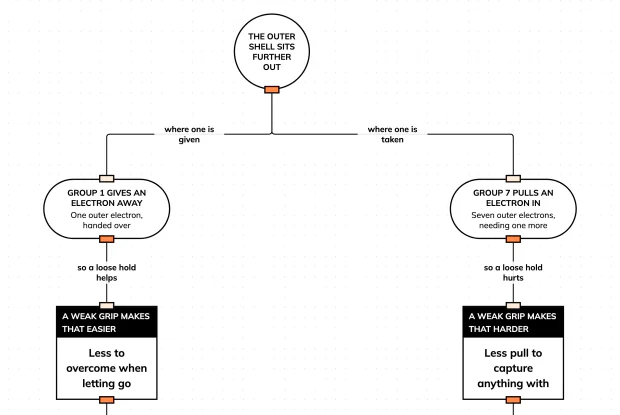
Why Does Group 7 Get Less Reactive Down the Group?
Group 1 gets more reactive going down and group 7 gets less, for exactly the same reason. Work out why one trend runs backwards, in an interactive playground.
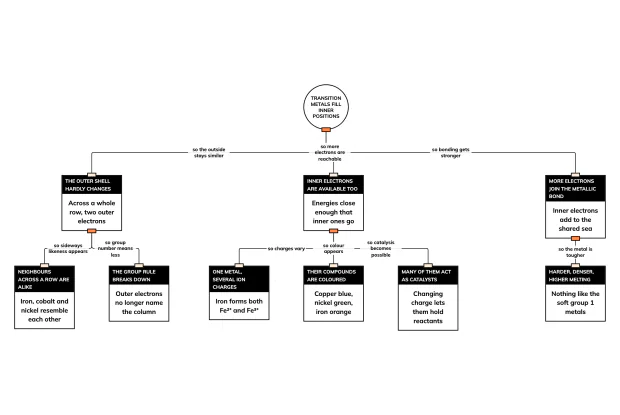
What Makes a Transition Metal Different?
Iron is nothing like sodium, and the periodic table’s simple group rule does not work on the middle block. Find the one fact that explains all of it, in an interactive playground.
Which Family Does an Element Belong To?
Given how an unknown element behaves, work out which part of the periodic table it came from — and why "it is coloured" is the one clue that means two different things. An interactive playground.
Why Were the Noble Gases Found Last?
Argon makes up almost one per cent of the air and nobody noticed it until 1894. Follow the weighing that gave it away, in an interactive playground.