Why Does Group 1 Get More Reactive Down the Group?
Root Concept
Every group 1 metal reacts by losing its single outer electron, and going down the group that electron sits in a shell further from the nucleus with more full shells screening it, so it is held more weakly and given up more easily — which is why reactivity increases down the group.
CodePLU Goal
Upgrading Human Mental Models
Learn how to think in Workflows

Concept Development By codeplu.com
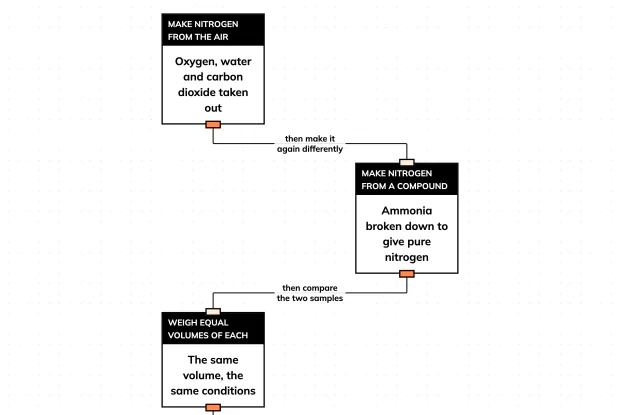
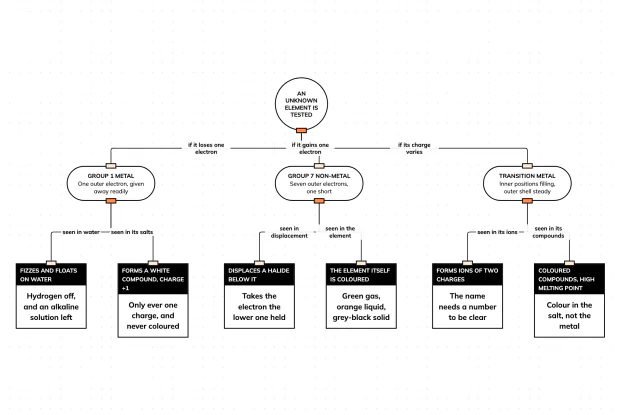
The first two steps are the same for all three metals. Only the steps below them change, which is why the difference has to come from there.
Same Electron, Very Different Reactions
Drop a small piece of lithium into water and it fizzes gently and floats about. Do the same with sodium and it melts into a ball and darts across the surface. Do it with potassium and the hydrogen it produces catches fire, usually with a lilac flame. Three metals from the same column of the periodic table, behaving in three noticeably different ways — and the further down the column you go, the more dramatic it gets.
That is awkward, because the reason they are in one column is that they are alike. The periodic table puts them together because each has exactly one electron in its outer shell, and that single fact is what makes them all react the same way: by giving that electron away. Lithium, sodium and potassium all form ions with a charge of plus one, all react with water to give hydrogen and an alkaline solution, all produce the same kind of compound.
So if the outer electron is identical in all three, it cannot be what makes potassium so much more violent than lithium. Something else has to be changing as you go down, and whatever it is must affect how easily that electron is lost rather than how many there are.
There are two such things, and they work together: the electron sits further from the nucleus in each successive element, and more full shells get in the way of the pull.
Working the Argument Through
Why does the outer electron not settle it?
Because it is the same in every member of the group, and a quantity that does not change cannot explain a difference. Lithium has one outer electron, sodium has one, potassium has one, and so does every element below them. If having one outer electron were the whole story, all of group 1 would react with water equally hard — and the demonstration shows plainly that they do not. This is a general move worth keeping: when two things differ, the explanation has to be something that also differs. What the shared outer electron explains is the part that is shared, which is that all of them react in the same WAY. How hard they react is a separate question with a separate answer.
What actually changes going down the group?
The size of the atom. Each step down the periodic table adds a whole new shell, so the outer electron of potassium sits in the fourth shell while sodium’s is in the third and lithium’s is in the second. The nucleus is positive and the electron is negative, so they attract — but the strength of that attraction falls off sharply with distance. An electron in an outer shell that is further away is simply not pulled on as hard. The nucleus of potassium does carry more positive charge than lithium’s, which would pull harder, and that is why the next step matters: something is cancelling most of that extra charge out.
What does shielding add to the argument?
It explains why the growing nuclear charge does not win. Between the outer electron and the nucleus sit all the full inner shells, and those electrons are negative too, so they repel the outer one and screen it from the full pull of the nucleus. Potassium has three full shells in the way; lithium has one. So although potassium’s nucleus holds nineteen protons against lithium’s three, the outer electron does not feel nineteen protons’ worth of attraction — most of it is cancelled by the electrons in between. The net pull reaching the outermost electron stays roughly similar down the group, while the distance keeps growing, so distance wins. That is the step most explanations leave out, and without it the growing nuclear charge looks like it should win the argument.
Why does a weakly held electron react harder?
Because the reaction IS the loss of that electron. When a group 1 metal meets water, the metal atom gives its outer electron up and becomes a positive ion in solution, while the water is broken down to hydrogen gas and hydroxide ions. Anything that makes the electron easier to remove makes that happen faster and release its energy more quickly. With lithium the heat comes out slowly enough to be carried away by the water. With potassium it comes out fast enough to ignite the hydrogen being produced right there at the surface, which is why the flame appears without anybody lighting it. The products are identical in all three cases; only the pace at which the energy arrives has changed.
Real World Example
The Three Metals in Water, in Order
The classroom demonstration is really one experiment repeated, and what escalates between the repeats is the one thing the argument predicts.
Step 1
Lithium: fizzes steadily and stays in one piece
A piece of lithium floats and gives off hydrogen in a steady stream of bubbles, and it stays solid throughout. The reaction is real and the solution left behind is alkaline enough to turn an indicator, but the energy comes out slowly enough that the water carries it away without the metal even melting. Lithium’s outer electron sits in the second shell with only one full shell shielding it, so it is the most tightly held of the three and the hardest to take. Of the three, this is where the argument above does the least work, and it is the one that looks least like a hazard.
Step 2
Sodium: melts into a ball and shoots about
Sodium reacts fast enough that the heat released melts the metal itself, which is why it collapses into a sphere, and the hydrogen streaming off one side pushes it around the surface. Everything about the chemistry is the same as lithium’s — same products, same charge on the ion, same alkaline solution — and only the pace has changed. The outer electron now sits a shell further out with two full shells screening it, so it leaves more readily. Sodium is the usual teaching example precisely because it sits in the middle: visibly more energetic than lithium, and still containable.
Step 3
Potassium: the hydrogen catches fire by itself
With potassium the energy arrives fast enough to ignite the hydrogen as it is produced, and the flame burns lilac because of the potassium ions in it. Nobody applies a spark; the reaction supplies its own. The outer electron is now in the fourth shell with three full shells between it and the nucleus, which is as loosely held as any of the three — and the demonstration usually stops here, because rubidium and caesium below it are violent enough to be genuinely dangerous. That is itself worth noticing — the trend does not stop at the bottom of the demonstration, it stops where the apparatus does.
FAQs
Final Words
Every group 1 metal reacts the same way, by giving away its single outer electron, and that shared electron is exactly why it cannot explain why potassium is so much more violent than lithium. An explanation of a difference has to be something that differs. Two things do, and they both point the same way: each step down the group puts the outer electron in a shell further from the nucleus, and adds another full shell between the two to screen the pull.
So the net attraction holding that electron weakens going down, even though the nucleus is gaining protons, because the inner electrons cancel most of the extra charge. A weakly held electron is an easily lost one, and since losing it is the reaction, losing it more easily means reacting harder. The next tutorial runs the same two arguments on a group that gains an electron instead of losing one, and gets the opposite answer.
Continue This Track
This concept is part 1 of Families in the Periodic Table.
Why Does Group 1 Get More Reactive Down the Group?
Lithium fizzes, sodium darts about, potassium bursts into flame — and all three have exactly one outer electron. Follow the argument that explains the difference, in an interactive playground.
Why Does Group 7 Get Less Reactive Down the Group?
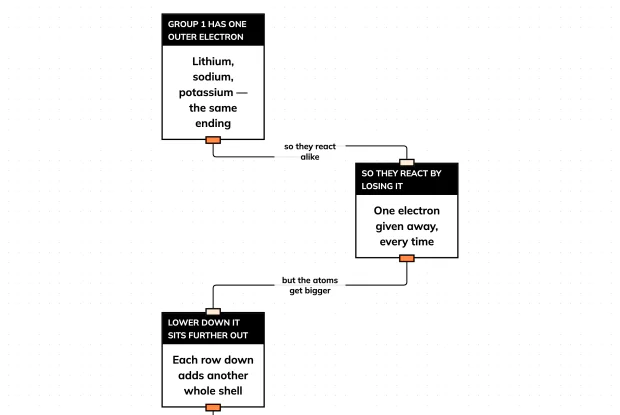
Group 1 gets more reactive going down and group 7 gets less, for exactly the same reason. Work out why one trend runs backwards, in an interactive playground.
What Makes a Transition Metal Different?
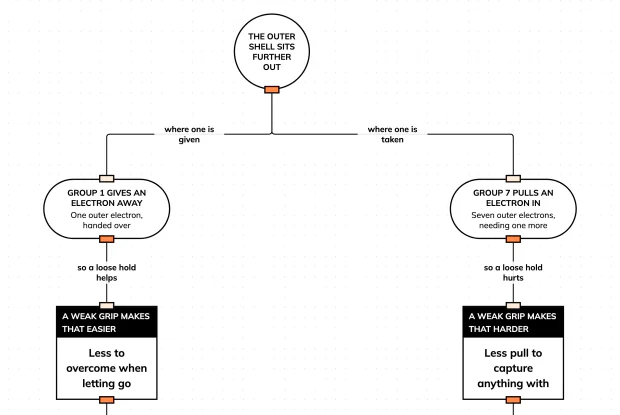
Iron is nothing like sodium, and the periodic table’s simple group rule does not work on the middle block. Find the one fact that explains all of it, in an interactive playground.
Which Family Does an Element Belong To?
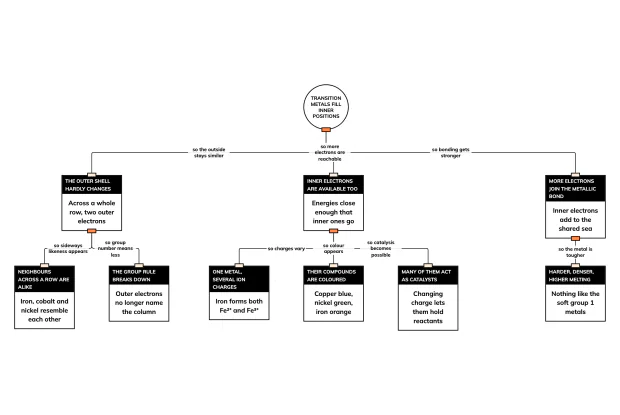
Given how an unknown element behaves, work out which part of the periodic table it came from — and why "it is coloured" is the one clue that means two different things. An interactive playground.
Why Were the Noble Gases Found Last?
Argon makes up almost one per cent of the air and nobody noticed it until 1894. Follow the weighing that gave it away, in an interactive playground.