Why Does Group 7 Get Less Reactive Down the Group?
Root Concept
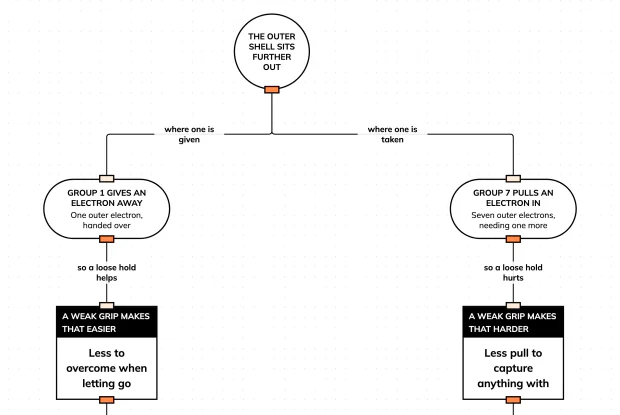
Group 7 elements react by pulling an electron in, so the weakening grip that makes group 1 more reactive down the group makes group 7 less reactive — the same cause helps an atom that gives an electron away and hinders one that has to capture one.
CodePLU Goal
Upgrading Human Mental Models
Learn how to think in Workflows

Concept Development By codeplu.com
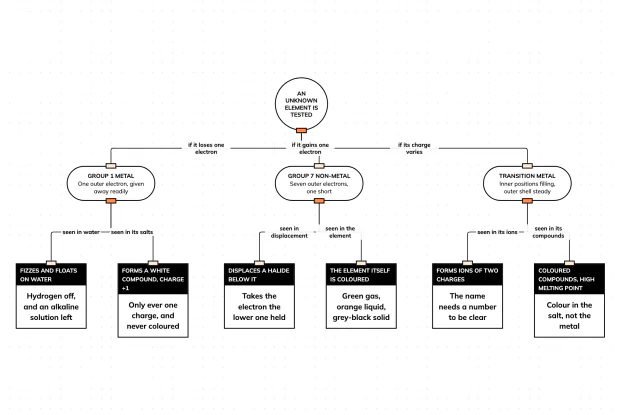
Both branches start from the same fact. Crossing them over is the mistake this tutorial exists to prevent.
One Cause, Two Opposite Trends
Group 7 — fluorine, chlorine, bromine, iodine — are the halogens, and they are the mirror image of group 1. Where a group 1 atom has one outer electron too many for a full shell, a halogen has seven and is one short. So where group 1 reacts by giving an electron away, group 7 reacts by taking one in, and the two groups react with each other enthusiastically for exactly that reason.
The previous tutorial showed that going down group 1 makes the elements more reactive, because the outer electron sits further from the nucleus with more full shells shielding it, so it is held weakly and lost easily. Every word of that applies to group 7 as well. Iodine’s outer shell is further out and better shielded than fluorine’s, in exactly the way potassium’s is further out than lithium’s.
And yet group 7 runs the other way: fluorine is the most reactive of the lot and reactivity falls steadily down to iodine. That is not a second rule overriding the first. It is the same rule reaching a different conclusion, because the two groups are doing opposite things with their electrons.
A weak grip is help if you are trying to let go of something and a hindrance if you are trying to grab something. That single sentence is the whole tutorial, and the board above is built so that crossing the two branches over gives you the version most people remember wrongly.
Following Both Branches
What does a halogen actually do in a reaction?
It completes its outer shell by acquiring one more electron, either by taking one outright from a metal to become a negative ion, or by sharing a pair with another non-metal. Chlorine reacting with sodium takes the sodium atom’s loose outer electron and becomes a chloride ion with a charge of minus one. That is the opposite movement to group 1 in every sense: the metal is the one giving and the halogen is the one receiving, the metal ends up positive and the halogen negative. Because the direction of the electron is reversed, anything that helps one side will hinder the other, and that is where the trend turns round.
Why does distance hinder rather than help here?
Because the halogen needs to pull an incoming electron in, and the pull has to reach out to wherever the outer shell is. In fluorine that shell is very close to the nucleus with only one full shell in the way, so an arriving electron feels a strong attraction. In iodine the outer shell is four shells out with a great deal of shielding in between, so the same electron feels far less. Fluorine is therefore greedy for an electron and iodine is comparatively indifferent — and since acquiring one is the reaction, being indifferent about it means reacting less readily. Fluorine is so greedy for that electron that it reacts with almost everything, including materials that resist every other chemical attack.
How do you see the trend without a reaction with metals?
By making the halogens compete with each other, which is the displacement experiment the reactions track introduced. Add chlorine water to a colourless solution of potassium bromide and the solution turns orange, because the chlorine has taken the electrons off the bromide ions and set bromine free. Do the reverse — bromine added to a chloride solution — and nothing happens at all. The more reactive halogen always wins the electron, so the pattern of which displaces which puts the whole group in order, and the order it gives runs down the group from fluorine. It is also a trend you can watch happen rather than one you have to be told.
What is the mistake this prevents?
Remembering that reactivity increases down a group, full stop. It does for group 1 and for the metals generally, and a learner who has only met metals will carry it across to group 7 and get every halogen question backwards. The fix is not a second fact to memorise alongside the first — two opposing rules are harder to keep straight than one. The fix is to hold the cause rather than the trend: the grip weakens going down in every group, and then ask whether this element is trying to lose an electron or gain one. The trend follows from the answer. One question answered correctly beats two rules remembered in the wrong order.
Real World Example
Three Displacement Tests in Order
Each test puts one halogen against another halogen’s ion, and the colour that appears says which of the two wanted the electron more.
Step 1
Chlorine added to potassium bromide turns it orange
The solution starts colourless, and the orange that appears is bromine set free. Chlorine has taken an electron from each bromide ion, becoming chloride, while the bromide ions become bromine molecules. Chlorine sits above bromine in the group, so its outer shell is closer in and less shielded, and it pulls the electron harder. Nothing about this test involves a metal at all — the comparison is purely between two halogens, which is what makes it a clean reading of the group trend. The potassium is a spectator throughout and takes no part in the change.
Step 2
Bromine added to potassium iodide turns it brown
The same result one step further down. Bromine takes the electrons off the iodide ions and iodine is released, giving a brown colour that darkens as more forms. So bromine beats iodine, just as chlorine beat bromine, and the three are now in order without any reference to the theory. This is the part worth noticing: the ranking is an experimental result, and the shielding argument is the explanation offered for it rather than the evidence for it. The tests would rank the halogens identically for someone who had never heard of a shell. That independence is what makes it evidence at all.
Step 3
Iodine added to potassium chloride does nothing
No colour change, no reaction, nothing. Iodine cannot take an electron off a chloride ion, because chlorine holds its electrons far more strongly than iodine could ever pull. The absence of a reaction is as informative as the two reactions above it — a displacement series only means something if the reverse genuinely fails, and a test where nothing happens is what establishes that the order runs one way only. A series in which everything displaces everything would rank nothing at all, and would mean the halogens did not differ in the way claimed. The nothing is the result here.
FAQs
Final Words
Group 7 gets less reactive down the group for precisely the reason group 1 gets more reactive, which is why the two are so easy to confuse. In both groups the outer shell moves further out with each step down and more full shells get in the way, so the grip weakens. The cause is identical. What differs is what the atom is trying to do with an electron.
A group 1 atom is trying to let one go, and a weakening grip makes that easier, so reactivity rises. A group 7 atom is trying to pull one in, and a weakening grip makes that harder, so reactivity falls. Hold the cause rather than either trend and neither can be got backwards. The displacement tests confirm the order experimentally: chlorine takes bromine’s electrons, bromine takes iodine’s, and iodine takes nothing from either.
The next tutorial turns to the block in the middle, where the rule that a group is its outer electrons stops working.
Continue This Track
This concept is part 2 of Families in the Periodic Table.
Why Does Group 1 Get More Reactive Down the Group?
Lithium fizzes, sodium darts about, potassium bursts into flame — and all three have exactly one outer electron. Follow the argument that explains the difference, in an interactive playground.
Why Does Group 7 Get Less Reactive Down the Group?
Group 1 gets more reactive going down and group 7 gets less, for exactly the same reason. Work out why one trend runs backwards, in an interactive playground.
What Makes a Transition Metal Different?
Iron is nothing like sodium, and the periodic table’s simple group rule does not work on the middle block. Find the one fact that explains all of it, in an interactive playground.
Which Family Does an Element Belong To?
Given how an unknown element behaves, work out which part of the periodic table it came from — and why "it is coloured" is the one clue that means two different things. An interactive playground.
Why Were the Noble Gases Found Last?
Argon makes up almost one per cent of the air and nobody noticed it until 1894. Follow the weighing that gave it away, in an interactive playground.