Why Do We Classify Living Things?
Root Concept
A useful classification groups organisms by shared ancestry, which makes it predictive rather than merely tidy.
CodePLU Goal
Upgrading Human Mental Models
Learn how to think in Workflows

Concept Development By codeplu.com
A grouping earns its place by predicting something. One that only matches appearance predicts nothing at all.
Filing, or Something More Useful?
There are somewhere around two million named species and almost certainly several times that number still unnamed. Faced with a list that long, the obvious reaction is that somebody had better organise it, and that is how classification is usually introduced — as tidying up, a librarian's job applied to life.
That explanation undersells it badly. A filing system is judged by whether you can find things in it. A classification is judged by something much stronger: whether knowing which group an organism belongs to lets you predict things about it that you have not looked at. Tell a biologist that an unfamiliar animal is a mammal and they will correctly expect a four-chambered heart, a diaphragm, milk and hair, without having seen the animal.
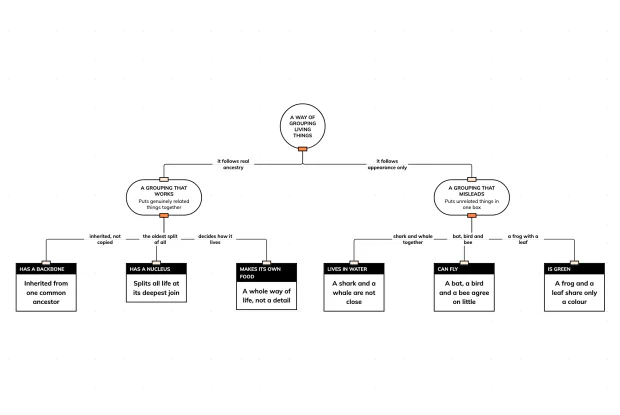
That only works if the groups reflect real ancestry rather than appearance. Group by "lives in water" and you have put a shark with a whale, which predicts nothing, because the two arrived at that shape separately. The playground below asks you to separate the criteria that make a real group from the ones that only make a tidy one.
What Makes a Grouping Worth Having
What is a classification actually for?
Prediction, more than storage. Once organisms are grouped by genuine relatedness, a fact discovered in one member of a group is a reasonable guess about the rest, and that is what makes the system worth the effort of building. It also makes communication possible: a biologist in one country can describe a specimen to another in a way that carries real information rather than a rough impression. And it gives new discoveries somewhere to go — when an unfamiliar organism is found, the question "where does this fit?" is answerable, and the answer immediately suggests what else to look for in it. A grouping that supports none of that is just a list with headings.
Why does appearance mislead so often?
Because unrelated organisms facing the same problem often arrive at the same solution. A shark is a fish and a dolphin is a mammal, and their last common ancestor was neither; they both look streamlined because water punishes anything that is not, not because they inherited the shape from the same place. The same goes for flight, which has been invented separately by insects, birds and bats. When two organisms share a feature because each evolved it independently, grouping them by it tells you nothing more than that they share a problem. The word for that resemblance is convergence, and sorting it out from genuine inheritance is most of a taxonomist's work.
What makes a feature a good one to classify by?
Being inherited from a common ancestor, and being deep rather than superficial. Having a backbone is a good criterion because every vertebrate got it from the same ancestral line, and it comes bundled with a great deal else. Having a nucleus is an even better one, because it marks the oldest and deepest division in all of life, as an earlier track described. How an organism feeds — making its own food, absorbing it, or eating it — is good in the same way: it is not a detail but a whole way of living, which shapes everything else about the organism. Colour is the opposite: easy to see, inherited from nowhere in particular, and changeable.
Does the system ever change?
Constantly, and that is a sign of health rather than confusion. Classification is a claim about ancestry, so every improvement in the evidence can revise it — and the evidence improved enormously when it became possible to compare DNA directly rather than argue from anatomy. Several groups that looked obvious have been broken up, and organisms have been moved between kingdoms. A classification is therefore a current best account rather than a finished catalogue, which is worth knowing before meeting the five kingdoms later in this track: that scheme is itself a revision, and it has been revised again since. Being told a scheme is provisional is not a weakness of the subject but the ordinary condition of any science.
Real World Example
Why a Whale Is Not a Fish
A whale lives in the sea, is shaped like a fish and swims like one. Nearly every visible feature says fish, and the classification says mammal — and the classification is right in a way that pays off.
Step 1
Everything obvious says fish
A whale is streamlined, has flippers and a tail fin, spends its whole life in water and is enormous. Every one of those is shared with a large fish, and for most of history whales were grouped with fish for exactly that reason. The resemblance is not an illusion — it is real, and it has a real cause. Moving efficiently through water imposes much the same demands on any large animal, so bodies converge on the same shape regardless of where they started. Appearance is reporting the environment accurately; it just is not reporting ancestry at all.
Step 2
The hidden features say mammal
A whale breathes air through lungs and must surface to do it. It is warm blooded, gives birth to live young and feeds them on milk. It has hair, at least as an embryo. Its flipper contains the same arrangement of bones as a human arm — upper arm, two forearm bones, wrist, five digits — rearranged but unmistakably inherited. None of those is visible from a distance, and every one of them is a feature passed down rather than invented in response to the sea. Taken together they place a whale firmly among animals that were living on land not very long ago.
Step 3
The right grouping predicted the fossils
Classifying whales as mammals is not merely a tidier answer; it makes claims that could have failed. It predicts land-living ancestors with legs, and fossils of exactly those have since been found, with hind limbs shrinking across a series of species. It predicts close genetic kinship with hoofed land mammals, which DNA comparison confirmed, placing whales surprisingly near hippos. A classification based on appearance would have predicted none of that and would have been quietly wrong forever, with nothing in it capable of exposing the error. That is the practical difference between a grouping that reflects history and one that reflects a glance.
FAQs
Final Words
Classification is not filing. A grouping earns its place by letting you predict things about an organism you have never examined, and that only works when the groups reflect genuine shared ancestry. Features that are inherited and deep — a backbone, a nucleus, how an organism feeds — make real groups. Features that are superficial or arrived at independently make tidy nonsense.
That is why a whale is a mammal despite looking like a fish, and why the grouping was able to predict fossils that had not yet been found. It is also why the system keeps changing: every classification is a claim about history, and claims get revised when the evidence improves. The next tutorial takes the structure those claims are written in — the ladder of ranks from kingdom down to species.
Continue This Track
This concept is part 1 of Sorting the Living World.
Why Do We Classify Living Things?
Classification is not filing. A grouping based on shared ancestry lets you predict things about an organism you have never examined, while one based on appearance tells you nothing. Sort six criteria in an interactive playground.
Kingdom to Species: the Ladder of Names
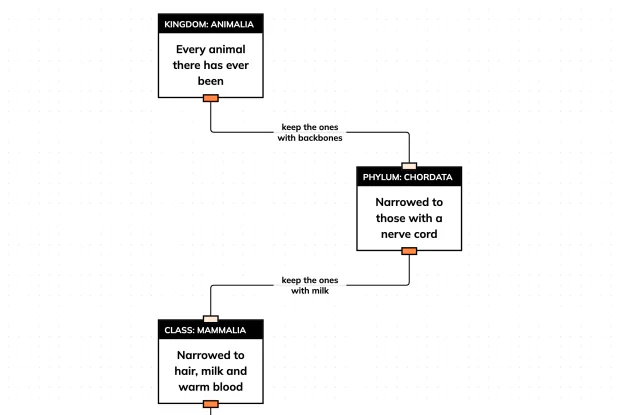
Classification is a set of nested groups running from kingdom down to species, each rung smaller and more closely related than the last. Follow all seven for a human in an interactive playground.
Why Does Every Species Get Two Names?
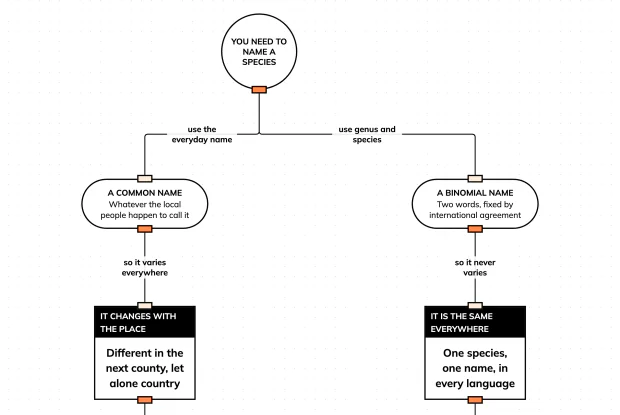
Every species has a two-word scientific name: the genus first, then the species. It is the same in every country and it carries the organism's group with it. Compare the two naming systems in an interactive playground.
The Five Kingdoms, and What Separates Them
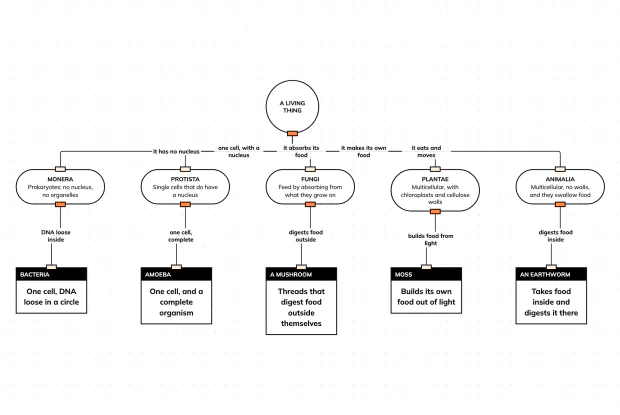
All life was long divided into five kingdoms, separated by whether cells have a nucleus, whether the organism is one cell or many, and how it obtains food. Place five organisms in an interactive playground.
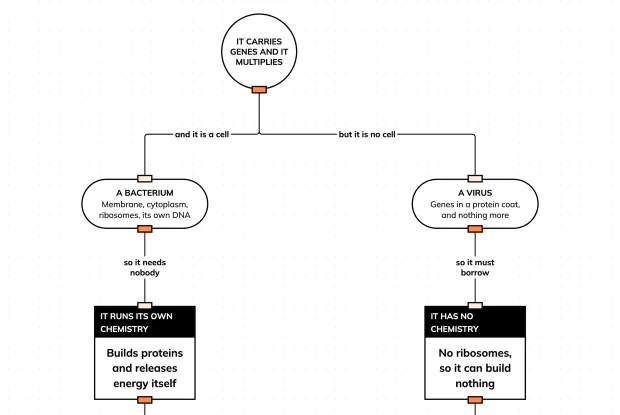
Where Does a Virus Fit? It Does Not
A virus is genetic material in a protein coat with no cell, no ribosomes and no chemistry of its own. It fits none of the five kingdoms, and whether it is alive depends on where you draw the line. Compare it with a cell in an interactive playground.