Kingdom to Species: the Ladder of Names
Root Concept
Classification is a nested hierarchy of seven ranks, each one a smaller and more closely related group than the one above.
CodePLU Goal
Upgrading Human Mental Models
Learn how to think in Workflows

Concept Development By codeplu.com
Each rung is contained in the one above it. Going down never adds anything; it only narrows what is left.
Groups Inside Groups
The last tutorial argued that a grouping is worth having when it reflects real ancestry. This one is about the structure those groupings are arranged in, which is not a flat list of categories but a set of boxes inside boxes.
That nesting is the part worth getting straight, because it is what makes the system work. Every species sits inside a genus, every genus inside a family, and so on up to kingdom — and nothing is ever in two boxes at the same level. Going down the ladder never introduces anything new; it only narrows what is left, and each step leaves a group whose members share more with each other than the step above did.
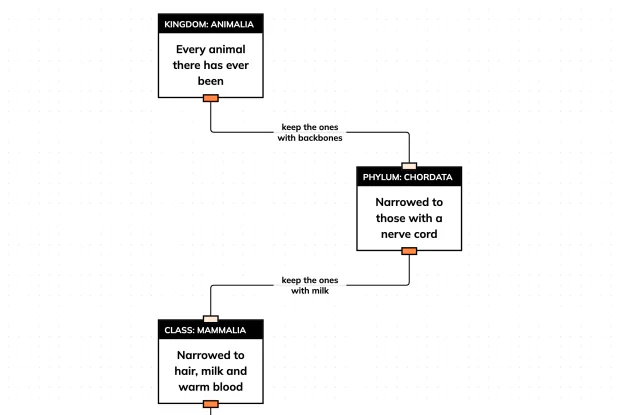
There are seven ranks in the traditional scheme, and the standard illustration is to run a familiar organism all the way down. The playground below does that for a human: starting from every animal that has ever lived and ending, seven steps later, at one species. The arrows say what each step throws away, which is more instructive than the names themselves.
The Seven Rungs, and What Each One Narrows
What are the seven ranks?
Kingdom, phylum, class, order, family, genus, species — in that order from largest to smallest. Most people meet them as a list to memorise and a mnemonic to remember the order by, which is fine as far as it goes, but it hides what the list is. These are not seven separate filing cabinets. They are seven sizes of the same kind of thing: a group of organisms believed to share an ancestor. A kingdom is an enormous group with a very distant common ancestor; a species is the smallest group, whose members share an ancestor so recent that they can still breed together. Everything between is a step along that scale.
What does each step actually do?
It discards everything that does not share the next feature. Starting with the animal kingdom, choosing the phylum Chordata keeps those with a nerve cord down the back and discards insects, worms, jellyfish and the rest — the overwhelming majority of animals, at a stroke. Choosing the class Mammalia then keeps the ones with hair and milk, discarding fish, reptiles, birds and amphibians. Each rung is the same operation applied to a smaller starting set, and because the features used are inherited, every narrowing is a statement about ancestry rather than about convenience. The group left at the bottom is the one most recently descended from a single population, and the most closely related as a result.
What exactly is a species?
The usual working definition is a group whose members can breed together and produce fertile offspring. It is the only rank with a test attached that does not depend on judgement, which is part of why it is treated as the real unit and the others as useful constructs. The definition is not watertight — it says nothing useful about bacteria, which do not breed in pairs at all, nor about organisms known only as fossils — and biologists argue about the edges constantly. For the organisms a school course deals with it works well, and the fertile part matters: a horse and a donkey produce a mule, which is healthy and sterile, so they remain two species.
Is seven ranks the whole story?
No, and it is worth knowing that before meeting a textbook that adds one. Modern schemes usually place a domain above kingdom, splitting all life three ways into Bacteria, Archaea and Eukarya, which reflects a division discovered only when genetic comparison became possible. Working taxonomists also insert intermediate levels — subphylum, superfamily, and others — wherever the evidence demands more resolution than seven steps allow. The seven are the backbone of the system and the ones examined, and they are a simplification of a scheme that is deeper than this wherever anyone has looked closely. Knowing that the seven are a backbone rather than the whole structure prevents a good deal of confusion later.
Real World Example
Running a Domestic Cat Down the Same Ladder
Doing a second organism makes the structure clearer than any amount of explanation, because the interesting question is where the two paths separate.
Step 1
The first three rungs are shared
A cat is in the kingdom Animalia, the phylum Chordata and the class Mammalia, which are exactly the first three rungs a human occupies. That is not a coincidence or an approximation: it is the claim that humans and cats share an ancestor that already had a nerve cord, hair and milk, and that everything descended from it inherits those. Three rungs down, the two are still in the same box, and anything true of all mammals is true of both — a four-chambered heart, a diaphragm, and the rest of the standard mammal package.
Step 2
They part at the order
The fourth rung is where the paths separate. A human is in the order Primates — grasping hands, forward-facing eyes, large brains — and a cat is in the order Carnivora, with the teeth and gut of a meat eater. From here on the two ladders have nothing further in common, and the point at which two organisms stop sharing a rung is a direct statement about how long ago their lines split. Parting at the order means a more distant relationship than parting at the family would, because the shared ancestor is that much further back.
Step 3
Down to Felis catus
The cat continues through the family Felidae, which is all the cats including lions and tigers, then the genus Felis, which is the small cats, and finally the species catus. Its full name is therefore Felis catus, against Homo sapiens for us. A lion is Panthera leo — same family, different genus — which tells you at a glance that a lion is further from a domestic cat than two members of Felis are from each other. The names carry the relationships with them, which is the subject of the next tutorial and the reason the system uses two words rather than one.
FAQs
Final Words
Classification is nested rather than flat: kingdom, phylum, class, order, family, genus, species, each one contained entirely within the one above it. Going down never adds anything — it discards whatever does not share the next inherited feature, so every step leaves a smaller group whose members share a more recent ancestor.
Species is the rank with a real test attached, membership meaning the ability to breed and produce fertile offspring, which is why a horse and a donkey stay separate despite producing a mule. And where two organisms stop sharing a rung is a direct statement about how long ago their lines split. The next tutorial takes the bottom two rungs, genus and species, and shows why those two in particular became an organism's name.
Continue This Track
This concept is part 2 of Sorting the Living World.
Why Do We Classify Living Things?
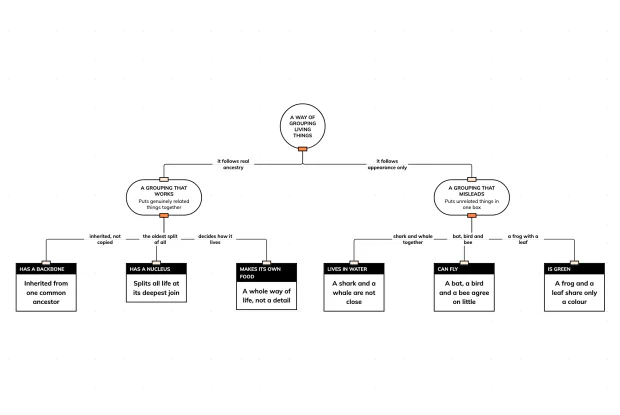
Classification is not filing. A grouping based on shared ancestry lets you predict things about an organism you have never examined, while one based on appearance tells you nothing. Sort six criteria in an interactive playground.
Kingdom to Species: the Ladder of Names
Classification is a set of nested groups running from kingdom down to species, each rung smaller and more closely related than the last. Follow all seven for a human in an interactive playground.
Why Does Every Species Get Two Names?
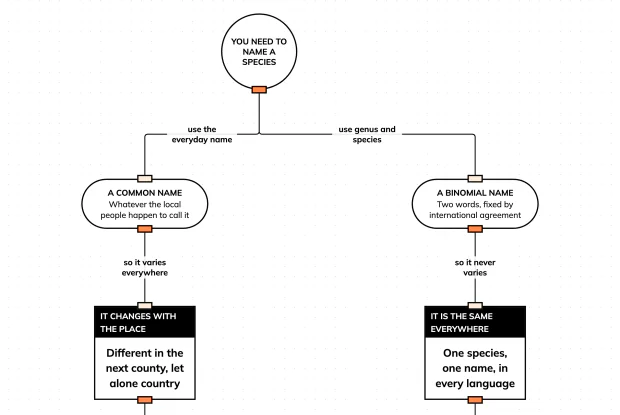
Every species has a two-word scientific name: the genus first, then the species. It is the same in every country and it carries the organism's group with it. Compare the two naming systems in an interactive playground.
The Five Kingdoms, and What Separates Them
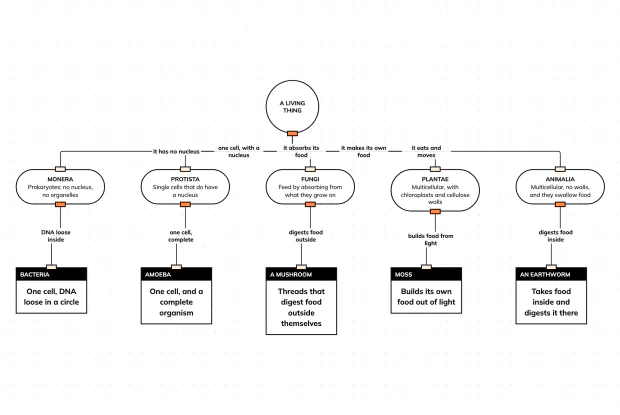
All life was long divided into five kingdoms, separated by whether cells have a nucleus, whether the organism is one cell or many, and how it obtains food. Place five organisms in an interactive playground.
Where Does a Virus Fit? It Does Not
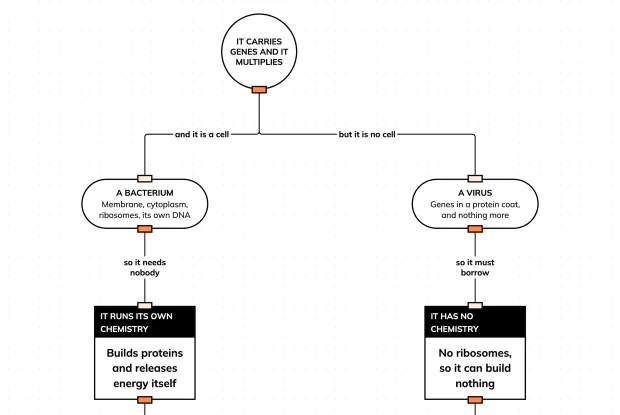
A virus is genetic material in a protein coat with no cell, no ribosomes and no chemistry of its own. It fits none of the five kingdoms, and whether it is alive depends on where you draw the line. Compare it with a cell in an interactive playground.