The Five Kingdoms, and What Separates Them
Root Concept
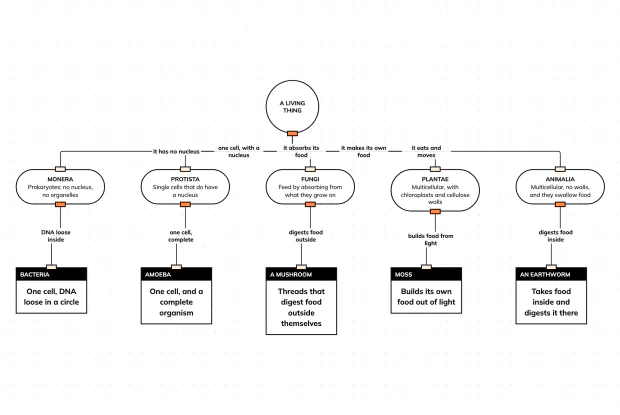
The five kingdoms are separated by whether cells have a nucleus, whether the organism is unicellular or multicellular, and how it obtains food.
CodePLU Goal
Upgrading Human Mental Models
Learn how to think in Workflows

Concept Development By codeplu.com
Each kingdom is defined by an answer, not by appearance. A mushroom is not a plant because of how it feeds.
Dividing All of Life Five Ways
For a long time the answer to "what kinds of living things are there?" was two: plants and animals. Anything that moved and ate was an animal, anything that did not was a plant, and fungi and bacteria were quietly filed with the plants for want of anywhere better.
That stopped being tenable once microscopes showed what cells are actually like. A mushroom turned out to have nothing important in common with a plant: no chloroplasts, no cellulose wall, and a completely different way of feeding. A bacterium turned out to lack a nucleus altogether, which is a deeper difference than any between a daisy and an elephant. In 1969 Robert Whittaker proposed five kingdoms instead of two, and that is the scheme most school courses still teach.
What makes it worth learning is that the divisions are not arbitrary. Three questions about an organism settle almost every case: does its cells have a nucleus, is it one cell or many, and how does it get its food. The playground below asks you to follow each of the five kingdoms down to an organism that belongs in it.
The Three Questions, and the Five Answers
Which question comes first?
Whether there is a nucleus, because it is the deepest split in all of life. Organisms whose cells have no nucleus and no membrane-bound organelles are prokaryotes, and in this scheme they form a kingdom of their own called Monera: bacteria and their relatives, and nothing else. Everything in the other four kingdoms is a eukaryote. That first division is far more fundamental than the difference between a plant and an animal, which is a point worth sitting with — two bacteria can be more different from one another than a mushroom is from a whale, and an earlier track in this subject set out exactly why having no compartments changes so much.
How do the remaining four divide?
By two further questions. Among eukaryotes, the ones that live as single cells are put in Protista — amoeba, paramecium and a great many others, each a complete organism in one cell. The multicellular remainder is then split by how it feeds, which is the question that finally separates the three familiar kingdoms. Plants make their own food from light. Fungi absorb food from whatever they are growing on, by releasing digestive chemicals outwards and taking the products back in. Animals take food inside themselves and digest it there. Three ways of eating, three kingdoms, and the method of feeding turns out to shape everything else. The way an organism feeds shapes its whole chemistry.
Why is a mushroom not a plant?
Because it feeds like nothing a plant does. Fungi were grouped with plants for centuries on the reasoning that they do not move, which is exactly the kind of superficial criterion the first tutorial in this track warned against. A fungus has no chloroplasts and makes no food at all; its walls are built of chitin, the material of an insect shell, rather than cellulose; and it digests outside its own body before absorbing the result. By the three questions that matter it has almost nothing in common with a plant, and genetic evidence has since shown fungi to be closer to animals than to plants. It is as clear a case as biology offers of appearance pointing the wrong way.
Is five kingdoms still the current answer?
Not among working biologists, though it remains the standard school scheme and is what examinations ask for. Genetic comparison revealed that Monera is really two profoundly different groups, Bacteria and Archaea, separated by a gulf older than the one between plants and animals — which is why most modern schemes use three domains above the kingdoms. Protista has also turned out to be a collection of unrelated lineages grouped mainly by what they are not. None of that makes the five-kingdom scheme useless: it is a good first map, and knowing it is provisional is part of understanding it. Every map is simpler than the ground it describes, and knowing where a map is approximate is part of reading it well.
Real World Example
Three Things Growing on a Dead Log
A rotting log in a wood carries organisms from at least three kingdoms within a few centimetres of each other, and the three questions separate them cleanly.
Step 1
The green cushion is a plant
Moss growing on the top of the log is multicellular, its cells have nuclei, and they are packed with chloroplasts making food from the light that reaches the woodland floor. Cellulose walls hold it up. By every one of the three questions it is a plant, and it is using the log only as somewhere to sit — it takes nothing from the wood itself. Moss has no proper roots or vascular tissue, which is why it stays low and damp, but none of that affects which kingdom it belongs to. The three questions never ask about size or shape at all.
Step 2
The bracket fungus is eating the log
The shelf-shaped growth on the side is the fruiting body of a fungus whose real bulk is a network of threads running through the wood. It has no chloroplasts and makes nothing; it releases enzymes into the log, digests the timber where it lies, and absorbs the sugars released. That is absorption rather than ingestion, and it puts the organism in Fungi regardless of how plant-like it looks sitting still. It is also the reason the log is rotting at all. It is also why the log will eventually collapse into the soil beneath it.
Step 3
The slime is bacteria, with no nucleus at all
The film in the damp crevices is largely bacterial — single cells, each with its DNA loose in a circle and no nucleus anywhere. That places them in Monera before any question about feeding is even asked, because the first question has already been answered. They are also doing much of the decomposition alongside the fungus. Three kingdoms, one log, and the differences between them are invisible until you ask about the cells rather than the appearance. That habit is what this whole track is trying to build, because appearance is the least reliable guide biology has.
FAQs
Final Words
Five kingdoms, separated by three questions. Do the cells have a nucleus? Organisms that do not are Monera. Among those that do, is the organism one cell or many? Single cells are Protista. And of the multicellular remainder, how does it feed? Making its own food gives Plantae, absorbing it gives Fungi, and taking it inside to digest gives Animalia.
None of those is about appearance, which is why a mushroom is not a plant despite sitting still and why bacteria are separated from everything else before feeding is even considered. The scheme is also provisional: Monera has since been split in two and Protista has turned out not to be a real group at all. The last tutorial in this track takes the thing that fits none of the five.
Continue This Track
This concept is part 4 of Sorting the Living World.
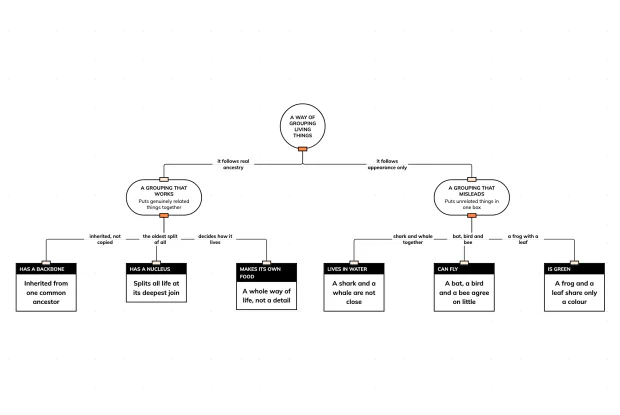
Why Do We Classify Living Things?
Classification is not filing. A grouping based on shared ancestry lets you predict things about an organism you have never examined, while one based on appearance tells you nothing. Sort six criteria in an interactive playground.
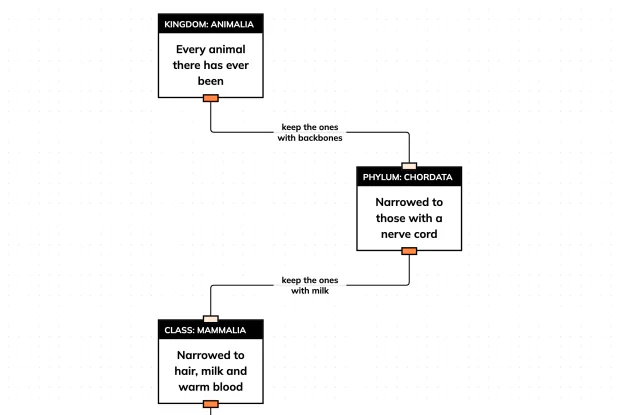
Kingdom to Species: the Ladder of Names
Classification is a set of nested groups running from kingdom down to species, each rung smaller and more closely related than the last. Follow all seven for a human in an interactive playground.
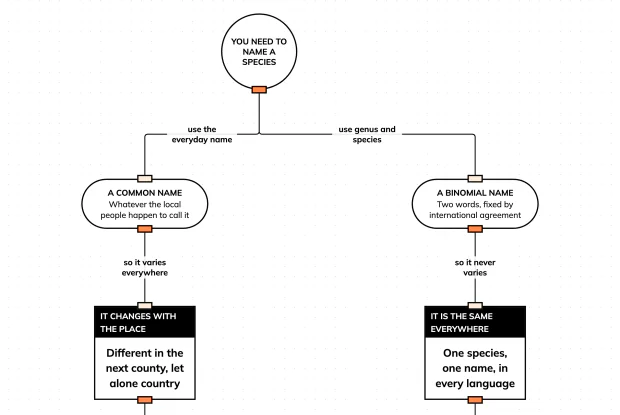
Why Does Every Species Get Two Names?
Every species has a two-word scientific name: the genus first, then the species. It is the same in every country and it carries the organism's group with it. Compare the two naming systems in an interactive playground.
The Five Kingdoms, and What Separates Them
All life was long divided into five kingdoms, separated by whether cells have a nucleus, whether the organism is one cell or many, and how it obtains food. Place five organisms in an interactive playground.
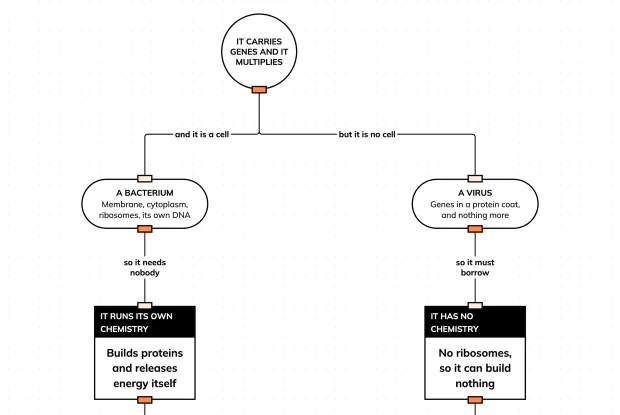
Where Does a Virus Fit? It Does Not
A virus is genetic material in a protein coat with no cell, no ribosomes and no chemistry of its own. It fits none of the five kingdoms, and whether it is alive depends on where you draw the line. Compare it with a cell in an interactive playground.