Sorting the Living World
Classification is usually introduced as tidying up, which undersells it badly. A filing system is judged by whether you can find things in it; a classification is judged by whether knowing an organism's group lets you predict things you have not looked at. That only works when the groups reflect real ancestry rather than appearance — which is why grouping by "lives in water" puts a shark with a whale and predicts nothing, and why classifying whales as mammals predicted land-living ancestors that were later dug up. The track then takes the structure those claims are written in: seven nested ranks from kingdom down to species, each one contained entirely within the one above, where going down never adds anything and only discards whatever does not share the next inherited feature. Species is the one rank with a real test attached, which is why a horse and a donkey stay separate despite producing a mule. The bottom two rungs turn out to be an organism's name: a binomial is identical in every country, which removes the ambiguity of everyday names — a robin is two unrelated birds depending on where you are standing — and its first word is a genus, so the name quietly carries a claim about relatedness. From there the track returns to the top and divides all cellular life five ways using three questions about cells: nucleus or not, one cell or many, and how it feeds. None of those is about appearance, which is why a mushroom is not a plant. It closes on the thing the scheme has no box for, because the first question assumes a cell and a virus is not one.
CodePLU Goal
Upgrading Human Mental Models
Learn how to think in Workflows
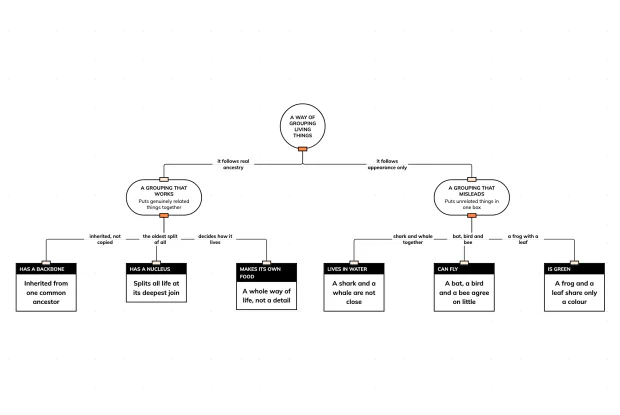
Why Do We Classify Living Things?
Classification is not filing. A grouping based on shared ancestry lets you predict things about an organism you have never examined, while one based on appearance tells you nothing. Sort six criteria in an interactive playground.
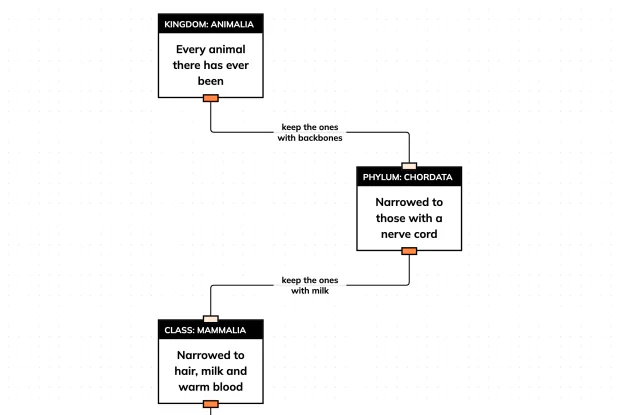
Kingdom to Species: the Ladder of Names
Classification is a set of nested groups running from kingdom down to species, each rung smaller and more closely related than the last. Follow all seven for a human in an interactive playground.
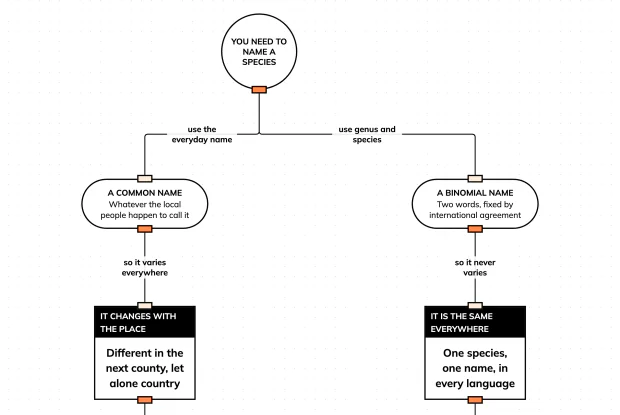
Why Does Every Species Get Two Names?
Every species has a two-word scientific name: the genus first, then the species. It is the same in every country and it carries the organism's group with it. Compare the two naming systems in an interactive playground.
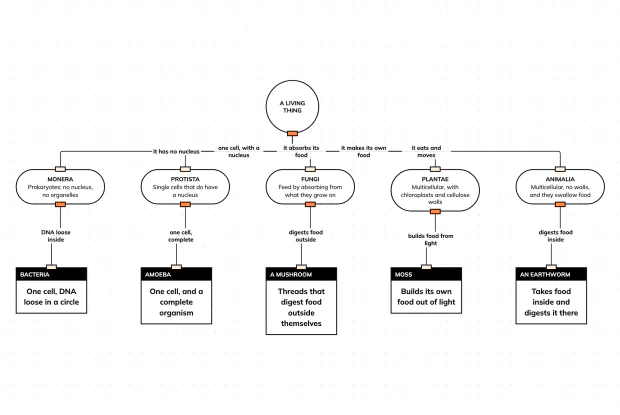
The Five Kingdoms, and What Separates Them
All life was long divided into five kingdoms, separated by whether cells have a nucleus, whether the organism is one cell or many, and how it obtains food. Place five organisms in an interactive playground.
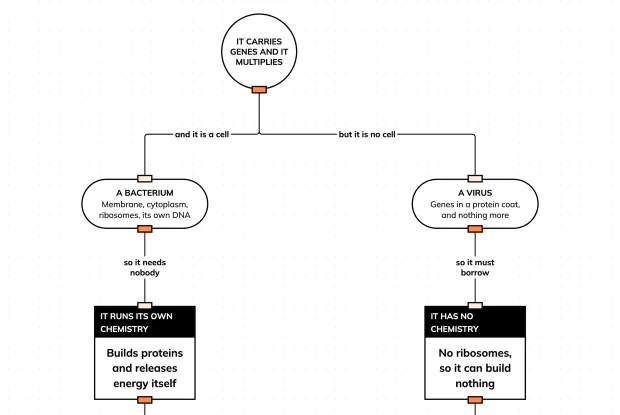
Where Does a Virus Fit? It Does Not
A virus is genetic material in a protein coat with no cell, no ribosomes and no chemistry of its own. It fits none of the five kingdoms, and whether it is alive depends on where you draw the line. Compare it with a cell in an interactive playground.