Where Does a Virus Fit? It Does Not
Root Concept
A virus is not a cell, so it fits no kingdom and only shows the properties of life while inside a host.
CodePLU Goal
Upgrading Human Mental Models
Learn how to think in Workflows

Concept Development By codeplu.com
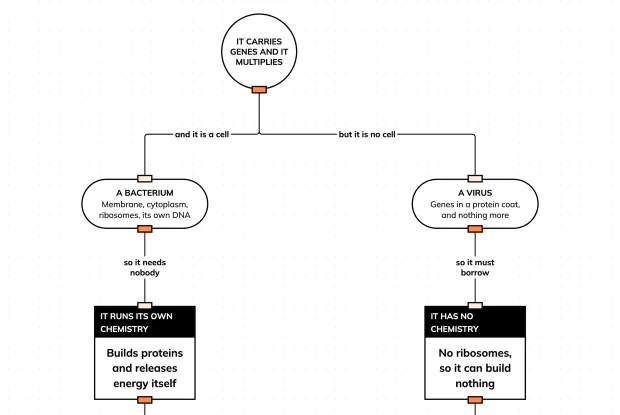
The same starting description leads to opposite answers. Having a cell is what decides it, not being small.
The Thing the System Has No Box For
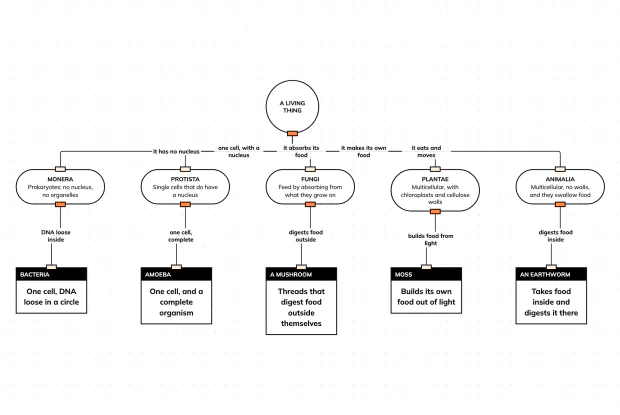
The last tutorial sorted all of life into five kingdoms using three questions about cells. Every one of those questions assumes there is a cell to ask about, and that is where viruses defeat the scheme entirely. A virus has no cell, so the first question has no answer, and the classification simply does not reach it.
This is not a gap waiting to be filled with a sixth kingdom. A virus is genetic material — DNA or RNA — wrapped in a coat of protein, and sometimes a scrap of stolen membrane around that. There is no cytoplasm, no membrane of its own making, no ribosomes and no way of releasing energy. Outside a host it does nothing whatever: it can be dried, crystallised and stored on a shelf like a chemical, which is not something you can do to anything alive.
Inside a host cell it is transformed. It takes over the cell's ribosomes and raw materials and turns them to producing more virus, often hundreds of copies before the cell is destroyed. So it is inert and then explosively active depending only on where it is, and that is why the question of whether a virus is alive has no tidy answer. The playground below puts it beside a bacterium so the difference is exact.
What It Lacks, What It Does, and Where the Line Falls
What is a virus actually made of?
Two things, and occasionally a third. There is a core of genetic material, which may be DNA or RNA — already unusual, since every cellular organism uses DNA — and around it a coat of protein called a capsid, built from repeating identical units that self-assemble into a regular shape. Some viruses add an outer envelope of membrane taken from the last cell they left. That is the complete inventory. A virus carries a handful of genes, sometimes fewer than ten against a bacterium's few thousand, and almost all of them code for either the coat or the tools needed to hijack a host. Nothing in it does any chemistry.
Why can it not reproduce on its own?
Because reproducing means building, and building needs ribosomes. A virus has none. Its genes are instructions for proteins, but instructions are useless without the machinery that reads them, and that machinery exists only inside cells. So a virus must get its genetic material into a host and let the host's ribosomes, enzymes and energy supply do all the work of making copies. The host is not helping in any meaningful sense; its machinery is simply following whatever instructions it is given, and the viral genes are written to look like the right ones. This is total dependence rather than a shortcut. A cell deprived of its surroundings struggles on; a virus does nothing at all.
So is a virus alive?
It depends entirely on which properties you treat as essential, and biologists genuinely disagree. Set out the usual tests for life — movement, respiration, sensitivity, growth, reproduction, excretion, nutrition — and a virus fails almost all of them outside a host and passes several inside one. It has genes, it reproduces, and it evolves by natural selection, which is a strong argument for yes. It carries out no chemistry of its own, does not grow, cannot respond to anything and does nothing at all outside a host, which is a strong argument for no. The honest answer is that life is not a sharply bounded category, and a virus is the clearest case of something sitting on the boundary.
Why does none of this fit a kingdom?
Because the five kingdoms classify cellular life, and the scheme's first division asks whether a cell has a nucleus. A virus is not a cell, so the question is not merely hard to answer — it is the wrong question. Adding a sixth kingdom would not help either, because kingdoms are branches of a shared tree of descent and viruses are not one branch: different groups of them appear to have separate origins, some possibly from fragments of host genetic material that escaped. Viruses are classified, but by a separate system of their own based on what genetic material they carry and how they reproduce. It is a parallel scheme rather than an extension of the kingdoms.
Real World Example
Why a Virus Can Be Kept in a Bottle
In 1935 Wendell Stanley took the virus that damages tobacco plants and treated it like a chemical. What happened next is why the argument about whether viruses are alive has never been settled.
Step 1
It formed crystals
Stanley purified tobacco mosaic virus and obtained needle-like crystals, which could be stored in a bottle on a shelf indefinitely. Crystallising is something that happens to salt and sugar — substances with identical units that stack into a regular lattice — and nothing living had ever done it. The result was a genuine shock, because it suggested that whatever a virus was, it was far closer to a very large and very regular molecule than to even the simplest organism anyone had examined. Nothing living had ever been persuaded to form a lattice. That alone made the result worth a Nobel Prize.
Step 2
The crystals still caused disease
Dissolve the crystals, apply them to a tobacco leaf, and the plants fell ill exactly as before. Nothing had been lost by the treatment. A bacterium put through the same process would be destroyed beyond recovery, because a cell is a working system that cannot be taken apart and reassembled. The virus had been reduced to an inert chemical and had resumed doing the one thing it does the moment it met a cell again, which is behaviour nothing in biology had prepared anyone for. The treatment had destroyed nothing because there was no working system to destroy.
Step 3
Which left the definition in trouble
A thing that sits in a bottle as a crystal for years and then causes an epidemic does not fit comfortably into either category. Stanley received a Nobel Prize for the work, and the question it raised has stayed open ever since. The useful conclusion is not that biologists cannot decide, but that the boundary around life was drawn by people who had never met anything like this — and a definition is a tool rather than a fact about the world, so a case that strains it is telling you about the tool. Viruses sit exactly where the tool stops being sharp.
FAQs
Final Words
A virus is genetic material in a protein coat and nothing else — no cytoplasm, no ribosomes, no chemistry of its own. It cannot build anything, so it cannot reproduce without taking over a cell and using that cell's machinery to make copies of itself. Outside a host it does nothing at all, and can be crystallised and stored in a bottle.
That is why it fits no kingdom: the five-kingdom scheme classifies cellular life and its very first question assumes a cell. Whether a virus is alive has no settled answer, because it carries genes and evolves while failing almost every other test — and the useful lesson is that life is not a sharply bounded category. A definition is a tool, and a case that strains it is telling you about the tool rather than about the case. That closes this track.
Continue This Track
This concept is part 5 of Sorting the Living World.
Why Do We Classify Living Things?
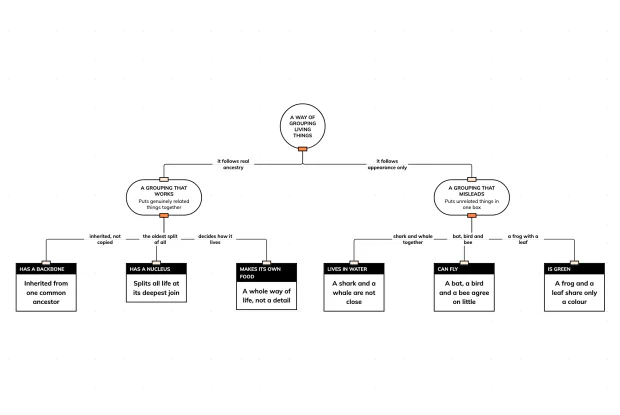
Classification is not filing. A grouping based on shared ancestry lets you predict things about an organism you have never examined, while one based on appearance tells you nothing. Sort six criteria in an interactive playground.
Kingdom to Species: the Ladder of Names
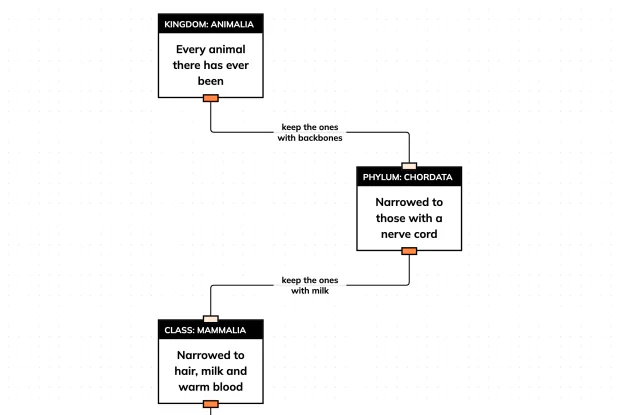
Classification is a set of nested groups running from kingdom down to species, each rung smaller and more closely related than the last. Follow all seven for a human in an interactive playground.
Why Does Every Species Get Two Names?
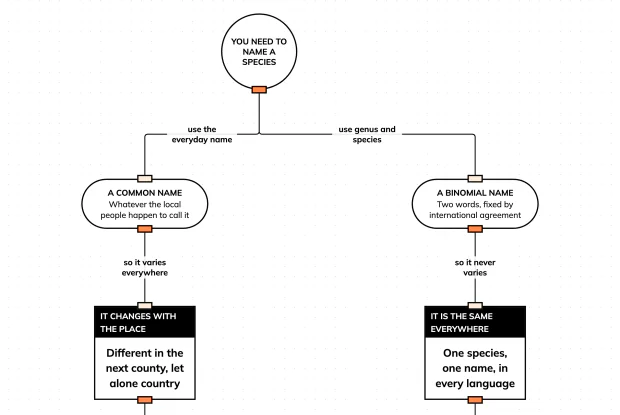
Every species has a two-word scientific name: the genus first, then the species. It is the same in every country and it carries the organism's group with it. Compare the two naming systems in an interactive playground.
The Five Kingdoms, and What Separates Them
All life was long divided into five kingdoms, separated by whether cells have a nucleus, whether the organism is one cell or many, and how it obtains food. Place five organisms in an interactive playground.
Where Does a Virus Fit? It Does Not
A virus is genetic material in a protein coat with no cell, no ribosomes and no chemistry of its own. It fits none of the five kingdoms, and whether it is alive depends on where you draw the line. Compare it with a cell in an interactive playground.