Why Does Every Species Get Two Names?
Root Concept
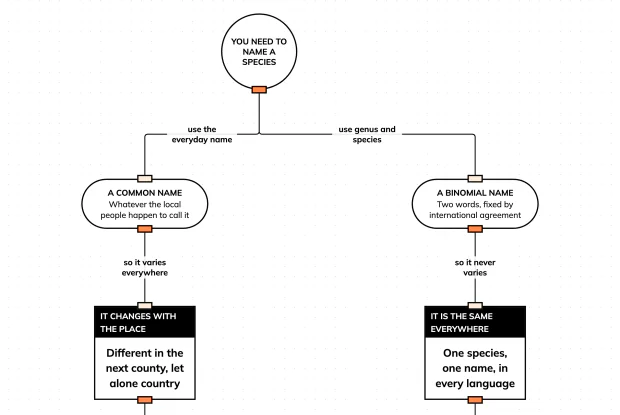
A binomial name gives the genus then the species, so it is unambiguous worldwide and carries the organism's grouping with it.
CodePLU Goal
Upgrading Human Mental Models
Learn how to think in Workflows

Concept Development By codeplu.com
Both routes name the organism. Only one of them also says what it is related to, and means the same thing everywhere.
One Name Is Not Enough
Every species has a scientific name made of two words: Homo sapiens, Felis catus, Panthera leo. The system is nearly three hundred years old, it is used identically in every country, and it is one of the few things in biology that is genuinely standardised worldwide.
It exists because ordinary names are a mess. The same animal has a different name in every language and often several within one language, and the same name is frequently used for completely different organisms in different places. A robin in Britain and a robin in North America are not closely related birds; they are a thrush and a flycatcher that happen to have red fronts. Anything written using those names has to be read with the author's location in mind.
The two-word system fixes that, and it does something extra that is easy to miss. The first word is not a decoration — it is the organism's genus, which is a real rung on the ladder from the last tutorial. So the name is also a statement about relatedness, and two species sharing a first word are being declared close relatives. The playground below follows both routes from the same starting point.
How the System Works, and What the First Word Buys
What are the two words?
The genus first, then the species. In Homo sapiens, Homo is the genus — the small group that includes us and our closest extinct relatives — and sapiens identifies which member of that group. The conventions are strict and examiners enforce them: the genus takes a capital letter, the species does not, and both are written in italics or underlined if handwritten. Once the genus has been given in full it may be abbreviated to its initial afterwards, so H. sapiens is correct on second mention. Writing homo Sapiens or Homo Sapiens is wrong in a way that is easy to avoid and frequently penalised, so it is worth getting into the habit early.
Why not just one unique name?
Because a single arbitrary name would carry no information at all. A system of unique codes would identify species perfectly well and tell you nothing else — and the genus is free information the system might as well deliver. Seeing Panthera leo and Panthera tigris together tells you instantly that lions and tigers are close relatives, without consulting anything. Felis catus does not share that first word, so a domestic cat is in a different genus and therefore further away, though all three are in the family Felidae. Every binomial is quietly carrying one rung of the classification along with it, free of charge, every time it is written down.
Why Latin?
Partly history and partly a genuine advantage. Carl Linnaeus formalised the system in the eighteenth century, when Latin was the common written language of European scholarship, so the choice was obvious at the time. It has been kept for a better reason: Latin belongs to nobody now, which makes it neutral. A system using English names would be awkward for most of the world, and one using several languages would defeat the purpose. The words often describe the organism too — sapiens means wise, and Tyrannosaurus rex means roughly tyrant lizard king — though the rules permit any name at all, so some honour a person or a place instead, and a few are outright jokes.
Who decides on a name?
Whoever first describes the species formally, subject to international rules. The describer publishes a description with a chosen name, and if the publication meets the requirements the name stands. Two separate codes govern it, one for animals and one for plants, and the first validly published name usually wins when two people name the same organism independently. Names do change, which is the one inconvenience of the system: if an organism is moved to a different genus on new evidence, its first word changes with it. That is the system working as intended rather than failing, because the name is a claim about relatedness, and a claim that turns out to be wrong ought to be corrected.
Real World Example
The Trouble With the Word "Robin"
The robin is the clearest demonstration of why common names cannot be trusted, because two famous birds share one and are not close relatives at all.
Step 1
Two birds, one name
The European robin, Erithacus rubecula, is a small round bird with an orange face and chest. The American robin, Turdus migratorius, is much larger, is a thrush, and is closely related to the European blackbird. The two are not in the same genus, the same family or even the same immediate group. They got the same everyday name because homesick settlers in North America saw a bird with a red front and used the name they already had, which is how most such collisions happen: a familiar name is reused for an unfamiliar organism that looks vaguely similar.
Step 2
The confusion is real, not theoretical
A study of "robins" written in one country means something different when read in another, and the difference is not subtle — a bird-feeding observation about a 20-gram insect-eater does not transfer to a 77-gram thrush that pulls worms from lawns. Before scientific names were standardised, exactly this kind of mismatch filled the literature, and sorting out which author meant which organism is still a recognised job for historians of biology working with older texts. Two authors can be describing entirely different animals while appearing to agree with one another perfectly, which is the worst kind of disagreement to have.
Step 3
The binomials settle it in two words
Write Erithacus rubecula or Turdus migratorius and there is nothing left to discuss, in any country or any language. Better still, the second name places the American robin in Turdus, the genus of the blackbirds and true thrushes, so a reader who knows nothing about the bird immediately knows roughly what it is and what else it resembles. The everyday name offered a misleading hint; the scientific name offers an accurate one for free. Two words have done the work of a paragraph of explanation, and done it unambiguously, in any language anywhere on earth.
FAQs
Final Words
Every species has a two-word scientific name: the genus first with a capital letter, then the species in lower case, both italicised. The system is identical worldwide, which removes the ambiguity of everyday names — a robin is two unrelated birds depending on which country you are standing in, and Erithacus rubecula is only ever one of them.
The part worth remembering is that the first word is doing real work. It is a rung on the classification ladder, so a name declares which genus an organism sits in and therefore what it is related to. That is also why names occasionally change: the first word is a claim, and claims get corrected. The next tutorial goes back to the top of the ladder and asks how all of life divides into just five kingdoms.
Continue This Track
This concept is part 3 of Sorting the Living World.
Why Do We Classify Living Things?
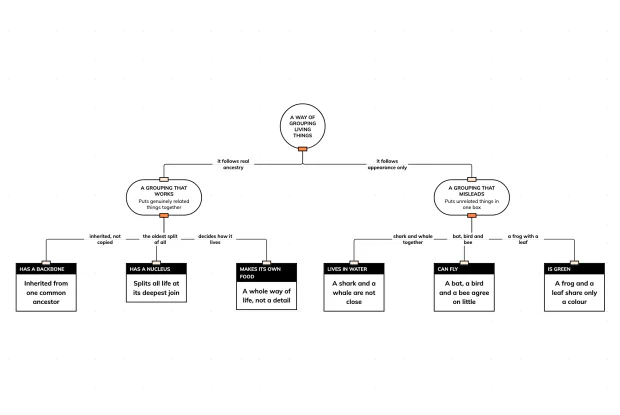
Classification is not filing. A grouping based on shared ancestry lets you predict things about an organism you have never examined, while one based on appearance tells you nothing. Sort six criteria in an interactive playground.
Kingdom to Species: the Ladder of Names
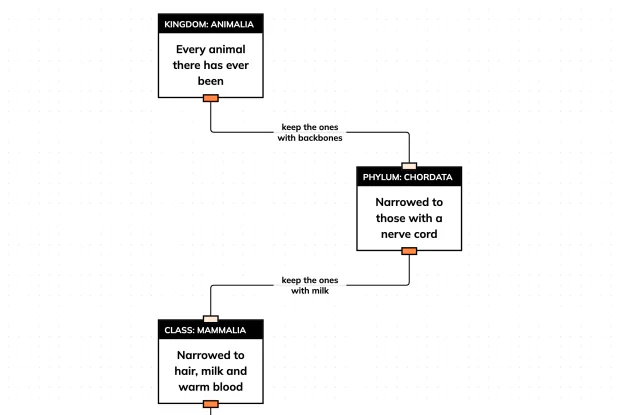
Classification is a set of nested groups running from kingdom down to species, each rung smaller and more closely related than the last. Follow all seven for a human in an interactive playground.
Why Does Every Species Get Two Names?
Every species has a two-word scientific name: the genus first, then the species. It is the same in every country and it carries the organism's group with it. Compare the two naming systems in an interactive playground.
The Five Kingdoms, and What Separates Them
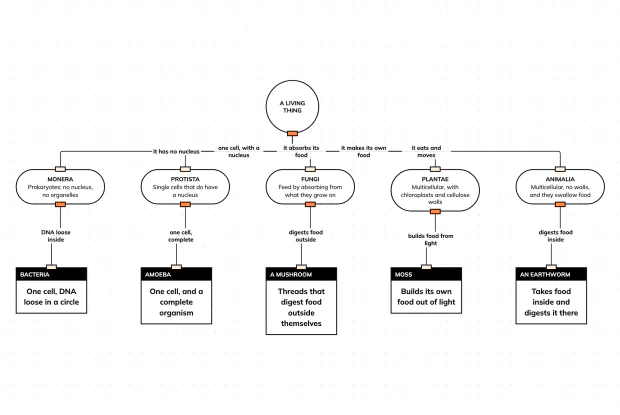
All life was long divided into five kingdoms, separated by whether cells have a nucleus, whether the organism is one cell or many, and how it obtains food. Place five organisms in an interactive playground.
Where Does a Virus Fit? It Does Not
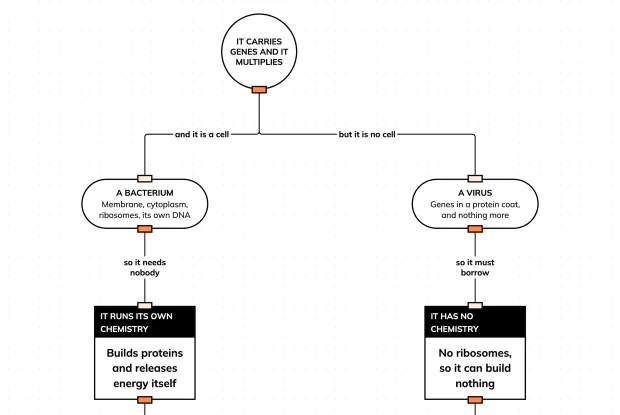
A virus is genetic material in a protein coat with no cell, no ribosomes and no chemistry of its own. It fits none of the five kingdoms, and whether it is alive depends on where you draw the line. Compare it with a cell in an interactive playground.