Why There Are Two High Tides a Day
Root Concept
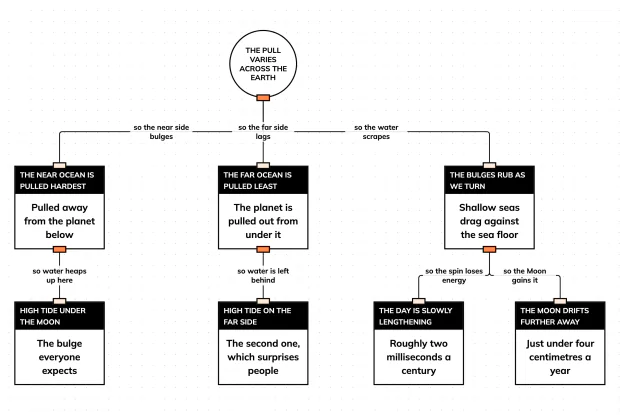
Tides are caused by the difference in the Moon pull across the width of the Earth rather than by the pull itself — the near ocean is pulled harder than the planet and the planet is pulled harder than the far ocean, which raises a bulge on both sides and gives every coast two high tides as the Earth turns.
CodePLU Goal
Upgrading Human Mental Models
Learn how to think in Workflows

Concept Development By codeplu.com
One fact at the top and four separate consequences below it. None of them leads to the next.
Why Two, and Not One?
Almost everybody knows the Moon causes the tides, and almost everybody carries a picture of how. The Moon passes overhead, its gravity lifts the water towards it, and the sea rises on that side of the planet.
That picture makes a prediction, and the prediction is wrong. One Moon overhead once a day should give one high tide a day. **Coasts all over the world get two, roughly twelve hours and twenty-five minutes apart, and the second one arrives when the Moon is on the opposite side of the planet entirely.** A model that misses half the observations needs replacing rather than patching.
The repair is one idea, and the previous tutorials have already supplied it. Gravity gets weaker with distance, and the Earth is twelve and a half thousand kilometres wide, so the Moon does not pull the near side, the middle and the far side by the same amount.
It is that difference, not the pull, that moves the oceans. Once you see it the second bulge stops being a puzzle, and a surprising amount else follows from the same fact, including the length of the day.
Stretching a Planet
What is actually different across the Earth?
The distance to the Moon, by about one part in thirty. The near face of the Earth is some six thousand four hundred kilometres closer to the Moon than the centre is, and the far face is the same distance further away. Gravity falls off with the square of the distance, as the earlier tutorial derived, so the pull on the near water is a few per cent stronger than the pull on the planet as a whole, and the pull on the far water is a few per cent weaker. A few per cent of a feeble force is a very small force indeed, which is why tides lift the sea by metres rather than kilometres. It is still enough to move an ocean, because an ocean is free to flow.
Why is there a bulge on the far side?
Because the planet is pulled out from underneath it. Compare each part with the Earth as a whole rather than with the ground. The near water is pulled towards the Moon harder than the Earth is, so it moves towards the Moon relative to the Earth and heaps up. The far water is pulled less hard than the Earth is, so the Earth moves towards the Moon and leaves that water behind — which looks, from the far shore, exactly like the sea rising. Two bulges, on opposite sides, produced by one pull that is merely uneven. Nothing is pushing the far water outwards, and any explanation that needs something to be is an explanation to distrust.
Why does the Earth turning give two tides?
The bulges stay pointed at the Moon while the planet rotates through them. In the course of a day any given coastline passes under the near bulge, then the low water between them, then the far bulge, then the other low, which is two highs and two lows. Note that the water is not being carried round the planet; the heap stays where the Moon is and the land arrives underneath it. The gap between highs is twelve hours and twenty-five minutes rather than twelve, because the Moon has moved a little further round its orbit by the time the Earth has caught up with it. That is why the tide table slips later by about fifty minutes each day, a pattern anyone living by the sea learns without being taught it.
Why does the Sun matter less than the Moon?
This is the part that catches people out, because the Sun pulls the Earth about a hundred and eighty times harder than the Moon does and yet raises a tide less than half the size. Tides are not produced by the pull, they are produced by the difference in the pull across the width of the planet. The Sun is so far away that the near and far faces of the Earth are almost exactly equally distant from it, so almost all of that enormous pull cancels out and only a small residue does any stretching. Being near matters more than being massive, which is the whole reason a small dead rock beats a star.
Real World Example
Three Things the Tides Do With That One Difference
The driving cause is identical in all three. What changes is the shape of the water it is acting on, and how long you watch for.
Step 1
The bay that amplifies it
The Bay of Fundy in eastern Canada has a tidal range of about sixteen metres, roughly the height of a five-storey building, while the open Atlantic a few hundred kilometres away manages less than one. The cause is not extra gravity but shape: the bay narrows and shallows along its length, funnelling the same volume of water into a steadily smaller space, and its size happens to match the rhythm of the tide so each push arrives in step with the last and adds to it. The Moon supplies a gentle nudge and the geography turns it into a wall of water.
Step 2
When the Sun joins in
Twice a month, at new moon and full moon, the Sun and the Moon line up with the Earth and their two stretches add together. The result is a spring tide, with higher highs and lower lows, and the name has nothing to do with the season. A week later the Sun sits at right angles to the Moon, the two partly cancel, and the range shrinks into a neap tide. Anyone planning to walk out to a tidal island checks which of the two is due, because the difference is measured in hours of safe crossing.
Step 3
The day that keeps getting longer
The bulges cannot slide across the planet for free. Water dragging over shallow sea floors loses energy to friction, and the energy comes out of the rotation of the Earth, so the day lengthens by roughly two milliseconds a century. The same interaction hands energy to the Moon, which climbs into a wider orbit at just under four centimetres a year — a figure measured by bouncing lasers off reflectors the Apollo crews left behind. Run that backwards far enough and the numbers become strange: hundreds of millions of years ago the day was closer to twenty-two hours, and fossil corals carry the extra days of the year as growth bands.
FAQs
Final Words
The Moon does not lift the sea. It pulls the near side of the Earth a little harder than the middle and the middle a little harder than the far side, and that difference leaves a heap of water at both ends. The planet turns through both of them, which is why a coast gets two high tides rather than one.
The same difference explains why a distant Sun loses to a nearby rock, why the day is two milliseconds longer each century, and why the Moon is drifting away.
This track has treated gravity as the force that pulls everything down. The next one asks why so much of what it pulls on refuses to go: a steel ship sits on an ocean, a balloon climbs through air, and neither has stopped being pulled.
Continue This Track
This concept is part 5 of What Keeps the Moon in the Sky.
Why Everything Pulls on Everything Else
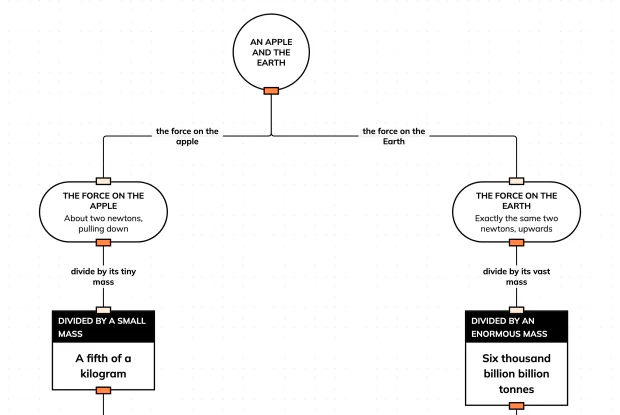
The Earth pulls an apple down — and the apple pulls the Earth up just as hard. Find out why gravity is mutual, why you never notice the other half, and trace both sides in an interactive playground.
Why Gravity Gets Weaker but Never Stops
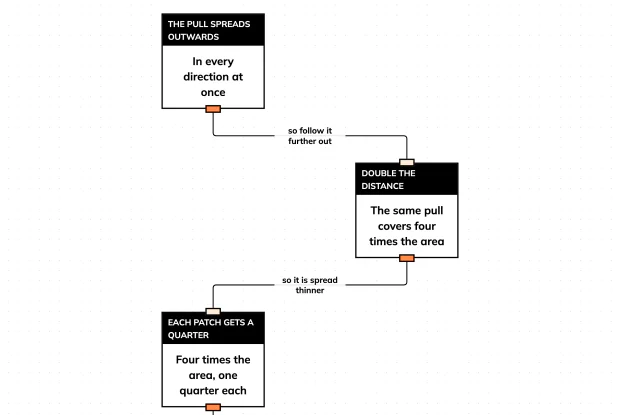
Astronauts are often said to be beyond gravity, and they are not. Find out how the pull thins out with distance, why squaring is involved, and why it never quite reaches zero — in an interactive playground.
Why the Moon Does Not Fall Down
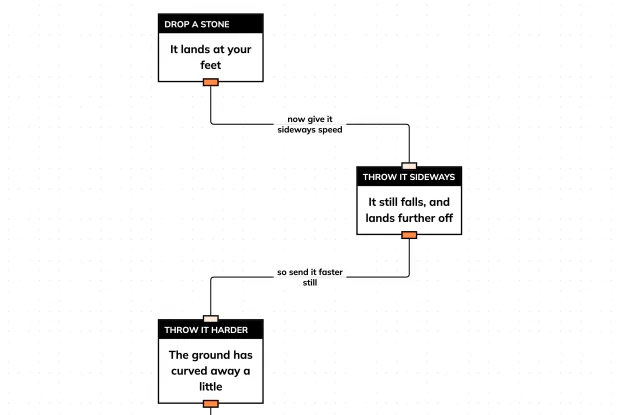
The Moon is falling towards us every second and has never arrived. Find out why going sideways fast enough turns falling into orbiting, and build the argument step by step in an interactive playground.
Why Astronauts Float When Gravity Is Still There
There is almost as much gravity on the space station as in your kitchen, so why does everything float? Find out what the sensation of weight really measures, and follow two falling lifts in an interactive playground.
Why There Are Two High Tides a Day
If the Moon pulled the ocean upwards there would be one high tide a day, and there are two. Find out what the second bulge is doing there, and trace the consequences in an interactive playground.