Why Astronauts Float When Gravity Is Still There
Root Concept
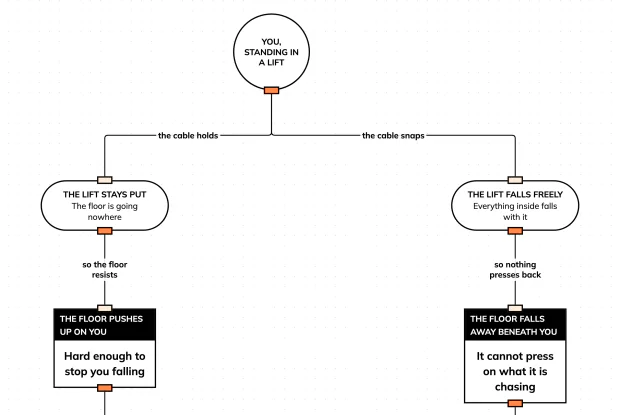
The sensation of weight is produced by a support force pressing on part of your body, never by gravity itself — so anything in free fall, from a dropped lift to an orbiting space station, feels weightless while still being pulled at very nearly full strength.
CodePLU Goal
Upgrading Human Mental Models
Learn how to think in Workflows

Concept Development By codeplu.com
The same person, the same planet and the same pull on both routes. Only the floor behaves differently.
If the Pull Is Still There, Why Does Everything Float?
Two tutorials ago the arithmetic said that gravity at the space station is about eighty-nine per cent of the gravity in your kitchen. The pictures from the station say otherwise: pens hang in mid-air, water forms balls and people sleep strapped to walls.
Both are correct, and reconciling them means asking a question that sounds childish and is not. **When you say you can feel how heavy you are, what is it that you are actually feeling?** Most people answer gravity, and that answer is wrong in a way that explains the whole of this tutorial.
Gravity pulls on every atom of you at once and very nearly equally. A force like that squeezes nothing, stretches nothing and presses on no surface, so there is nothing for a nerve to report. What your body actually detects is the floor shoving upwards on a few square centimetres of foot.
Take that floor away and the sensation goes with it, instantly and completely, while the pull carries on unchanged. That is what has happened on the space station, and it can be arranged much closer to home with nothing more exotic than a lift and a severed cable.
What the Sensation of Weight Actually Measures
Can you feel gravity at all?
You cannot, and the reason is that gravity acts on every part of you simultaneously. Your bones, your blood and the contents of your stomach are all accelerated by the same amount, so none of them is pushed against any other and nothing anywhere in you is compressed. **Many beginners treat the feeling of heaviness as a direct reading of gravity — actually it is a reading of whatever is stopping you falling.** Senses report pressure, stretch and contact, and a force that produces none of those is invisible to them. What you do feel is the chair under you or the ground beneath your feet pushing back, which is a contact force applied to a small patch of your body and passed up through everything resting on it.
What happens the moment the support goes?
Everything that was pressing stops pressing. In a lift whose cable has just parted, you and the floor and the walls all begin to accelerate downwards at the same rate, because gravity gives the same acceleration to everything regardless of mass — which is the result the previous track established and the reason this works at all. The floor can no longer push on you, since pushing would require it to be in your way and it is retreating at precisely your speed. Stand on bathroom scales inside and they read zero, which is the honest answer to what they measure: they were never weighing you, they were measuring how hard you pressed on them. Your mass has not changed and neither has the pull.
Is the space station doing anything different?
No, apart from going sideways fast enough that the fall never finishes. The station is in exactly the condition of the falling lift, and so is everyone in it, and so is every pen, crumb and droplet aboard. Nothing inside can press on anything else, because they are all accelerating together under the same pull. The only real difference is duration: a lift shaft runs out after a few seconds while an orbit does not run out at all. The proper name for the condition is free fall, and it is a far better name than the one the news uses, because it says what is happening instead of denying something that is still there.
Why is zero gravity the wrong phrase?
Because the gravity is not zero and nothing has been switched off. Scientists working on the station call it microgravity, and the micro refers to the small leftover accelerations that free fall does not quite cancel: the faint drag of the last traces of air, the slight difference in pull between the near and far ends of a structure a hundred metres long, and the nudge of an astronaut pushing off a wall. Those add up to roughly a millionth of the pull at the surface, which is a genuinely useful laboratory condition rather than an absence of anything. Crystals grow differently in it and flames burn as spheres, and both of those are experiments in very slight gravity rather than in none.
Real World Example
Three Ways to Be Weightless Without Leaving the Planet
In all three cases gravity is at full strength. What changes is whether anything underneath you is still in a position to push.
Step 1
Bathroom scales in a falling lift
Put a set of scales on the floor of a lift, stand on them and watch the display as the lift starts downwards. The reading dips while the lift is picking up speed, settles back to normal once the descent is steady, and climbs above your usual figure as the lift slows to a stop. Now imagine the cable parting. The scales and you fall together, you press on them with nothing at all, and they read zero for as long as the fall lasts. Nothing about your body or the planet changed during any of that.
Step 2
The aeroplane that falls on purpose
Space agencies train crews in an aircraft that climbs steeply and then flies a carefully shaped arc with its engines doing no more than cancelling air resistance. For about twenty-two seconds the aircraft and everyone in it fall together, and the cabin becomes indistinguishable from the space station: people drift, tools hang in mid-air, spilled water gathers itself into spheres. Then the pilot pulls out of the arc and everyone lands on the padded floor at nearly twice their normal weight, which is why the aircraft has a famously unpleasant nickname. It never left the atmosphere and the gravity never varied by a measurable amount.
Step 3
The crest of a roller coaster
Going over a sharp hump at the right speed, the car curves downwards exactly as fast as you would fall on your own. For the half second that lasts, the seat stops pressing on you, your stomach stops being held up by anything, and the result is the lurch the whole ride was designed around. Engineers choose the radius of the hump deliberately to produce it, and choose it carefully, because a slightly tighter curve would lift riders out of their seats. It is the same effect astronauts live in, sold by the minute at a fairground and rationed to a fraction of a second at a time.
FAQs
Final Words
Nobody has ever felt gravity. It acts on every atom at once, so it compresses nothing and no nerve can report it. What gets felt is the floor, the chair or the harness pushing back on a small patch of body, and the heaviness is that push travelling up through everything above it.
Remove the support and the feeling vanishes while the pull continues at full strength. That is the falling lift, the parabolic aircraft, the crest of a roller coaster and the space station, which is simply a fall arranged so that it never finishes.
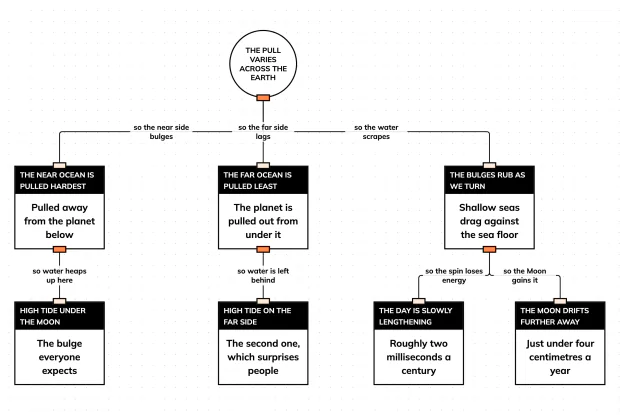
One detail in all of this was quietly approximate. Gravity pulls every part of you equally only because you are small. Across something as wide as a planet it does not, and the next tutorial finds that difference moving every ocean on Earth twice a day.
Continue This Track
This concept is part 4 of What Keeps the Moon in the Sky.
Why Everything Pulls on Everything Else
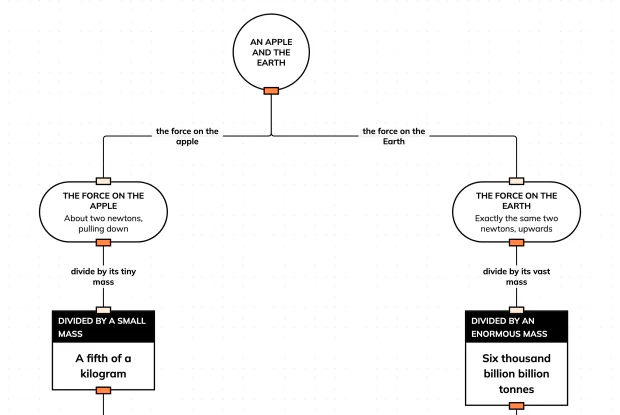
The Earth pulls an apple down — and the apple pulls the Earth up just as hard. Find out why gravity is mutual, why you never notice the other half, and trace both sides in an interactive playground.
Why Gravity Gets Weaker but Never Stops
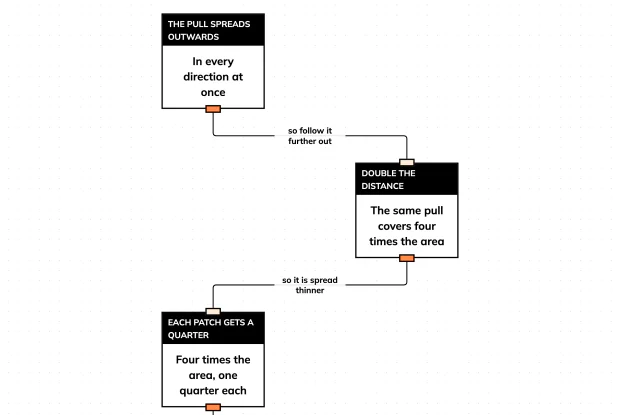
Astronauts are often said to be beyond gravity, and they are not. Find out how the pull thins out with distance, why squaring is involved, and why it never quite reaches zero — in an interactive playground.
Why the Moon Does Not Fall Down
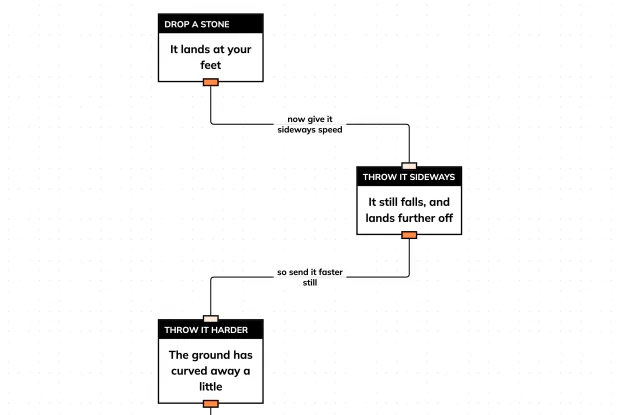
The Moon is falling towards us every second and has never arrived. Find out why going sideways fast enough turns falling into orbiting, and build the argument step by step in an interactive playground.
Why Astronauts Float When Gravity Is Still There
There is almost as much gravity on the space station as in your kitchen, so why does everything float? Find out what the sensation of weight really measures, and follow two falling lifts in an interactive playground.
Why There Are Two High Tides a Day
If the Moon pulled the ocean upwards there would be one high tide a day, and there are two. Find out what the second bulge is doing there, and trace the consequences in an interactive playground.