Why the Moon Does Not Fall Down
Root Concept
An orbit is continuous falling combined with enough sideways speed that the curve of the fall matches the curve of the planet below — so the Moon is pulled towards the Earth every second of its existence and never gets any closer, with no upward force involved anywhere.
CodePLU Goal
Upgrading Human Mental Models
Learn how to think in Workflows

Concept Development By codeplu.com
One thought experiment in five steps. Nothing new is added after the first stage except speed.
What Is Holding the Moon Up?
The previous tutorial left a number lying about. At the distance of the Moon, the pull of the Earth is one part in three thousand six hundred of what it is here — feeble, but emphatically not zero. Something is being pulled, and it has been pulled continuously for about four and a half billion years.
So why has it not arrived? **The usual answers are that the Moon is too far away, or that something is holding it up, or that the pull is balanced by a force pushing it outwards.** None of those is what is happening, and the last one is the most stubborn because it feels so much like the shove you get in a turning car.
Newton gave the answer with a thought experiment that costs nothing to follow. There is no upward force on the Moon at all. The only force acting on it is gravity, pointing straight at us, and the Moon is falling exactly as a dropped stone falls.
What the Moon also has is sideways speed. It is moving across our line of sight fast enough that by the time it has fallen, we are no longer where it was aiming. An orbit is not a balance. It is a very long miss.
From a Thrown Stone to an Orbit
Is the Moon actually falling?
Continuously, and the amount can be worked out. With an acceleration of under three thousandths of a metre per second every second, the Moon drops about one and a half millimetres in the course of a second — roughly the thickness of a coin. In that same second it travels rather more than a kilometre sideways. Those two numbers are the whole story, because over a kilometre of travel the curve of its circular path carries it away from a straight line by precisely that one and a half millimetres. It falls, and the path it would otherwise have taken drops away underneath it by the same amount, so it ends the second exactly as far from us as it began.
Why does falling not bring it down?
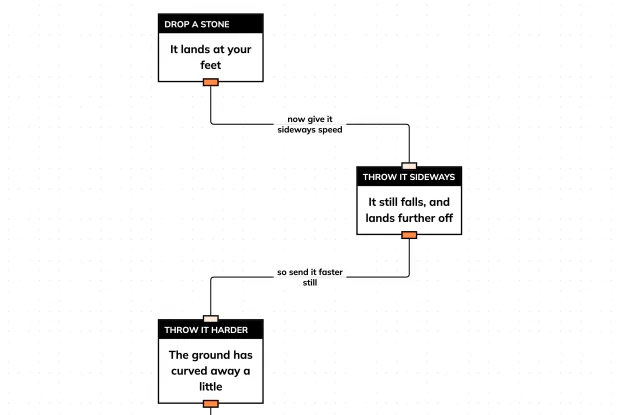
Because falling has never meant moving straight down. Throw a ball horizontally and it falls at the same rate as a ball dropped beside it, while also travelling forwards, which is why it lands some distance away rather than at your feet. Throw it harder and it lands further off still. Newton asked what happens if you keep going: fire it from a mountain top with a cannon powerful enough, and the ground it is falling towards has curved away beneath it before it can get there. The ball is still falling the entire time. It has simply run out of planet to land on, and comes round behind you.
How fast would you have to throw it?
Close to the Earth, about eight kilometres every second, and the reason is a piece of arithmetic you can check. A dropped object falls roughly five metres in the first second. The surface of the Earth curves away by about five metres over a distance of eight kilometres. So anything crossing eight kilometres in the second it takes to fall five metres is still exactly as high as it was when it started, and will be again a second later. That speed is the entire difficulty of getting to orbit, and it is why a rocket spends most of its fuel tipping over and accelerating sideways rather than climbing. Further out the requirement relaxes, because gravity is weaker and the circle is far larger: the Moon manages on roughly one kilometre per second, which is slower than a rifle bullet.
So what is pushing it outwards?
Nothing whatsoever, and this is where the familiar intuition has to be handled carefully rather than dismissed. In a turning car you are thrown against the door, and it is tempting to say the same outward push keeps the Moon from falling in. Measured from outside the turn, there is no outward force at all: your body is going straight and the door is curving into you. The outward push is a bookkeeping entry that appears only when you insist on measuring from inside something that is turning. It is a legitimate choice for some calculations and it is not a force anything exerts, which is why no orbit needs one.
Real World Example
Three Ways to Watch an Orbit Being a Fall
Each case below is the same idea at a different scale. In none of them is anything holding anything up.
Step 1
One second in the life of the Moon
In any given second the Moon falls towards us by about one and a half millimetres and moves sideways by a little over a kilometre. Draw the straight line it would have followed with no gravity at all, then measure how far the real path has dropped below that line after a kilometre of travel. The answer is one and a half millimetres. The two figures are not close by coincidence; they are equal because that is what keeps a circle a circle. Repeat that second about a hundred trillion times and you have the history of the Moon.
Step 2
Newton cannon on an impossible mountain
Newton drew a cannon on a mountain tall enough to clear the air, and fired it with increasing charges. A weak shot drops into the valley below. A stronger one lands beyond the horizon. A stronger one still comes down a quarter of the way around the world, and the ground it finally meets is tilted noticeably compared with the ground it left. Load the cannon with enough powder and the shot falls past the planet entirely and arrives back at the cannon from behind, having never once stopped falling. The diagram appeared in print in 1728 and it is still the clearest explanation of an orbit anyone has drawn.
Step 3
The space station that keeps sinking
Four hundred kilometres up there is still a trace of atmosphere, thin enough to ignore for most purposes and thick enough to rob the station of a little speed every day. Losing speed means the sideways motion no longer quite matches the curve, so the station drifts gradually lower — around two kilometres a month, which adds up to a serious problem over a year. Visiting spacecraft fire their engines while docked to push the whole thing back up again. The orbit needs topping up not because gravity is slowly winning but because the sideways speed is being stolen, and it is the speed that was doing the work.
FAQs
Final Words
The Moon is falling and always has been. Gravity pulls it towards us every second, it drops about a millimetre and a half in that second, and in the same second it moves far enough sideways that the curve of its path carries it away by exactly as much.
That is all an orbit is, and nothing is holding anything up. There is no outward force in the picture, only a sideways speed large enough to keep the fall from ever arriving — which is why removing that speed would bring the Moon down in five days.
If falling continuously is what an orbit is, then everything aboard a space station is falling too, including the floor. The next tutorial asks what that does to the sensation of having any weight at all.
Continue This Track
This concept is part 3 of What Keeps the Moon in the Sky.
Why Everything Pulls on Everything Else
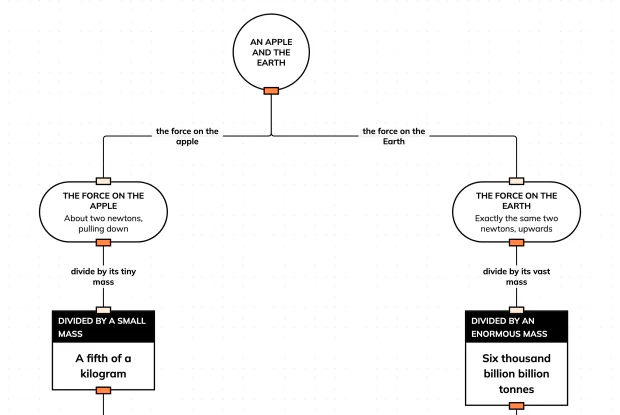
The Earth pulls an apple down — and the apple pulls the Earth up just as hard. Find out why gravity is mutual, why you never notice the other half, and trace both sides in an interactive playground.
Why Gravity Gets Weaker but Never Stops
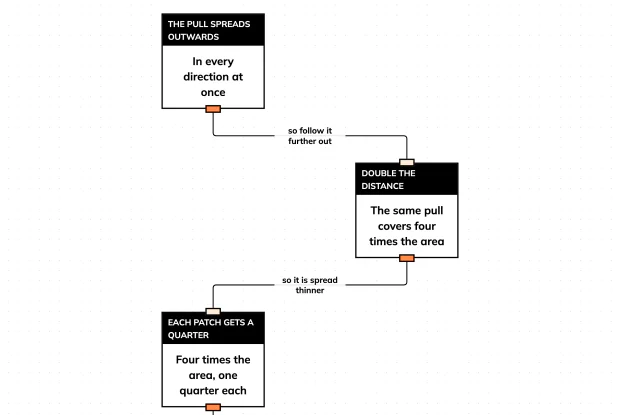
Astronauts are often said to be beyond gravity, and they are not. Find out how the pull thins out with distance, why squaring is involved, and why it never quite reaches zero — in an interactive playground.
Why the Moon Does Not Fall Down
The Moon is falling towards us every second and has never arrived. Find out why going sideways fast enough turns falling into orbiting, and build the argument step by step in an interactive playground.
Why Astronauts Float When Gravity Is Still There
There is almost as much gravity on the space station as in your kitchen, so why does everything float? Find out what the sensation of weight really measures, and follow two falling lifts in an interactive playground.
Why There Are Two High Tides a Day
If the Moon pulled the ocean upwards there would be one high tide a day, and there are two. Find out what the second bulge is doing there, and trace the consequences in an interactive playground.