Why Everything Pulls on Everything Else
Root Concept
Gravity is a mutual attraction between any two masses, equal in size on both of them and never switched off — and the reason only the smaller object is seen to move is that the same force divided by a far larger mass gives an acceleration too small to detect.
CodePLU Goal
Upgrading Human Mental Models
Learn how to think in Workflows

Concept Development By codeplu.com
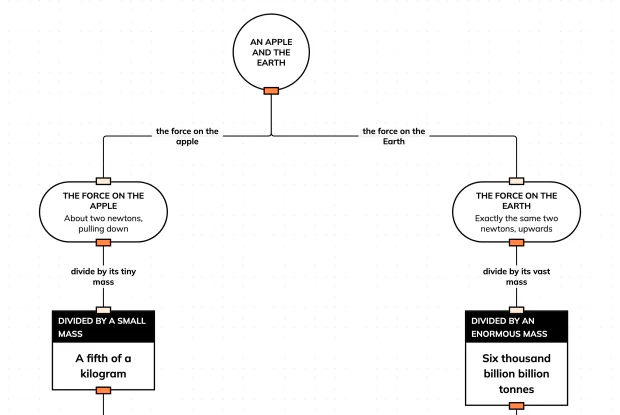
Two routes from one pair of objects. The forces are identical; only what they are divided by differs.
Does the Apple Pull the Earth Back?
The apple story is the most retold anecdote in science, and it is almost always told the wrong way round. An apple falls, Newton wonders why, and the answer given is that the Earth pulls it. That much is true and it is also only half of what he worked out.
The half that gets left out is the question nobody thinks to ask. While the Earth is pulling the apple down, is the apple pulling the Earth up? **Almost everyone says no, because gravity feels like something a planet has and an apple does not.** The honest answer is yes, and not slightly — the apple pulls the Earth with exactly the same number of newtons.
That sounds absurd, and the reason it does not contradict anything you can see is the relationship built in the previous track. A force does not produce motion on its own; it produces acceleration, and the acceleration you get depends on what mass you divide that force by.
Once you accept that, gravity stops being a property of planets and becomes something far stranger and far more useful: an attraction between any two lumps of matter anywhere, including the two in your own hands.
A Force That Acts on Both Ends
Does the apple really pull the Earth?
It does, with a force of exactly the same size. An earlier tutorial in this category established that forces come in pairs acting on different objects, and gravity is the cleanest example there is: the pair is the Earth and the apple, each pulling the other towards it. The two forces point in opposite directions along the line joining the objects, and because they act on different things they never cancel. **Many beginners read the equal pair as meaning the two objects should move equally — actually the pair says nothing whatsoever about motion until each force is divided by its own mass.** Nothing about the pair itself is lopsided. What is lopsided is everything that follows, and that comes entirely from the two masses rather than from the two forces.
Then why does the Earth not visibly move?
Because acceleration is force divided by mass, and the two masses here are not remotely comparable. An apple of about two hundred grams feels roughly two newtons and accelerates at ten metres per second every second, which is a fall you can watch. The Earth feels the same two newtons and has a mass of six thousand billion billion tonnes, so its acceleration works out at a few ten thousand billion billionths of a metre per second every second. Over the whole second the apple takes to reach the ground, the Earth shifts by far less than the width of a single atomic nucleus. The motion is not absent. It is real, it is calculable, and no instrument that has ever been built could notice it.
So does my pen pull my desk?
Yes, and this is the part that makes gravity universal rather than planetary. Every pair of masses in the universe attracts, including two objects on a table, two people in a room and two grains of sand. The pull between everyday objects is simply far too weak to do anything against friction. It is not too weak to measure, though. In 1798 Henry Cavendish hung two small lead balls from a fine fibre, brought two large ones near them, and watched the fibre twist by a hair. That twist is ordinary matter attracting ordinary matter, with no planet involved, and it remains one of the most delicate measurements ever made with simple equipment.
What decides how strong the pull is?
Two things only: how much mass each object has, and how far apart they are. Double either mass and you double the pull. Move them apart and the pull weakens, which the next tutorial takes up properly. Nothing else enters into it — not the material, not the shape, not the temperature, not whether the objects are moving. That is an unusually short list for a law of physics and it is why the same rule covers a dropped apple and a galaxy. One honest caveat belongs here. Treating gravity as a force reaching across space is Newton's model of it, and the model predicts everything in this track correctly; a deeper picture replaced it in 1915 without making any of this useless.
Real World Example
Three Pairs of Objects, All Pulling on Each Other
Every pair below attracts by the same rule. Only the masses and the distances change, and they change enough to hide the effect completely in two cases out of three.
Step 1
The apple and the planet
A two hundred gram apple hanging from a branch is pulled down with about two newtons, which is what a set of kitchen scales would read if you rested the apple on them. The Earth is pulled upwards towards the apple with exactly two newtons as well. Both numbers are correct and only one of them has a visible consequence, because dividing two newtons by the mass of an apple gives a brisk fall while dividing it by the mass of a planet gives a number with twenty-four zeros after the decimal point. The force is symmetric; the outcome is not.
Step 2
Two people standing a metre apart
Two adults of seventy kilograms each, standing a metre apart, really do attract one another. The force comes to roughly three ten-millionths of a newton, which is about the weight of a speck of dust. Friction between their shoes and the floor is thousands of times larger, so nobody slides anywhere and nobody ever has. The pull is nonetheless there and has been measured between objects of this size in a laboratory, using instruments no more exotic than a mirror, a light source and a very patient observer. This is the case that makes the law universal rather than merely astronomical, and it is the one people find hardest to believe.
Step 3
Cavendish, weighing the world
Cavendish built his apparatus in a sealed outbuilding and operated it from outside through a telescope, because the warmth of his own body would have stirred enough air to ruin the reading. Two large lead spheres were swung near two small ones hanging from a torsion fibre, and the fibre twisted by an amount he could read off a scale. From that twist he worked out how strongly ordinary matter attracts, and from that the density of the Earth itself. He had weighed the planet without leaving a shed in Clapham, and his figure sits within a per cent of the value accepted today.
FAQs
Final Words
Gravity is not something a planet does to things near it. It is a mutual attraction between any two masses, equal in size on both of them, pointing along the line that joins them, and never switched off. The apple pulls the Earth with the same two newtons the Earth uses on the apple.
Only one of them is seen to move, and the reason is the relationship from the previous track rather than anything about gravity: the same force divided by a far larger mass gives an acceleration nothing can detect.
Two things set the strength of the pull, and only one has been examined here. The next tutorial takes up the other, because what gravity does with distance decides whether there is anywhere in the universe it fails to reach.
Continue This Track
This concept is part 1 of What Keeps the Moon in the Sky.
Why Everything Pulls on Everything Else
The Earth pulls an apple down — and the apple pulls the Earth up just as hard. Find out why gravity is mutual, why you never notice the other half, and trace both sides in an interactive playground.
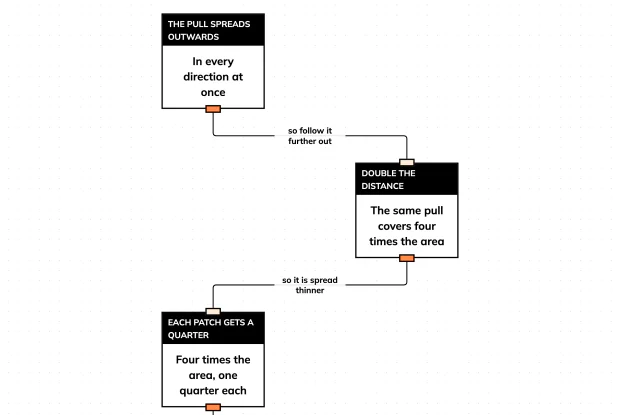
Why Gravity Gets Weaker but Never Stops
Astronauts are often said to be beyond gravity, and they are not. Find out how the pull thins out with distance, why squaring is involved, and why it never quite reaches zero — in an interactive playground.
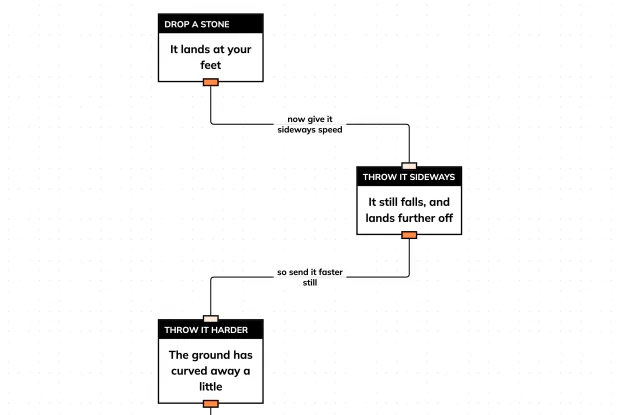
Why the Moon Does Not Fall Down
The Moon is falling towards us every second and has never arrived. Find out why going sideways fast enough turns falling into orbiting, and build the argument step by step in an interactive playground.
Why Astronauts Float When Gravity Is Still There
There is almost as much gravity on the space station as in your kitchen, so why does everything float? Find out what the sensation of weight really measures, and follow two falling lifts in an interactive playground.
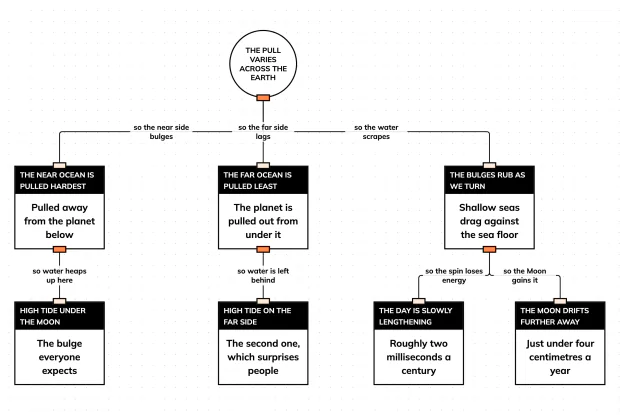
Why There Are Two High Tides a Day
If the Moon pulled the ocean upwards there would be one high tide a day, and there are two. Find out what the second bulge is doing there, and trace the consequences in an interactive playground.