Why Gravity Gets Weaker but Never Stops
Root Concept
Gravity spreads outwards from a mass over a surface that grows with the square of the distance, so the pull falls to a quarter at twice the distance and a hundredth at ten times — a division that gets very small very quickly but never reaches zero, which is why there is no height at which gravity stops.
CodePLU Goal
Upgrading Human Mental Models
Learn how to think in Workflows

Concept Development By codeplu.com
Each step follows from the one above it. The last one is the claim that surprises people, and it is unavoidable once you accept the first.
Where Does Gravity Stop?
Ask where gravity ends and most answers point upwards. Somewhere above the clouds, perhaps at the edge of the atmosphere, there is supposed to be a line past which things float.
The pictures encourage it. Astronauts drift about the space station looking thoroughly released from something, and the phrase used on the news is usually **zero gravity**, which sounds like a place rather than a sensation. The International Space Station orbits about four hundred kilometres up, and the pull of the Earth there is close to ninety per cent of what it is in your kitchen.
So gravity does not stop at the edge of the atmosphere, and the floating has another explanation entirely, which a later tutorial in this track takes up. What gravity does do is get weaker with distance, and it does so in a very particular way that is worth deriving rather than memorising.
The reason is geometry rather than physics, which is why the same rule turns up for light, for sound and for radiation. Something spreading out from a point has to cover more and more area as it goes, and there is only so much of it to go round.
Following One Pull Outwards
Why does spreading out make it weaker?
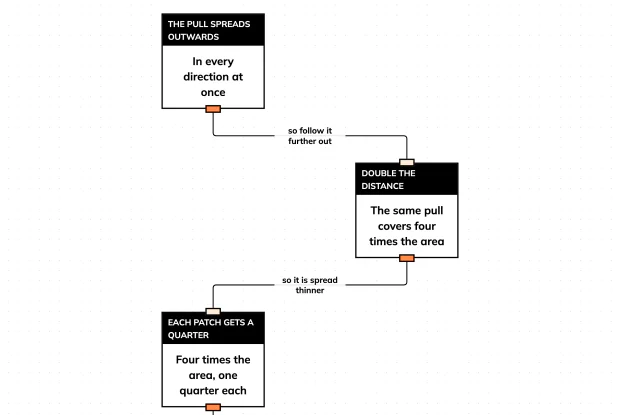
Picture the pull leaving a planet in every direction at once, so that at any distance it is spread evenly over the surface of a sphere. Now go twice as far out. The sphere you are standing on is twice the radius, and a sphere of twice the radius has four times the surface — not twice, because a surface is two-dimensional and both of its directions have doubled. The same total pull now has four times as much area to cover, so any one patch of it receives a quarter as much. Nothing has been lost or used up. It has simply been shared out among four times as many places, which is exactly why the weakening is geometric rather than a property of gravity itself.
How much weaker, exactly?
Square the distance and divide. At twice the distance from the centre of a planet the pull is a quarter, at three times it is a ninth, at ten times it is a hundredth, and at sixty times it is one part in three thousand six hundred. That last figure is not chosen at random: the Moon sits about sixty Earth radii away, and the next tutorial needs it. Notice how fast the numbers collapse. Going merely ten times further out leaves you with one per cent of the pull you started with, which is why gravity feels like a local affair even though it is not one. Halving the distance works the other way and multiplies the pull by four.
Why does a mountain top barely change your weight?
Because the distance that matters is measured from the centre of the Earth, not from the ground under your feet. **Many beginners picture the distance as height above the ground, which would make a top-floor flat noticeably lighter than a basement — actually the ground is nowhere near the thing you are being pulled towards.** You are already six thousand three hundred and seventy-one kilometres from that centre while standing at sea level, so climbing the highest mountain on the planet moves you outwards by less than a seventh of a per cent. Squaring a change that small leaves a difference bathroom scales could never show, and the same reasoning explains why the pull at the top of a skyscraper is indistinguishable from the pull in its car park.
Is there anywhere gravity does not reach?
Dividing by a larger and larger number produces smaller and smaller answers, and it never produces zero. There is no distance at which the arithmetic hands back nothing, which means every mass in the universe is being pulled, right now, by every other mass in the universe. In practice one pull almost always dominates and the rest are ignored, which is a choice about what is worth calculating rather than a claim that the others have stopped. The Sun still pulls on spacecraft that left the planets decades ago and is still bending their paths measurably. The galaxy holds together over distances where the arithmetic has long since become absurd, and holds together precisely because the pull was never cut off anywhere along the way.
Real World Example
The Same Planet, Measured From Three Distances
Every figure below is the pull of the same unchanged Earth. Only the distance from its centre differs, and the square of that distance does all the work.
Step 1
Standing in your kitchen
At sea level you are six thousand three hundred and seventy-one kilometres from the centre of the Earth, and gravity pulls with about ten newtons on every kilogram of you. This is the figure every weight in the previous track was worked out from, and it is the baseline for everything that follows. It is worth noticing how far from the centre you already are, because that distance is the reason ordinary changes in height do so little. A lift to the top of a tall building changes it by five parts in a hundred thousand.
Step 2
On the space station
The station orbits roughly four hundred kilometres above the surface, which puts it six thousand seven hundred and seventy-one kilometres from the centre. That is only six per cent further out than your kitchen, and six per cent is nothing at all once you remember where the measurement starts from. Squaring the ratio gives a pull of about eighty-nine per cent of the surface value, so an astronaut up there is being pulled almost as hard as they would be at home, and a kilogram of equipment weighs almost what it weighs on the ground. They are nonetheless floating, which tells you immediately that floating and the absence of gravity are two different things.
Step 3
Out at the Moon
The Moon orbits at about three hundred and eighty-four thousand kilometres, which is sixty times the radius of the Earth. Sixty squared is three thousand six hundred, so the pull out there is one part in three thousand six hundred of the surface value, giving an acceleration of under three thousandths of a metre per second every second. That is feeble by any standard, and it is still enough to run the whole arrangement. Newton compared the number with how sharply the Moon actually curves around us, found that the two agreed, and had his proof that one rule covered both the orchard and the sky. That comparison is the whole of the next tutorial.
FAQs
Final Words
Gravity thins out with distance because it is shared across a sphere, and a sphere of twice the radius has four times the surface. So the pull falls to a quarter at twice the distance and a hundredth at ten times, and the distance is counted from the centre of the planet rather than from the ground.
That explains why a mountain top weighs almost the same as a beach, and why the space station still sits in nearly ninety per cent of the gravity you are standing in. It also settles the larger question: dividing never produces zero, so gravity has no edge.
One figure from this tutorial is about to do some work. The pull at the distance of the Moon is one part in three thousand six hundred, and the next tutorial asks why that is not enough to bring it down on top of us.
Continue This Track
This concept is part 2 of What Keeps the Moon in the Sky.
Why Everything Pulls on Everything Else
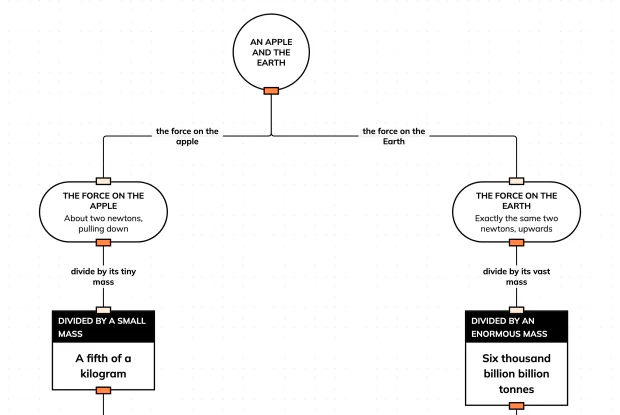
The Earth pulls an apple down — and the apple pulls the Earth up just as hard. Find out why gravity is mutual, why you never notice the other half, and trace both sides in an interactive playground.
Why Gravity Gets Weaker but Never Stops
Astronauts are often said to be beyond gravity, and they are not. Find out how the pull thins out with distance, why squaring is involved, and why it never quite reaches zero — in an interactive playground.
Why the Moon Does Not Fall Down
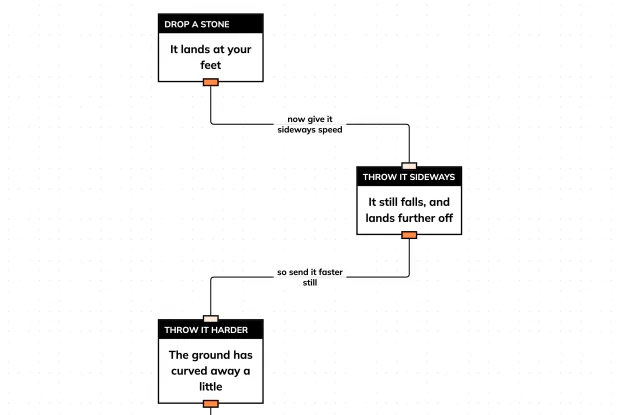
The Moon is falling towards us every second and has never arrived. Find out why going sideways fast enough turns falling into orbiting, and build the argument step by step in an interactive playground.
Why Astronauts Float When Gravity Is Still There
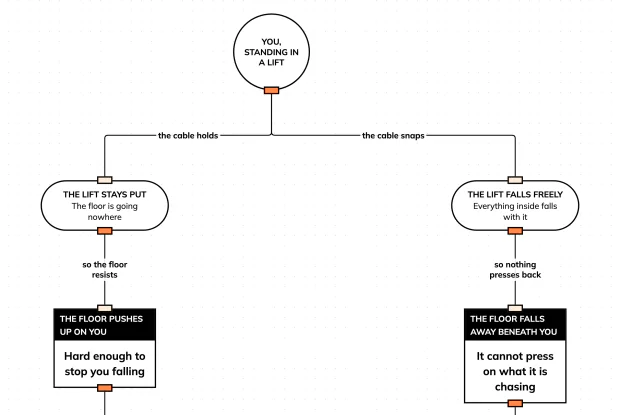
There is almost as much gravity on the space station as in your kitchen, so why does everything float? Find out what the sensation of weight really measures, and follow two falling lifts in an interactive playground.
Why There Are Two High Tides a Day
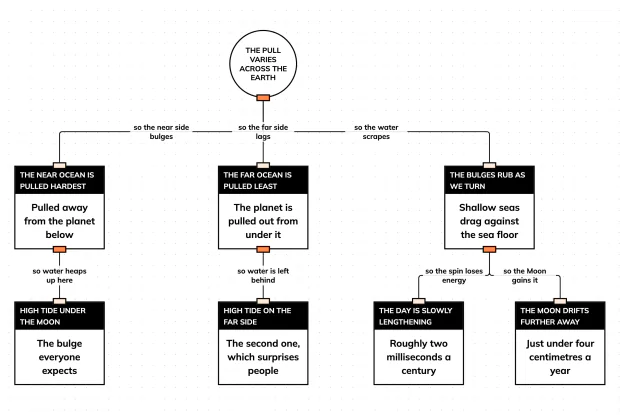
If the Moon pulled the ocean upwards there would be one high tide a day, and there are two. Find out what the second bulge is doing there, and trace the consequences in an interactive playground.