What Keeps the Moon in the Sky
Five parts on the one force the previous track used throughout without ever examining it. It opens by turning the apple story round: the Earth pulls the apple down, and the apple pulls the Earth up with exactly the same number of newtons, which sounds absurd until the same force is divided by a planet and the resulting acceleration turns out to be smaller than anything that could ever be measured. Gravity stops being a property of planets there and becomes an attraction between any two lumps of matter, measured between lead balls in a shed in 1798. The second part follows one pull outwards and finds it spread across a sphere whose surface grows with the square of the distance, so it falls to a quarter at twice the distance and a hundredth at ten times, and never once reaches zero. The third spends that result: the pull at the distance of the Moon is one part in three thousand six hundred, which is feeble and still enough, because the Moon is falling and has simply been moving sideways fast enough to keep missing for four and a half billion years. The fourth asks why anybody aboard a space station floats when the gravity there is eighty-nine per cent of the gravity in a kitchen, and finds that nobody has ever felt gravity at all — what the body detects is the floor pushing back, and a floor that is falling with you cannot. The last turns the whole track on the oceans: gravity does not pull every part of a planet equally, and that difference raises a bulge at both ends of the Earth, which is why a coast gets two high tides a day rather than one.
CodePLU Goal
Upgrading Human Mental Models
Learn how to think in Workflows
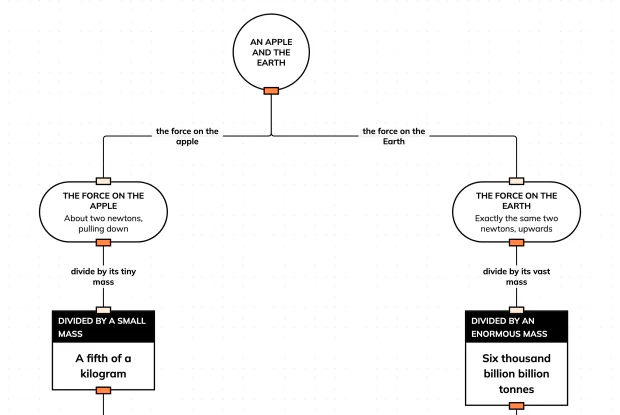
Why Everything Pulls on Everything Else
The Earth pulls an apple down — and the apple pulls the Earth up just as hard. Find out why gravity is mutual, why you never notice the other half, and trace both sides in an interactive playground.
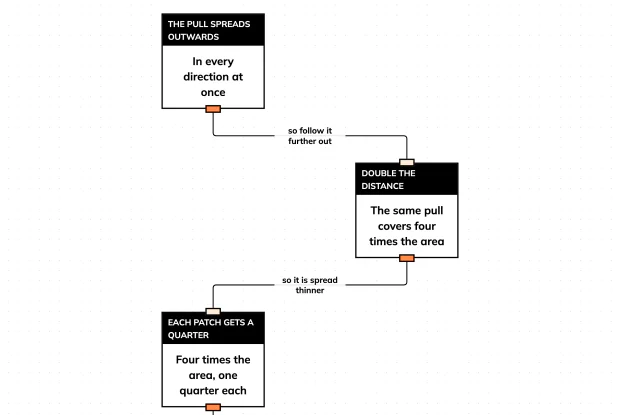
Why Gravity Gets Weaker but Never Stops
Astronauts are often said to be beyond gravity, and they are not. Find out how the pull thins out with distance, why squaring is involved, and why it never quite reaches zero — in an interactive playground.
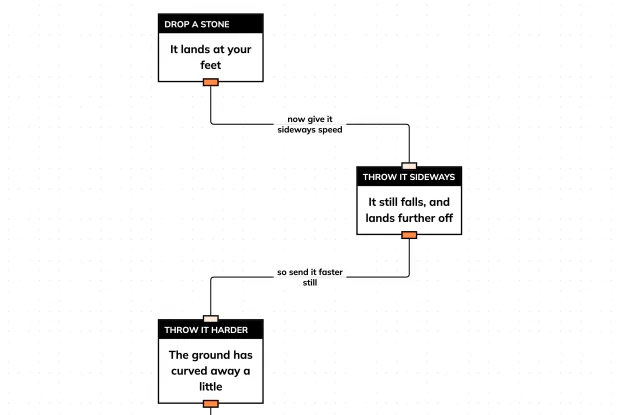
Why the Moon Does Not Fall Down
The Moon is falling towards us every second and has never arrived. Find out why going sideways fast enough turns falling into orbiting, and build the argument step by step in an interactive playground.
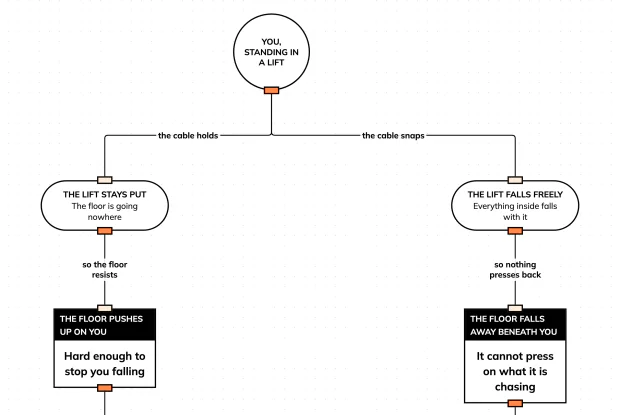
Why Astronauts Float When Gravity Is Still There
There is almost as much gravity on the space station as in your kitchen, so why does everything float? Find out what the sensation of weight really measures, and follow two falling lifts in an interactive playground.
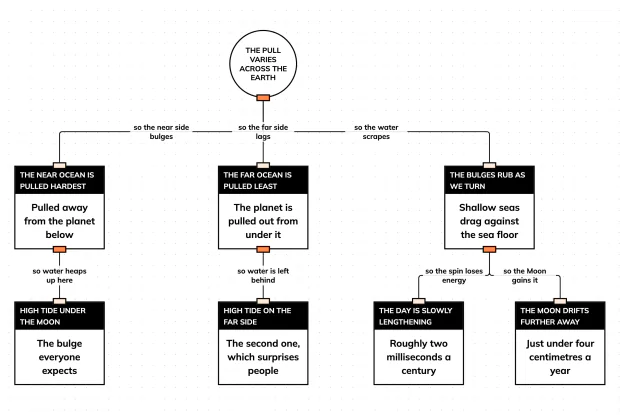
Why There Are Two High Tides a Day
If the Moon pulled the ocean upwards there would be one high tide a day, and there are two. Find out what the second bulge is doing there, and trace the consequences in an interactive playground.