Why Is the Periodic Table That Shape? Count Outwards
Root Concept
The periodic table is arranged so that each row corresponds to a shell being filled and each column to a number of outer electrons, which is why elements in the same group behave alike and why an element’s position can be used to predict its chemistry rather than merely to record it.
CodePLU Goal
Upgrading Human Mental Models
Learn how to think in Workflows

Concept Development By codeplu.com
The groups are not three categories somebody chose. They are what you get when you sort by outer electrons.
Not a Chart, a Consequence
The periodic table is usually met as a poster: a wall of boxes with an odd outline, to be memorised in places and otherwise looked up. Taken that way it is a reference card, and a fairly intimidating one. It is worth knowing that almost every feature of its shape follows from the previous tutorial, and that none of it was decided for the sake of the layout.
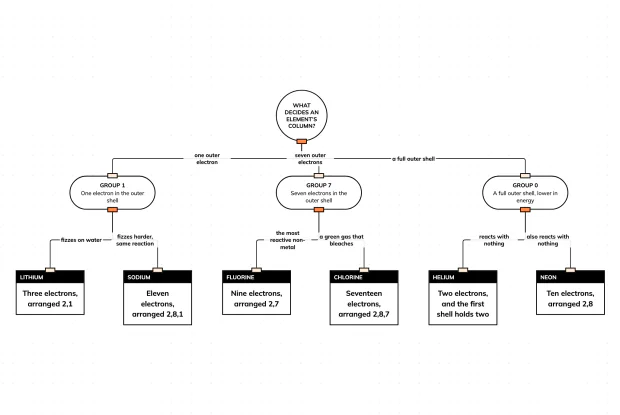
Two rules do most of the work. Each row, called a period, is one shell being filled: you start a new row when an electron has to start a new shell. Each column, called a group, holds the elements with the same number of outer electrons. That is why lithium, sodium and potassium sit in a vertical line — they are 2,1 and 2,8,1 and 2,8,8,1, all ending in one.
The consequences are what make the table worth having. The first row holds only two elements because the first shell holds only two electrons. The main block is eight wide because the next shells hold eight. The noble gases sit at the right-hand edge because a full outer shell is where each row ends. And an element you have never heard of can be placed in a group and described before you test it, which is the difference between a filing system and a theory.
The playground sorts six elements into three groups by the one thing that decides the column.
Reading the Table as a Result
Why does a group behave as a family?
Because every element in it meets other atoms with the same number of outer electrons, and that is the whole of what another atom encounters. Group 1 all have one outer electron, held loosely, so all of them lose it readily and all form ions with a charge of +1. Group 7 are all one short of a filled shell, so all of them take an electron and form ions with a charge of −1. The inner electrons differ enormously across a group — potassium has eighteen more than lithium — and make almost no difference, because they are buried. A group is therefore not a convenient grouping of similar-looking elements. It is a statement that these atoms present the same face to the world.
Why do the rows have the lengths they do?
Because a row ends when a shell is full, so the length of a row is the capacity of the shell being filled. The first shell holds two electrons, so the first period holds exactly two elements, hydrogen and helium, which is why the top of the table looks so sparse. The second shell holds eight, so the second period runs eight elements from lithium to neon. The third does the same. The table then widens, because from the fourth row onwards another set of electron positions becomes available and ten more elements fit in before the row ends — which is where the block of transition metals in the middle comes from. The outline is a record of shell capacities, not a design.
What do the trends down a group tell you?
That position predicts not just the kind of behaviour but its strength. Going down group 1, each element has one more filled shell beneath its outer electron, so that electron is further from the nucleus and held less tightly — and the reactions get more vigorous all the way down. Going down group 7 the same reasoning runs the other way: an arriving electron is attracted less strongly as the outer shell gets further out, so fluorine at the top is the most reactive and the group gets milder as you descend. Two opposite trends from one cause. Neither has to be memorised separately once you can say where the outer shell sits.
How did anyone build this before atoms were understood?
By noticing the repeat without knowing its cause. Mendeleev arranged the known elements by atomic mass in 1869 and found that similar properties recurred at regular intervals, so he laid them out in rows that put the similar ones underneath each other. What makes his table a theory rather than a catalogue is that he left gaps where the pattern demanded an element nobody had found, and predicted the properties each missing one would have. Gallium, scandium and germanium were all discovered afterwards and all matched. He had no idea that electrons existed; he had found the pattern that electron shells produce, about forty years before anyone could say why it was there.
Real World Example
Using Position Instead of Testing
A table that only recorded what was known would be a catalogue. These are the occasions it was used to say something nobody had measured.
Step 1
A missing element described before it was found
Mendeleev left a gap below silicon and said what the element filling it would be like: a grey metal of a particular density, forming an oxide of a particular formula, with a chloride that would boil below a hundred degrees. Germanium was isolated fifteen years later and matched closely enough that the table stopped being treated as one chemist’s arrangement and started being treated as a law. The prediction worked because position encodes outer electrons, even though nobody involved knew that at the time. A table that could only describe what had been found would never have risked the claim.
Step 2
A whole column nobody had noticed was missing
The noble gases were not in the original table at all, because none had been discovered — they are unreactive, so they form no compounds to be found in. When argon was isolated from air in 1894 it fitted nowhere, and the resolution was to add an entire new column at the right-hand edge. Helium, neon, krypton and xenon followed within years. The reason they belong together is the reason they were hard to find in the first place: a full outer shell is a low-energy arrangement, so these atoms take part in almost nothing.
Step 3
Choosing a substitute by looking sideways
Chemists routinely pick a replacement material by moving within a group, because group members behave alike. Potassium compounds substitute for sodium compounds in low-salt foods; lithium sits above both and shares the single outer electron that makes it useful in batteries. The same logic has a darker side: strontium from fallout is dangerous partly because it sits directly below calcium, so the body handles it as though it were calcium and deposits it in bone. Position predicts behaviour whether or not the behaviour is welcome, and it is a reminder that a group is a statement about how atoms behave rather than about whether the behaviour is useful.
FAQs
Final Words
The periodic table’s shape is a result, not a design. A row is a shell being filled, so the first row holds two elements and the next two hold eight. A column is a number of outer electrons, so lithium, sodium and potassium line up vertically and behave alike, while the inner electrons that differ so much between them stay buried. The noble gases sit at the right-hand edge because a full outer shell is where every row ends.
That is what makes the table a theory rather than a catalogue. Mendeleev found the repeat forty years before anyone could explain it, and trusted it enough to leave gaps and describe what would fill them. This track opened an atom, found the number that fixes its element, explained a mass that looked impossible, and arranged its electrons. What is missing is what happens when two atoms meet, and that is the bond the last track kept pointing at. The next track begins there.
Continue This Track
This concept is part 5 of Inside the Atom.
What Is Actually Inside an Atom? Label the Parts
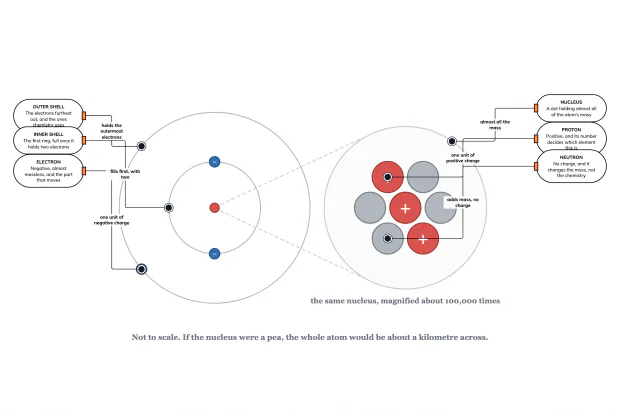
An atom is three kinds of particle in two places, and overwhelmingly empty space. Label a lithium atom and its magnified nucleus in an interactive playground.
What Is the Atomic Number? Rule Out the Rest
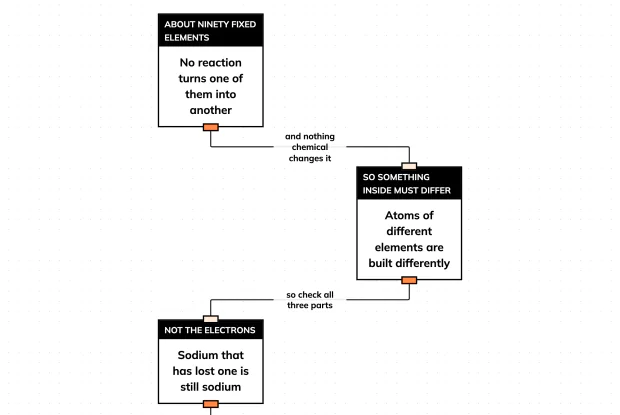
An atom has three kinds of particle, and only one of them decides which element it is. Eliminate the other two step by step in an interactive playground.
Why Does Chlorine Weigh 35.5? Count Both Kinds
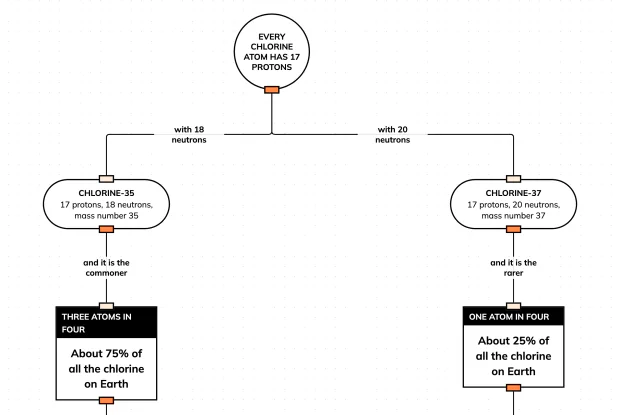
Atoms are built from whole particles, so a mass of 35.5 looks impossible. Follow both isotopes of chlorine to the weighted average in an interactive playground.
How Are an Atom’s Electrons Arranged? 2, 8, 8
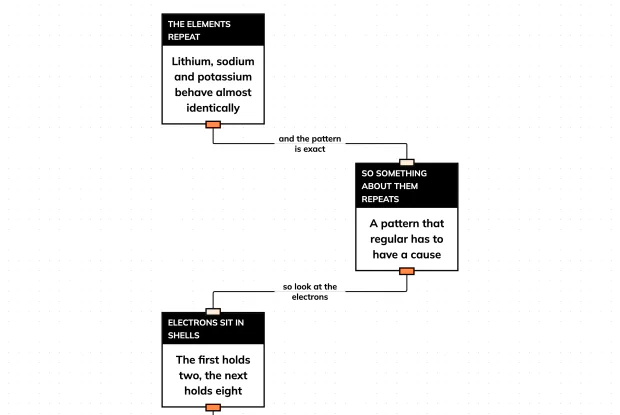
Lithium, sodium and potassium behave almost identically, and that is not a coincidence. Work back from the repeating pattern to how electrons are arranged in shells.
Why Is the Periodic Table That Shape? Count Outwards
The periodic table is not a chart to memorise. Its rows are shells and its columns are outer electrons. Sort three groups by what their atoms have in common in an interactive playground.