Inside the Atom
Five parts opening the thing the last track deliberately left closed. It starts with the inventory — three kinds of particle in two places — and with two facts that do most of the later work: the nucleus holds nearly all the mass while taking up almost none of the room, so an atom is overwhelmingly empty and what feels solid is really electrons repelling electrons. The second part answers the question Track 2 asked twice and never settled, and answers it by elimination rather than assertion: electrons cannot decide which element an atom is, because a sodium ion has lost one and is still sodium; neutrons cannot, because chlorine comes with eighteen of them or twenty and both are chlorine; so it is the protons, and that number is fixed because no chemical process reaches the nucleus — which is also why the alchemists were attempting something chemistry cannot do. The third part clears up a number that looks impossible, since atoms are built from whole particles and yet chlorine is printed as 35.5; it is a weighted average of two isotopes, and no chlorine atom weighs it. The last two parts move outwards to the electrons and find the pattern that explains the periodic table: shells fill from the inside, only the outermost electrons are exposed to another atom, and so the elements repeat every eight. By the end the table is a consequence rather than a chart — rows are shells being filled, columns are outer electrons, and an element can be described from its position before anybody tests it.
CodePLU Goal
Upgrading Human Mental Models
Learn how to think in Workflows
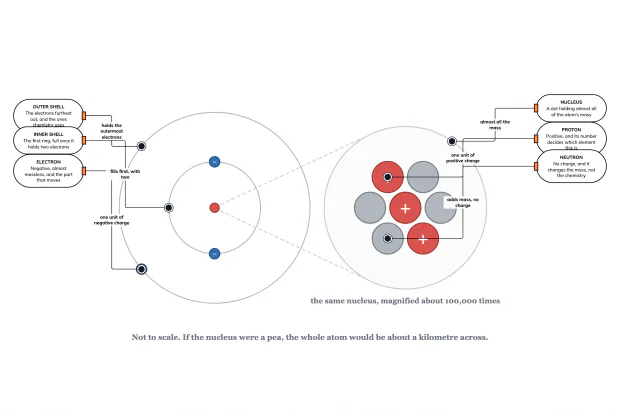
What Is Actually Inside an Atom? Label the Parts
An atom is three kinds of particle in two places, and overwhelmingly empty space. Label a lithium atom and its magnified nucleus in an interactive playground.
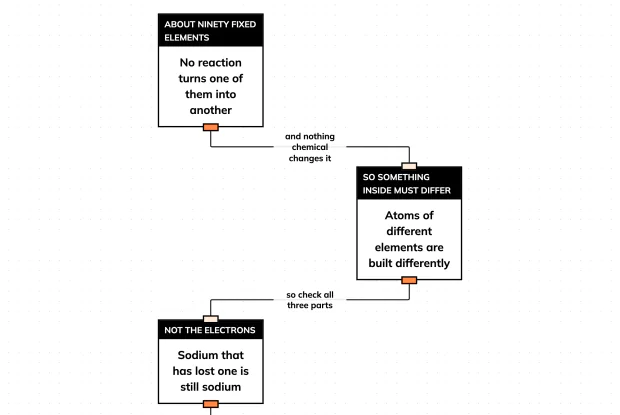
What Is the Atomic Number? Rule Out the Rest
An atom has three kinds of particle, and only one of them decides which element it is. Eliminate the other two step by step in an interactive playground.
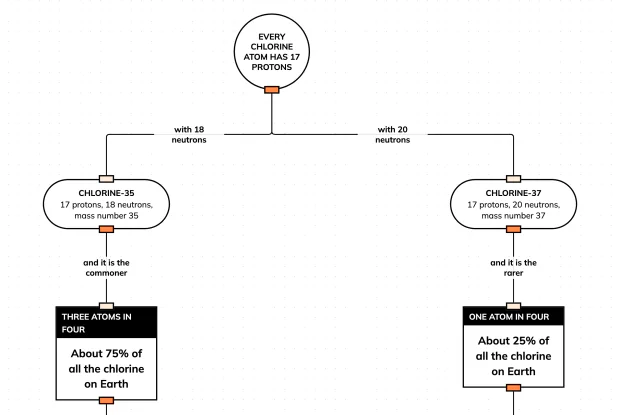
Why Does Chlorine Weigh 35.5? Count Both Kinds
Atoms are built from whole particles, so a mass of 35.5 looks impossible. Follow both isotopes of chlorine to the weighted average in an interactive playground.
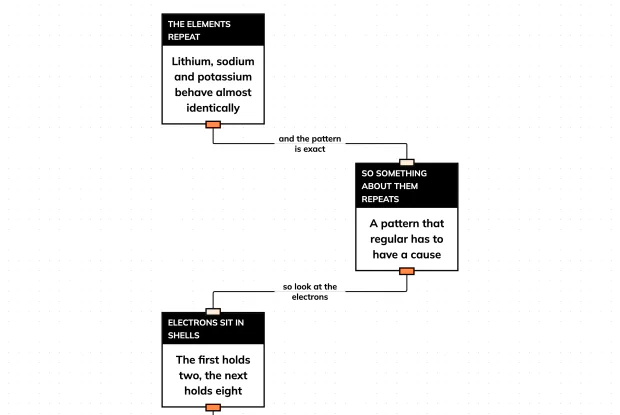
How Are an Atom’s Electrons Arranged? 2, 8, 8
Lithium, sodium and potassium behave almost identically, and that is not a coincidence. Work back from the repeating pattern to how electrons are arranged in shells.
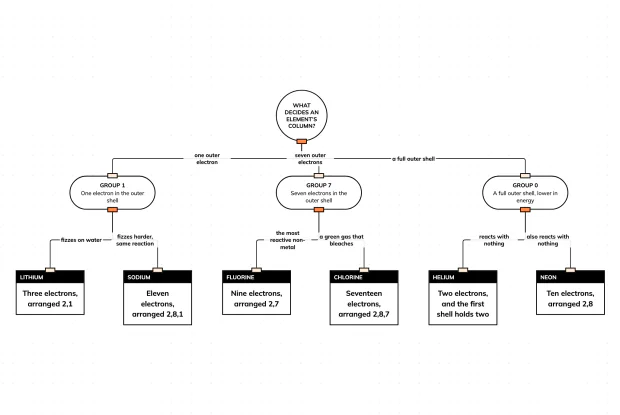
Why Is the Periodic Table That Shape? Count Outwards
The periodic table is not a chart to memorise. Its rows are shells and its columns are outer electrons. Sort three groups by what their atoms have in common in an interactive playground.