Why Does Chlorine Weigh 35.5? Count Both Kinds
Root Concept
An element’s relative atomic mass is the weighted average of its isotopes, so it is usually not a whole number even though every individual atom has a whole-number mass — chlorine is about three parts chlorine-35 to one part chlorine-37, which averages to 35.5 although no single chlorine atom weighs that.
CodePLU Goal
Upgrading Human Mental Models
Learn how to think in Workflows

Concept Development By codeplu.com
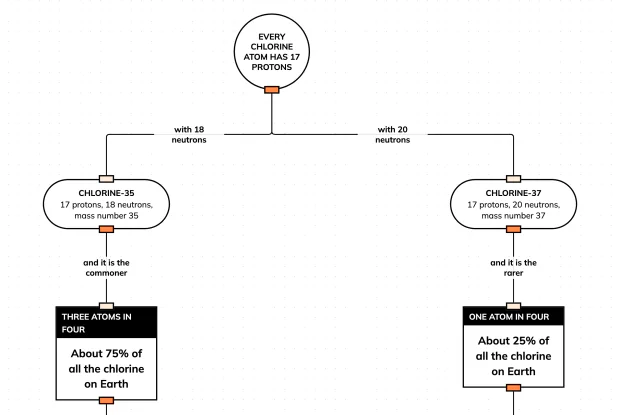
Both routes start from the same 17 protons. The two numbers at the bottom add to 35.5.
A Number That Should Not Be Possible
An atom is built from protons and neutrons, and you cannot have part of one. Every atom therefore has a whole-number mass: 35 of them, or 37, never 35 and a half. Yet the periodic table prints 35.5 beside chlorine, and most other elements get a decimal too. Copper is 63.5. Something is clearly being left unsaid.
What is being left unsaid is that the number on the table is not the mass of an atom. It is an average across all the atoms of that element, and averages are not obliged to look like the things they average. A class with some pupils aged 13 and some aged 14 can perfectly well have a mean age of 13.4 without anybody being 13.4 years old.
The previous tutorial already established why an element can come in more than one version: neutrons do not decide the element, so atoms with 17 protons are chlorine whether they carry 18 neutrons or 20. Those versions are called isotopes. Chlorine has two stable ones, and crucially they are not equally common — roughly three atoms in four are the lighter kind.
That proportion is what makes the average 35.5 rather than 36. The playground runs both isotopes down to the number each contributes, and the two contributions add up to the figure on the table.
Working the Average Out
What exactly is an isotope?
An atom of a given element with a particular number of neutrons. All chlorine has 17 protons — that is what makes it chlorine — but some chlorine atoms have 18 neutrons and some have 20, giving mass numbers of 35 and 37. Those two are isotopes of chlorine, written chlorine-35 and chlorine-37, where the number is the mass number rather than anything about the element. Nearly every element has isotopes: tin has ten stable ones. A handful do not, which is why fluorine is 19.0 and sodium is 23.0 on the table, both suspiciously tidy. A whole number on a periodic table is usually a sign of an element with only one stable form.
Why do isotopes behave identically in reactions?
Because chemistry is done by electrons, and isotopes have the same number of those. A neutral chlorine-35 atom and a neutral chlorine-37 atom both have 17 protons and therefore both have 17 electrons, arranged in exactly the same way. Everything a chlorine atom does in a reaction — joining sodium to make salt, bleaching a dye, reacting with hydrogen — depends on those electrons and not on what is sitting in the nucleus. So the two isotopes are chemically indistinguishable. They do differ in mass, by about 6%, which means they differ very slightly in how fast they move and diffuse, and that tiny physical difference is occasionally useful for separating them.
How is the average actually calculated?
By weighting each isotope by how common it is, rather than simply averaging the mass numbers. The plain average of 35 and 37 would be 36, and that would only be right if the two were equally abundant. They are not: about 75% of chlorine is chlorine-35 and about 25% is chlorine-37. So the sum is (35 × 0.75) + (37 × 0.25), which is 26.25 + 9.25 = 35.5. Read aloud, that is three quarters of thirty-five plus one quarter of thirty-seven. The lighter isotope is three times as common, so it pulls the average three times as hard, and the result lands much nearer 35 than 37. That is the whole method, and it works for any element once you know the proportions.
Why is it called a relative atomic mass?
Because it is a comparison rather than a measurement in grams. An atom weighs far too little for any ordinary unit to be useful — a single chlorine atom is around 0.000000000000000000000059 grams — so masses are quoted relative to a standard. The agreed standard is the carbon-12 atom, which is defined as exactly 12, and every other mass is expressed against it. So a relative atomic mass of 35.5 means an average chlorine atom is 35.5 twelfths as heavy as a carbon-12 atom. It has no units for that reason, and it is why the numbers on the table are convenient small figures rather than strings of zeros. The standard has moved over the years — hydrogen first, then oxygen, then carbon-12 — which is why an older book may quote a very slightly different value.
Real World Example
Where These Proportions Are Put to Work
The proportions are not constants handed down. They are measured, they vary slightly from sample to sample, and that variation is useful.
Step 1
A mass spectrometer counts the two peaks
The abundances are found by separating the isotopes by mass and counting them. The sample is turned into ions, accelerated, and deflected by a magnetic field, which bends lighter ions more sharply than heavier ones. Chlorine gives two peaks, one at 35 and one at 37, and the heights of those peaks give the proportions directly — roughly three to one. The instrument is doing physically what the playground does arithmetically. It is also why the figure on the periodic table is occasionally revised: it is a measurement, not a definition, and better instruments refine it.
Step 2
Ice cores are read through oxygen isotopes
Oxygen comes mostly as oxygen-16 with a little oxygen-18, and water made with the lighter one evaporates slightly more readily. The balance between the two in ancient ice therefore depends on how warm the ocean was when that water evaporated. Drilling a core through a glacier and measuring the ratio layer by layer gives a temperature record going back hundreds of thousands of years. The chemistry of the two kinds of water is identical, which is exactly why the ratio survives unchanged and can be read so long afterwards. Nothing in the ice has reacted at any point: the record is physical, which is exactly what makes it trustworthy.
Step 3
Uranium has to be separated by mass alone
Natural uranium is about 99.3% uranium-238 and 0.7% uranium-235, and only the rarer one is useful as a reactor fuel. Because the two are chemically identical, no reaction can separate them and every technique in the mixtures track is useless. What is used instead is the roughly 1% difference in mass, exploited over and over in thousands of stages of centrifuging. The sheer difficulty and cost of that process, and the scale of the plant it demands, follow directly from the rule in this tutorial: isotopes differ in mass and in nothing else that chemistry can reach.
FAQs
Final Words
Atoms are built from whole particles, so every chlorine atom has a mass number of 35 or 37 and none has a mass of 35.5. The number on the periodic table is not an atom’s mass at all — it is an average across every atom in a sample, weighted by how common each isotope is. Chlorine runs about three parts chlorine-35 to one part chlorine-37, so the sum is 26.25 plus 9.25, and the answer lands much closer to 35 than to 37.
The reason this works is the point of the previous tutorial restated: neutrons change the mass and nothing else. Both isotopes have 17 protons and 17 electrons, so they react identically, which is why no chemical method separates them and why an ice core can still be read after a hundred thousand years. Mass belongs to the nucleus; behaviour belongs to the electrons. The next tutorial asks how those electrons are arranged, because that explains the shape of the whole table.
Continue This Track
This concept is part 3 of Inside the Atom.
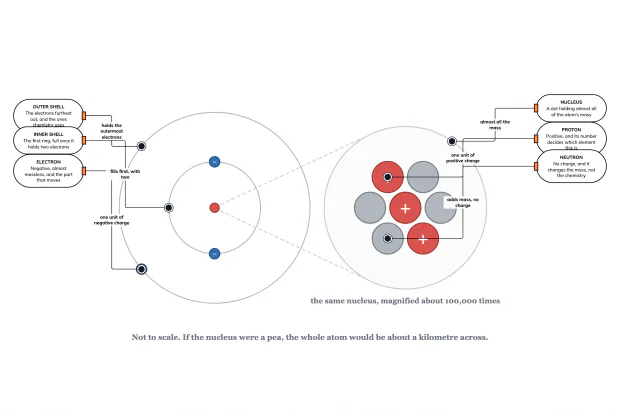
What Is Actually Inside an Atom? Label the Parts
An atom is three kinds of particle in two places, and overwhelmingly empty space. Label a lithium atom and its magnified nucleus in an interactive playground.
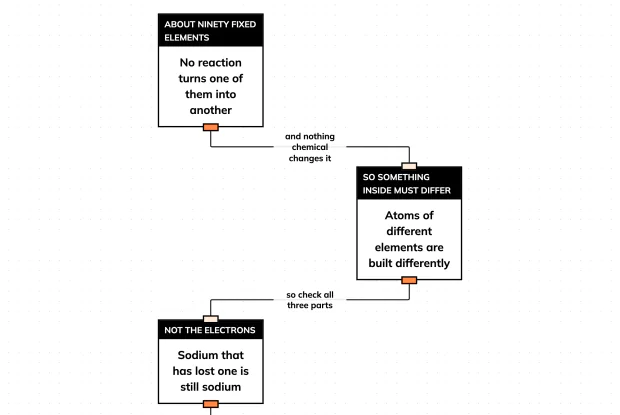
What Is the Atomic Number? Rule Out the Rest
An atom has three kinds of particle, and only one of them decides which element it is. Eliminate the other two step by step in an interactive playground.
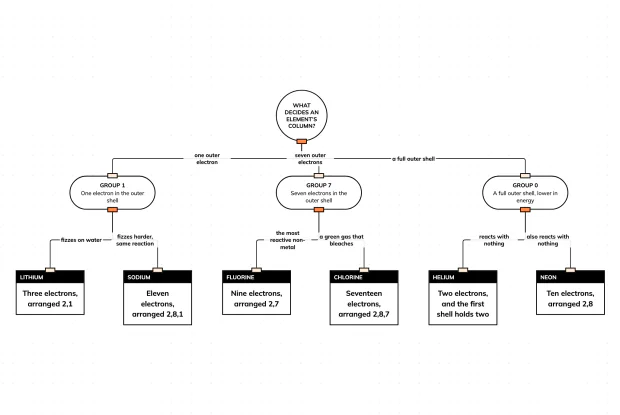
Why Does Chlorine Weigh 35.5? Count Both Kinds
Atoms are built from whole particles, so a mass of 35.5 looks impossible. Follow both isotopes of chlorine to the weighted average in an interactive playground.
How Are an Atom’s Electrons Arranged? 2, 8, 8
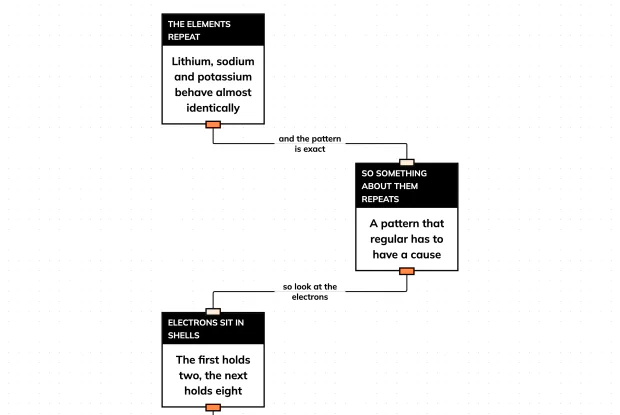
Lithium, sodium and potassium behave almost identically, and that is not a coincidence. Work back from the repeating pattern to how electrons are arranged in shells.
Why Is the Periodic Table That Shape? Count Outwards
The periodic table is not a chart to memorise. Its rows are shells and its columns are outer electrons. Sort three groups by what their atoms have in common in an interactive playground.