What Is Actually Inside an Atom? Label the Parts
Root Concept
An atom is made of protons and neutrons packed into a nucleus that holds almost all of its mass, with electrons arranged in shells around it, and because the nucleus is about a hundred thousand times smaller than the atom, nearly all of an atom is empty space.
CodePLU Goal
Upgrading Human Mental Models
Learn how to think in Workflows

Concept Development By codeplu.com
The two halves are drawn at wildly different scales, and the caption says so. At one scale the nucleus would be invisible.
The Last Track Stopped at the Door
The previous track ended by admitting it had left something closed. Elements are the substances nothing breaks down, compounds and mixtures are the two ways elements go together, and the difference between them is a chemical bond — but what a bond is, and what makes a copper atom different from a sulfur atom, both depend on what is inside an atom. This track opens it.
There is less in there than most people expect, and it is arranged more simply. Three kinds of particle, in two places. Protons and neutrons are packed together in the centre, in a nucleus. Electrons are arranged around it in shells. That is the whole inventory, and almost every idea in the rest of chemistry is built from it.
Two facts about the arrangement matter more than the names. The first is that mass and size point in opposite directions: the nucleus holds very nearly all of the atom’s mass while taking up almost none of its room. The second follows from that — an atom is overwhelmingly empty. If a nucleus were the size of a pea, the atom around it would be roughly a kilometre across, and everything in between would be nothing at all except a few electrons.
The playground labels a lithium atom, with its nucleus magnified beside it because at one scale you would not be able to see it.
What Each Part Is For
What holds almost all of an atom’s mass?
The nucleus, and it is not close. A proton and a neutron each have a relative mass of 1. An electron has a relative mass of about 1/1836 — so small that for most purposes it is treated as nothing at all. A lithium atom has 3 protons and 4 neutrons, giving it a mass number of 7, and its 3 electrons add roughly another 0.0016 between them. That is why the mass number of any atom counts protons and neutrons and simply ignores the electrons: they are there, and on this scale they do not register. It also means that when a substance gains or loses electrons, its mass barely changes, even though its behaviour can change completely.
Why is an atom neutral when it contains charges?
Because the charges cancel exactly. A proton carries one unit of positive charge and an electron carries one unit of negative charge — the same size, opposite signs. A neutron carries none, which is where its name comes from. An atom has equal numbers of protons and electrons, so the total is zero and the atom as a whole is neutral. Lithium has 3 protons and 3 electrons; carbon has 6 of each; uranium has 92 of each. That balance is not a coincidence or a rule imposed from outside — it is what being an atom rather than a charged particle means, and the next track is about what happens when the balance is broken.
What is a shell, and what is it not?
A shell is a way of counting electrons, and it is worth being honest about that straight away. The rings in the drawing are not paths. Electrons do not travel round the nucleus the way planets go round the Sun, and nothing in an atom follows a track you could draw. What the rings do record is real: electrons are found at certain distances from the nucleus and not others, the nearest region holds at most two, and the next holds more. Drawing those regions as circles is a bookkeeping device that makes the counting visible. It will be replaced by something better later, and knowing now that it is a picture rather than a photograph makes that replacement easy instead of annoying.
How much of an atom is actually empty?
Almost all of it. An atom is roughly a hundred thousand times wider than its nucleus, and because volume grows with the cube of width, the nucleus occupies something like a thousand-billionth of the space. Put the other way round: if this page showed a nucleus at the size of a full stop, the atom would not fit in the building. Everything that feels solid — a desk, a wall, your hand — is made of this. What stops your hand going through the desk is not the particles meeting but the electrons of one repelling the electrons of the other, because like charges push apart. Solidity is an electrical effect, not a question of things being full.
Real World Example
How Anyone Found Out the Nucleus Was There
The structure in the playground was not observed directly. It was deduced, in 1909, from an experiment whose result was so unexpected that the man running it spent two years not believing it.
Step 1
The expectation was that nothing would happen
The accepted picture of an atom at the time was a ball of positive charge with electrons dotted through it, spread evenly, like fruit in a pudding. A beam of small fast positive particles fired at a sheet of gold foil only a few atoms thick should therefore have gone almost straight through, with slight deflections at most, because nothing in that picture is concentrated enough to turn anything sharply. The experiment was given to two junior researchers largely as a training exercise, on the understanding that the result was already known. Nobody expected it to settle anything, which is part of why the answer took so long to be believed.
Step 2
Most went through, and a few came back
Most of the particles did go straight through, which fitted. But a very small fraction — roughly one in eight thousand — were deflected through enormous angles, and some came almost straight back towards the source. Rutherford later said it was about as credible as firing a shell at tissue paper and having it bounce back at you. Nothing spread evenly through an atom could do that. Turning a fast positive particle right round needs something both very concentrated and strongly positive for it to run into. The numbers mattered as much as the effect: counting how many bounced, and at what angles, is what turned a surprise into a measurement.
Step 3
Two conclusions, straight from the numbers
The fact that nearly everything passed through meant the atom is mostly empty. The fact that a few bounced back meant its positive charge and nearly all its mass sit in something tiny at the centre. Both halves of the playground figure come from that one result, and the proportion that bounced even gives a rough size for the nucleus: the rarer the bounce, the smaller the target. This is also why the figure is split in two. The experiment says the nucleus is about a hundred thousand times smaller than the atom, so no honest single drawing can show both.
FAQs
Final Words
Three particles and two places. Protons, which are positive and have a relative mass of 1, and neutrons, which have no charge and the same mass, are packed together in the nucleus. Electrons, which are negative and about 1/1836 as heavy, are arranged in shells around it, two in the first and more further out. An atom has as many electrons as protons, so the charges cancel and the atom is neutral.
Two consequences are worth carrying forward. The nucleus holds the mass but almost none of the room, so an atom is overwhelmingly empty and what feels solid is really electrons repelling electrons. And the shells in the drawing are a way of counting, not a map of where anything goes. The next tutorial uses this inventory to answer the question the last track left open: of these three particles, which one decides that an atom is copper rather than sulfur?
Continue This Track
This concept is part 1 of Inside the Atom.
What Is Actually Inside an Atom? Label the Parts
An atom is three kinds of particle in two places, and overwhelmingly empty space. Label a lithium atom and its magnified nucleus in an interactive playground.
What Is the Atomic Number? Rule Out the Rest
An atom has three kinds of particle, and only one of them decides which element it is. Eliminate the other two step by step in an interactive playground.
Why Does Chlorine Weigh 35.5? Count Both Kinds
Atoms are built from whole particles, so a mass of 35.5 looks impossible. Follow both isotopes of chlorine to the weighted average in an interactive playground.
How Are an Atom’s Electrons Arranged? 2, 8, 8
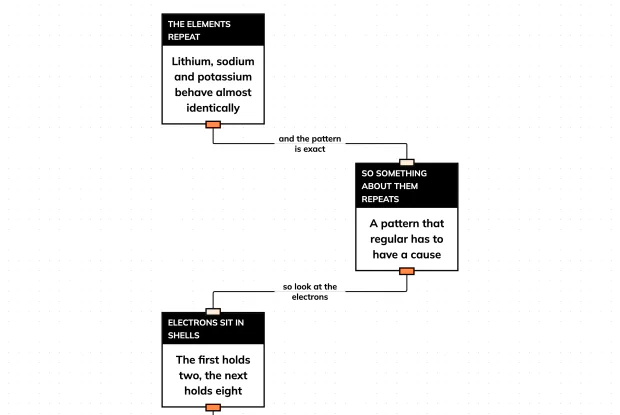
Lithium, sodium and potassium behave almost identically, and that is not a coincidence. Work back from the repeating pattern to how electrons are arranged in shells.
Why Is the Periodic Table That Shape? Count Outwards
The periodic table is not a chart to memorise. Its rows are shells and its columns are outer electrons. Sort three groups by what their atoms have in common in an interactive playground.