What Is the Atomic Number? Rule Out the Rest
Root Concept
The number of protons in an atom’s nucleus is what makes it an atom of a particular element, because electrons can be gained or lost and neutrons can vary without the element changing, while the proton number cannot be altered by any chemical process — which is why it is called the atomic number.
CodePLU Goal
Upgrading Human Mental Models
Learn how to think in Workflows

Concept Development By codeplu.com
Nothing here is asserted. Two of the three candidates are eliminated by counter-example, and one is left.
The Question the Last Track Left Open
An element is a substance nothing breaks down into anything simpler, and there are about ninety of them occurring naturally. That much was settled two tracks ago. What was left hanging was the obvious follow-up: what actually makes a copper atom a copper atom rather than a sulfur one? Something inside it must be different, because nothing on the outside is reliable and no reaction has ever turned one element into another.
The previous tutorial handed over the only three candidates there are. An atom contains protons, neutrons and electrons, and nothing else. So the question has become small enough to answer properly: which of those three decides the element?
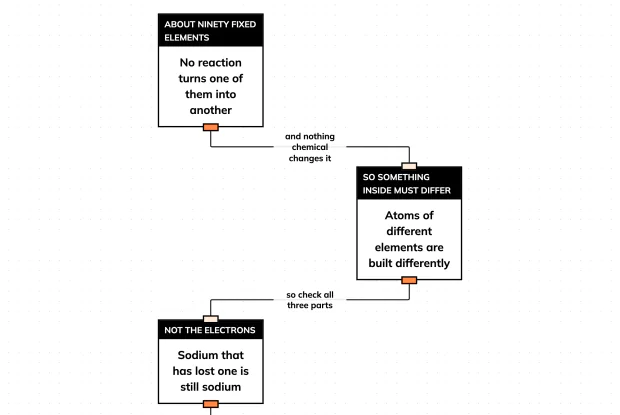
It is worth resisting the urge to be told. Two of the three can be ruled out by counter-example, and the counter-examples are ordinary rather than exotic. An atom can lose an electron and still be the same element — that is what happens every time salt dissolves. An atom can carry a different number of neutrons and still be the same element — that is why the mass on a periodic table is so often not a whole number. Each of those facts knocks out one candidate.
Which leaves one. The playground runs the elimination a step at a time, and the answer arrives because the alternatives have gone.
Eliminating the Candidates
Why can the electrons be ruled out?
Because atoms gain and lose them constantly without becoming anything else. A sodium atom has 11 protons and 11 electrons. Give it the chance and it readily loses one electron, leaving 11 protons and 10 electrons and an overall charge of +1. That charged particle is called an ion, and the crucial point is what it is an ion of: it is still sodium. It is written Na⁺, with the same symbol, and it sits in the same place on the periodic table. Table salt is full of them. If losing an electron turned sodium into something else, that something else would need a name and a place of its own, and it has neither. Electrons are therefore not what decides the element. What ions actually do is the subject of the next track.
Why can the neutrons be ruled out?
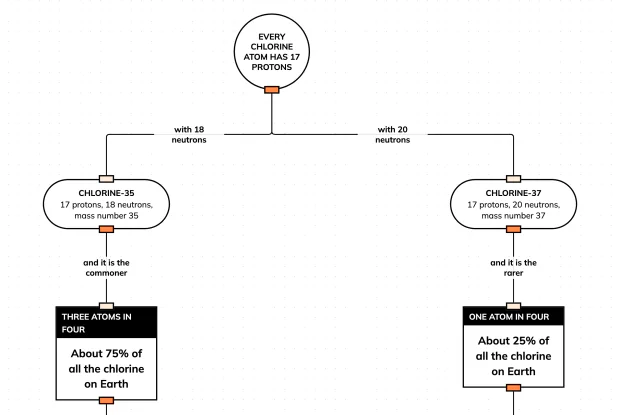
Because the same element routinely comes with different numbers of them. Every chlorine atom has 17 protons, but some have 18 neutrons and some have 20, giving mass numbers of 35 and 37. Both are chlorine. Both are green, both are poisonous, both react identically with sodium to make ordinary salt, and no chemical test distinguishes them. Atoms of one element with different neutron counts are called isotopes, and almost every element has more than one. If neutrons decided the element, chlorine-35 and chlorine-37 would have to be two different elements, which would mean two entries on the periodic table and two sets of reactions. There is one of each. The next tutorial takes this further, because it also explains a number that looks wrong.
So what is left, and why is it fixed?
Only the protons, and this is where the elimination stops being a trick of logic and starts being a definition. An atom with 3 protons is lithium. Not usually lithium, or lithium under normal conditions — lithium, with no exceptions, whatever its neutron count and whatever charge it carries. An atom with 6 protons is carbon and an atom with 79 is gold. That number is called the atomic number, written as Z, and it is the one thing about an atom that no chemical process can change. Reactions move electrons about; they never touch the nucleus. This is exactly why the alchemists failed: turning lead into gold means changing 82 protons into 79, and no amount of heating or mixing reaches that far in.
Why is the periodic table in this order?
Because it is ordered by atomic number, and that choice is less obvious than it sounds. The table was first built by ordering elements by atomic mass, which mostly works and occasionally does not: tellurium is heavier than iodine, yet putting them in mass order places each in a group whose chemistry it does not share. Mendeleev swapped them anyway, on the grounds that the chemistry had to be right, and could not say why. The answer came later — the correct order is proton number, and by that measure tellurium genuinely does come first. Every element in the modern table sits at the position matching its atomic number, which is why there are no gaps and no judgement calls left.
Real World Example
Three Cases Where Only the Proton Count Survives
The elimination is easier to trust once you see that each counter-example is something ordinary rather than a laboratory curiosity.
Step 1
Dissolving salt makes ions by the trillion
When salt dissolves in water, the sodium and chlorine separate into charged particles: each sodium has lost one electron and each chlorine has gained one. A glass of salty water therefore contains an enormous number of atoms that are not electrically neutral, and not one of them has changed element. The sodium is still sodium — it is why the label says sodium chloride, and why the sodium in your blood is measured as sodium. Electrons move in and out all the time in ordinary chemistry, which is precisely the reason they cannot be what fixes an element’s identity.
Step 2
Carbon dating relies on an element having isotopes
All carbon has 6 protons. Most of it has 6 neutrons, a small amount has 7, and a tiny trace has 8 — carbon-12, carbon-13 and carbon-14. Living things take up all three in the proportions found in the air, and carbon-14 slowly breaks down after death while the others do not, which is what lets a bone be dated. The whole technique depends on carbon-14 being carbon: it is absorbed by plants exactly as carbon-12 is, because chemistry cannot tell them apart. Different neutrons, same element, same reactions — and a dating method that works precisely because the difference is invisible to chemistry and plain to a detector.
Step 3
Alchemy failed for a reason nobody could see
Centuries of work went into turning base metals into gold, and the failure was not down to poor technique or missing ingredients. Lead has 82 protons and gold has 79, so the task was never a chemical one at all — it required removing three protons from a nucleus, and chemistry only ever rearranges electrons. The alchemists had no way of knowing this, because the proton was not identified until the twentieth century. It can in fact be done today in a particle accelerator, at a cost per atom that makes the result worth far less than the electricity used.
FAQs
Final Words
Three candidates, two eliminated, one left. Electrons cannot decide it: atoms gain and lose them constantly, and a sodium ion is still sodium. Neutrons cannot either, because chlorine comes with 18 of them or 20 and both are chlorine. That leaves the protons, and the proton count turns out to be fixed in a way neither of the others is: no chemical process reaches the nucleus, so an atom with 3 protons is lithium permanently.
That number is the atomic number, and it does more work than its size suggests. It is the element’s identity, it is the order the periodic table runs in, and it is the reason the table has no gaps left to argue about. It also explains a famous failure: lead has 82 and gold has 79, so the alchemists were attempting something chemistry cannot do. The next tutorial picks up the loose end left here — why the mass on the periodic table is so often not a whole number.
Continue This Track
This concept is part 2 of Inside the Atom.
What Is Actually Inside an Atom? Label the Parts
An atom is three kinds of particle in two places, and overwhelmingly empty space. Label a lithium atom and its magnified nucleus in an interactive playground.
What Is the Atomic Number? Rule Out the Rest
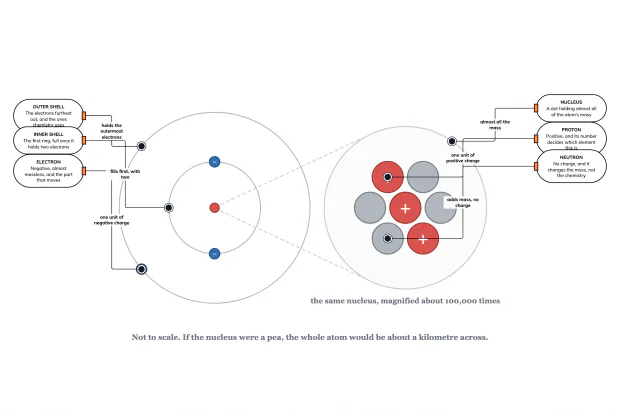
An atom has three kinds of particle, and only one of them decides which element it is. Eliminate the other two step by step in an interactive playground.
Why Does Chlorine Weigh 35.5? Count Both Kinds
Atoms are built from whole particles, so a mass of 35.5 looks impossible. Follow both isotopes of chlorine to the weighted average in an interactive playground.
How Are an Atom’s Electrons Arranged? 2, 8, 8
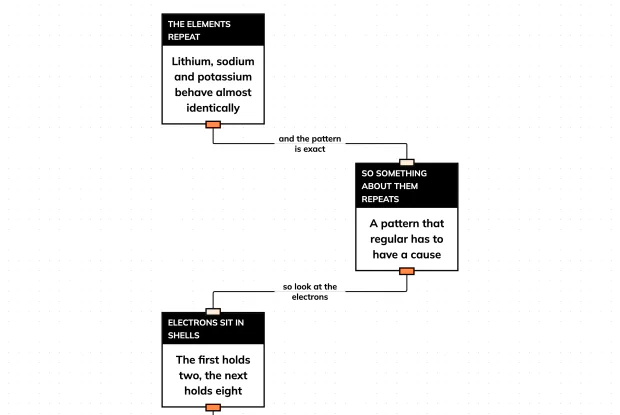
Lithium, sodium and potassium behave almost identically, and that is not a coincidence. Work back from the repeating pattern to how electrons are arranged in shells.
Why Is the Periodic Table That Shape? Count Outwards
The periodic table is not a chart to memorise. Its rows are shells and its columns are outer electrons. Sort three groups by what their atoms have in common in an interactive playground.