How Are an Atom’s Electrons Arranged? 2, 8, 8
Root Concept
Electrons occupy shells that fill from the inside outwards, holding two in the first and eight in the next two, and because only the outermost electrons are exposed to another atom, elements with the same number of outer electrons behave alike — which is why the properties of the elements repeat.
CodePLU Goal
Upgrading Human Mental Models
Learn how to think in Workflows

Concept Development By codeplu.com
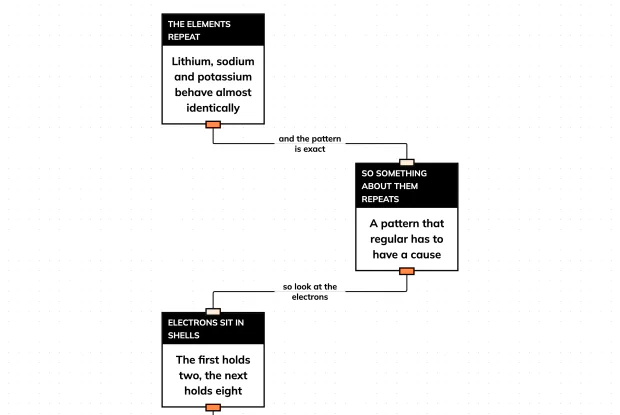
The chain starts from something observable — elements that behave alike — and ends at the arrangement that explains it.
A Pattern Too Regular to Be Chance
Lithium, sodium and potassium are three different elements with three different masses, and they behave so similarly that you could mistake a description of one for a description of another. All three are soft metals that can be cut with a knife. All three react with water, fizzing and releasing hydrogen, and each does it more vigorously than the one above it. All three form compounds with chlorine in a one to one ratio.
Now look at where they sit. Lithium is element 3, sodium is element 11, potassium is element 19. The gaps are eight and eight. Go to the other end of the table and the same thing happens: helium is 2, neon is 10 and argon is 18, and all three are gases that take part in almost no reactions at all. Something is repeating with a period of eight, and a pattern that exact does not happen by accident.
The previous tutorials established that an atom is a nucleus with electrons around it, and that the nucleus decides which element an atom is but takes no part in reactions. So whatever is repeating has to be about the electrons. This tutorial works backwards from the pattern to the arrangement that produces it.
The answer is that electrons occupy shells which fill from the inside outwards, and that only the outermost ones are exposed. The playground builds that reasoning one step at a time.
From the Pattern to the Arrangement
What does it mean to say electrons sit in shells?
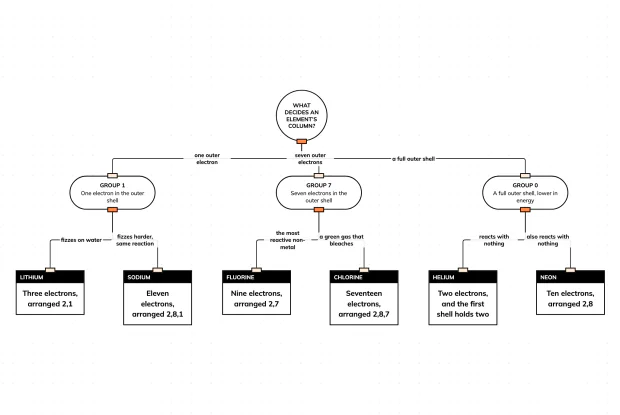
That electrons are found at certain distances from the nucleus and not at others, and that each of those regions takes only so many before the next begins to be used. The first shell takes two, the second eight, and the third eight for the first twenty elements. So lithium, with three electrons, is written 2,1 — two in the first shell and one left over in the second. Sodium, with eleven, is 2,8,1. Potassium, with nineteen, is 2,8,8,1. Writing the three out underneath one another makes the thing they share obvious, and it is the only thing they share: each ends in a single outer electron. The rest of their arrangements are entirely different.
Why does only the outer shell matter?
Because it is the part of an atom that another atom encounters. Inner electrons are held closer to the nucleus and are surrounded by the outer ones, so when two atoms come near each other it is their outermost electrons that interact. Everything chemistry describes — bonding, reactions, why an element is a metal, what charge an ion carries — is decided there. This is why the arrangement is usually written with the last number emphasised, and why two elements with wildly different masses can behave the same. Potassium has more than six times as many electrons as lithium, and almost all of them are buried where no other atom will ever reach them.
So why do the gaps come out as eight?
Because eight is how many electrons the second and third shells hold, so that is how many elements it takes to go from one outer electron back round to one outer electron again. Start at lithium, 2,1. Adding electrons one at a time fills the second shell — beryllium 2,2, boron 2,3, and so on up to neon at 2,8, where that shell is full. The next electron has to start a new shell, so sodium is 2,8,1 and the pattern begins again. Eight steps, and the outer count is back where it started. The period of the repeat is simply the capacity of the shell being filled, which is also why the first row of the periodic table is short: the first shell holds only two.
What does a full outer shell actually mean?
It means an arrangement that is low in energy, and it is worth being careful about how that is phrased. Atoms do not want full shells, do not try to fill them, and are not happier when they do — that way of talking is everywhere and it replaces a mechanism with a motive. What is true is that an arrangement with a filled outer shell is lower in energy than the alternatives, and systems settle into lower-energy arrangements. Helium at 2 and neon at 2,8 are already in such an arrangement, which is why they take part in almost no reactions: there is nothing to be gained by rearranging. Elements one or two electrons away from that situation are the reactive ones.
Real World Example
Three Families, Read Straight off the Arrangement
Once the arrangements are written out, the behaviour of a whole family stops being a list to learn and becomes something you can read off.
Step 1
One outer electron, and all of them fizz
Lithium is 2,1, sodium is 2,8,1 and potassium is 2,8,8,1. Each has a single outer electron that is loosely held, and each loses it readily, which is why all three react with water in the same way and why all three form ions carrying a charge of +1. The reactions get more vigorous going down the group because the outer electron is further from the nucleus each time and therefore held less tightly. These reactions are demonstrated by teachers behind a screen and are never attempted outside a laboratory; potassium ignites the hydrogen it produces.
Step 2
Seven outer electrons, and all of them grab one
Fluorine is 2,7 and chlorine is 2,8,7, each one electron short of a filled outer shell. Both react readily with metals, both form ions carrying a charge of −1, and both combine with sodium in a one to one ratio to give a compound of the same general kind — sodium fluoride and sodium chloride. The trend runs the other way from the metals here: fluorine is the more reactive, because its outer shell is closer to the nucleus and an arriving electron is attracted more strongly. Two families, opposite trends, and both read straight off the same arrangement — which is the point of writing it down at all.
Step 3
A full outer shell, and almost nothing happens
Helium is 2, neon is 2,8 and argon is 2,8,8, and all three have filled outer shells. They form almost no compounds, which is why they are used where a completely unreactive atmosphere is needed — argon inside a welding shield, helium in balloons and in cooling superconducting magnets. The word inert was once applied to the whole group and has been quietly dropped, because the heavier ones do react under extreme conditions. Unreactive is accurate; incapable of reacting is not. The distinction matters, because the group is the clearest evidence there is that a filled outer shell is a low-energy arrangement rather than an unbreakable rule.
FAQs
Final Words
The argument starts from something anyone can observe and ends at something nobody can. Lithium, sodium and potassium behave almost identically, and they sit eight apart in the list of elements. A repeat that regular needs a cause, and the cause cannot be the nucleus, because the nucleus takes no part in reactions. It has to be the electrons.
Electrons occupy shells that fill from the inside outwards — two in the first, eight in the next two — and only the outermost ones are exposed to another atom. So lithium at 2,1, sodium at 2,8,1 and potassium at 2,8,8,1 share the one thing that matters, and it takes exactly eight elements to fill a shell and arrive back at a single outer electron. That is the whole of the repeat. The last tutorial in this track takes that result and uses it to explain the shape of the periodic table itself.
Continue This Track
This concept is part 4 of Inside the Atom.
What Is Actually Inside an Atom? Label the Parts
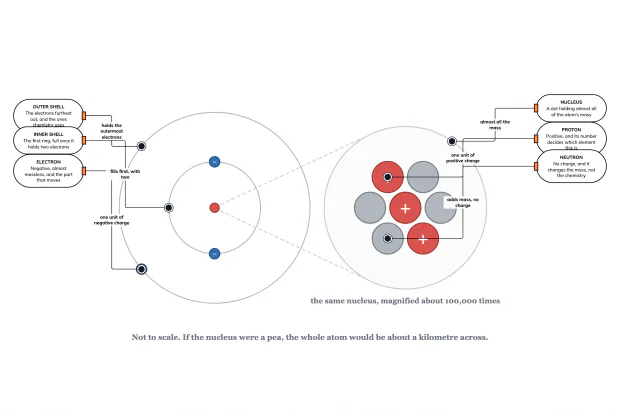
An atom is three kinds of particle in two places, and overwhelmingly empty space. Label a lithium atom and its magnified nucleus in an interactive playground.
What Is the Atomic Number? Rule Out the Rest
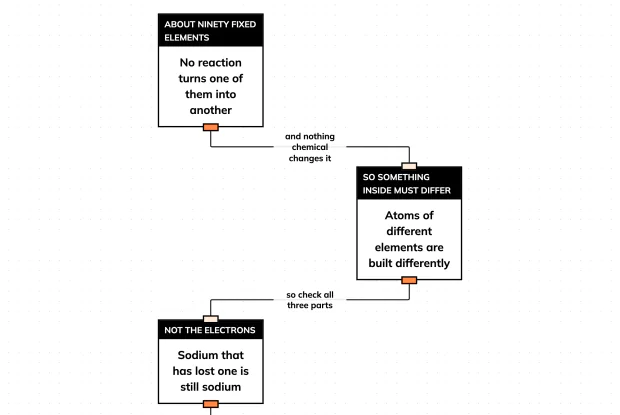
An atom has three kinds of particle, and only one of them decides which element it is. Eliminate the other two step by step in an interactive playground.
Why Does Chlorine Weigh 35.5? Count Both Kinds
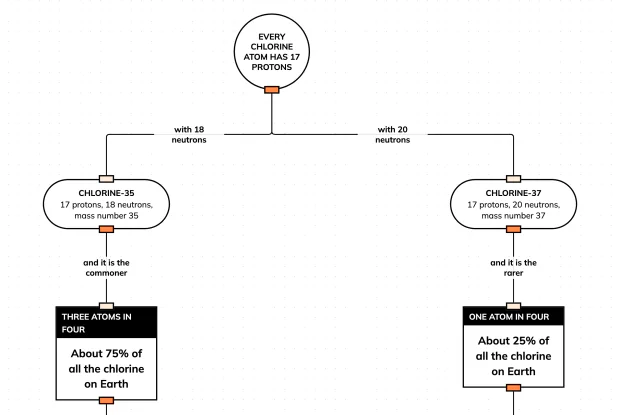
Atoms are built from whole particles, so a mass of 35.5 looks impossible. Follow both isotopes of chlorine to the weighted average in an interactive playground.
How Are an Atom’s Electrons Arranged? 2, 8, 8
Lithium, sodium and potassium behave almost identically, and that is not a coincidence. Work back from the repeating pattern to how electrons are arranged in shells.
Why Is the Periodic Table That Shape? Count Outwards
The periodic table is not a chart to memorise. Its rows are shells and its columns are outer electrons. Sort three groups by what their atoms have in common in an interactive playground.