Why Is the Haber Process a Compromise? Rate vs Yield
Root Concept
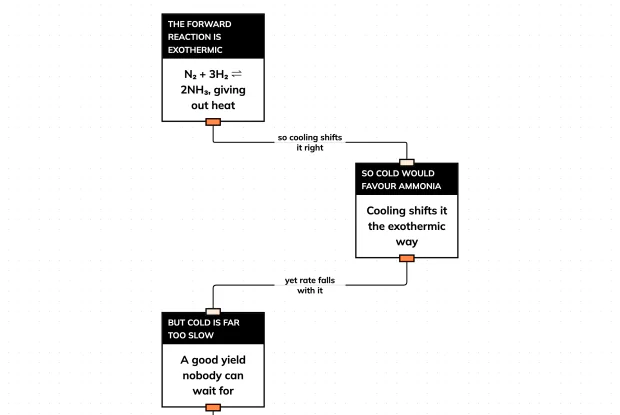
Ammonia production is exothermic, so a low temperature would give the best yield but an unusably slow reaction, and a high temperature the reverse — so a plant runs at an intermediate temperature chosen to balance the two, with a catalyst restoring the rate that the lowered temperature costs.
CodePLU Goal
Upgrading Human Mental Models
Learn how to think in Workflows

Concept Development By codeplu.com
The fourth step is not a chemical result. It is a decision, forced by the two above it disagreeing.
When the Chemistry Gives Two Answers
Nitrogen and hydrogen combine to make ammonia: N₂ + 3H₂ ⇌ 2NH₃, read aloud as nitrogen plus three hydrogen gives two ammonia, and back again. Ammonia is the basis of most of the world’s fertiliser, so the question of what conditions to run this in is one of the more consequential questions in industrial chemistry.
Everything needed to answer it is now in place, and the answer is awkward. The forward reaction is exothermic. So by the rule from two tutorials ago, cooling the mixture shifts the balance towards ammonia — a low temperature gives the best yield. But the rates track is equally clear that cooling slows a reaction down, and at a low enough temperature the reaction is so slow that an excellent yield arrives long after anybody could use it.
Those are not two views of one quantity. They are two different quantities, answered by the same lever, pulling opposite ways. A plant cannot have both, and pretending otherwise is how the topic is usually got wrong.
So the temperature is chosen rather than derived: around 450 °C, which is neither answer. The yield at that temperature is poor — well under half — and the rate is tolerable. A catalyst then buys back speed without costing any yield, which is exactly the trade the previous tutorial showed a catalyst can make, and the unreacted gases are recycled so the poor yield per pass matters far less than it looks.
Working the Decision Through
Why does cooling improve the yield?
Because making ammonia gives out heat, and an equilibrium shifts in whichever direction opposes the change imposed on it. Take heat away and the balance moves towards the direction that produces heat, which here is the forward one — so more ammonia. Add heat and it moves the other way, breaking ammonia back down. This is the counter-intuitive result the shifting tutorial flagged as worth repeating: with a reversible exothermic reaction, hotter means less product. Everything about the design of this plant follows from that one sentence, and a reader who has it backwards will get every subsequent step backwards too. It is also why the plant cannot simply be made hotter when more ammonia is wanted, which is the first instinct almost everybody has.
Why not simply run it cold, then?
Because the yield is only half the question. A rate is a count of collisions per second hard enough to react, and cooling reduces both how often particles meet and — far more importantly — what fraction of those meetings clears the activation energy. The nitrogen molecule is held together by an unusually strong triple bond, so this reaction has a high barrier to begin with, and at low temperature almost nothing gets over it. A reactor at room temperature would produce ammonia at a rate no factory could sell. An excellent position reached too slowly is commercially identical to no reaction at all. The plant is therefore built around a rate it can live with rather than the position the chemistry would prefer.
What does the pressure do?
It helps the yield, and unlike temperature it costs nothing in rate. Count the gas molecules on each side: four on the left — one nitrogen and three hydrogen — and two on the right. Raising the pressure shifts the balance towards the side with fewer gas molecules, which is the ammonia side, so high pressure improves the yield AND speeds the reaction up by crowding the particles together. The reason plants do not simply raise it further is engineering rather than chemistry: vessels and pipework able to hold very high pressures safely become disproportionately expensive and dangerous. So the operating pressure is set by what a vessel can safely hold, not by any point at which the chemistry stops helping.
What is the catalyst actually buying?
Speed at a temperature that would otherwise be too cold to use. Iron provides a surface route that weakens the nitrogen triple bond, so the reaction proceeds usably at 450 °C rather than needing something far hotter — and as the previous tutorial established, it speeds both directions equally and therefore costs nothing in yield. That is the whole value of it here. Without a catalyst the plant would need a higher temperature to reach the same rate, and a higher temperature would move the balance the wrong way. The catalyst buys yield indirectly, by removing the reason to heat. That distinction is worth holding onto, because the catalyst is very often credited with a yield improvement it does not itself produce.
Real World Example
The Numbers a Real Plant Actually Uses
Every figure in a set of industrial conditions is the outcome of an argument like the one above, and each can be read backwards to find it.
Step 1
About 450 °C, and a yield well under half
The temperature is high enough for a workable rate and low enough that the equilibrium has not moved too far the wrong way. The yield that results is poor by the standards of a school calculation — the reaction converts only a fraction of what goes in on each pass — and it is accepted deliberately, because the alternative is a better yield that arrives too slowly to sell. Reading that figure as a failure misses that it was chosen with the trade-off fully in view. The right question to ask of that figure is not how much it converts, but how much it converts per hour of plant time.
Step 2
About 200 atmospheres, limited by steel rather than chemistry
Pressure is the lever with no downside in the chemistry: it improves the yield and the rate at once, because the ammonia side has fewer gas molecules and because crowding particles together makes them collide more often. The ceiling is entirely practical. Vessels rated for higher pressures cost more, leak more consequentially and fail more dangerously, so the figure chosen is where the chemistry stops arguing with the engineering. So this is the one condition where the chemistry and the economics disagree outright: the reaction would take as much pressure as it was given, and the limit is drawn entirely by the cost of holding it.
Step 3
Recycling makes the poor yield almost irrelevant
The gases leaving the reactor are cooled until the ammonia condenses to a liquid and is drawn off, while the unreacted nitrogen and hydrogen stay gaseous and are fed back round. So almost everything is eventually converted even though each pass converts little. Removing the product also shifts the balance forwards, as the shifting tutorial described, so the separation is doing two jobs at once — and it is why the yield per pass is the wrong figure to judge the process by. A reactor that converts a small fraction per pass and recycles the rest is, taken as a whole plant, one that converts almost everything.
FAQs
Final Words
Making ammonia is exothermic, and that fact forces the whole design. Cooling shifts the balance towards ammonia, so a low temperature gives the best yield — and cooling slows the reaction, so it gives a rate nobody can use. Two quantities, one lever, opposite directions. A plant cannot have both, so its operating figure is a decision, not a result.
The compromise is around 450 °C — poor yield, workable rate — and the rest of the design repairs what that costs. An iron catalyst buys back speed without touching the position, buying yield indirectly by removing the reason to run hotter. High pressure improves yield and rate together, limited by what steel can hold. And the ammonia is condensed out and the rest recycled, which shifts the balance forwards and makes the yield per pass the wrong figure.
The next track examines what every argument here used without examining: what a column of the periodic table tells you, and where that rule runs out.
Continue This Track
This concept is part 5 of Reactions That Go Both Ways.
A Reaction You Can Run Backwards, and Watch
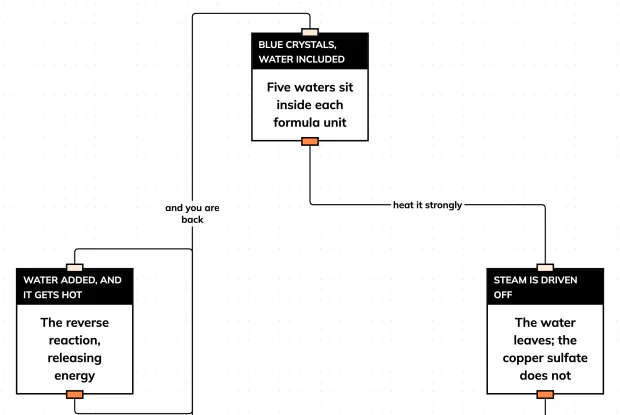
Heat blue copper sulfate and it turns white. Add water and it turns blue again, and gets hot. Follow a reaction round a closed loop in an interactive playground.
What Is Dynamic Equilibrium? Nothing Has Stopped
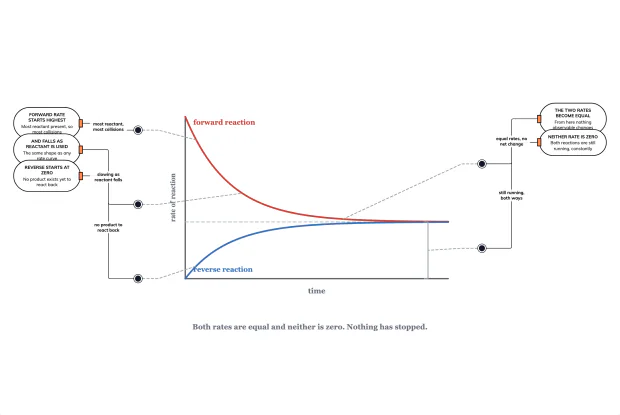
A reaction at equilibrium looks finished and is not — both directions are running at equal rates. Read it off a graph of rates in an interactive playground.
What Shifts an Equilibrium? Push It and See
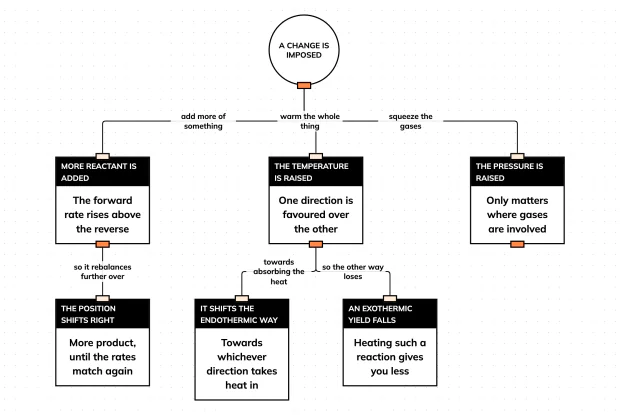
An equilibrium that is disturbed settles somewhere new, and which way it moves can be predicted. Trace three kinds of change and their consequences in an interactive playground.
Does a Catalyst Shift an Equilibrium? No — Here Is Why
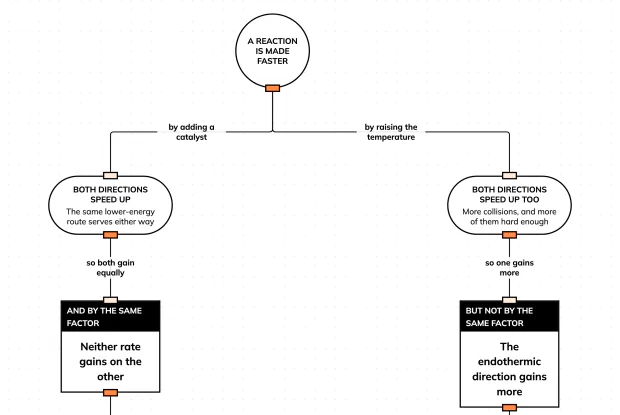
A catalyst and a temperature rise both speed a reversible reaction up, and only one changes where the balance sits. Follow both routes from one starting point in an interactive playground.
Why Is the Haber Process a Compromise? Rate vs Yield
The conditions that favour ammonia yield and the conditions that favour speed pull in opposite directions. Follow the argument to the figure a real plant uses, in an interactive playground.