What Shifts an Equilibrium? Push It and See
Root Concept
When a condition is changed, an equilibrium shifts in whichever direction opposes that change and then settles at a new balance — adding a substance shifts it away from that substance, raising the temperature shifts it the endothermic way, and raising the pressure shifts it towards whichever side has fewer gas molecules.
CodePLU Goal
Upgrading Human Mental Models
Learn how to think in Workflows

Concept Development By codeplu.com
Three kinds of change, and one of them does nothing at all unless gases are involved.
A Balance That Pushes Back
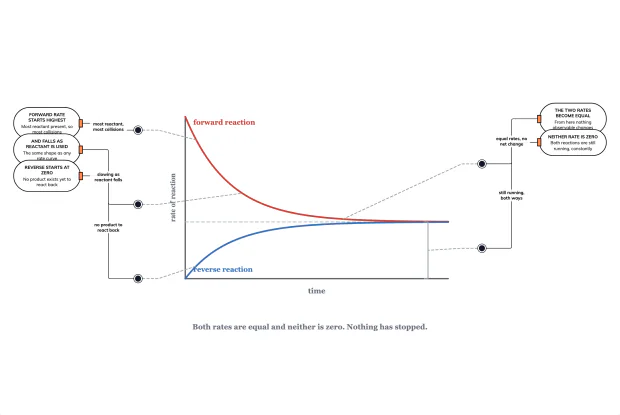
The previous tutorial established that an equilibrium holds itself: the two rates are equal, so the amounts stop changing, and because the amounts stop changing the rates stay equal. That is a stable state rather than a passing moment.
Stable does not mean fixed. Change a condition and the two rates stop matching, so the amounts start changing again — and they keep changing until the rates are equal once more, at a new balance with different amounts of everything. The equilibrium has shifted.
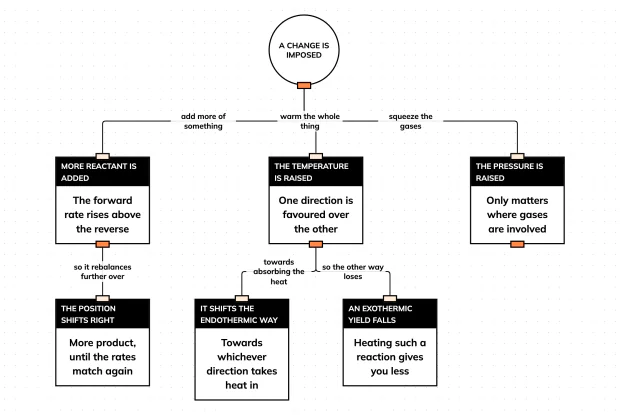
What makes this worth a tutorial is that the direction is predictable. The rule, stated carefully, is that the system shifts in whichever direction opposes the change imposed on it. Add more of a substance and it shifts away from that substance, using it up. Raise the temperature and it shifts in whichever direction absorbs heat. Raise the pressure on a gas mixture and it shifts towards whichever side has fewer gas molecules, because that reduces the pressure.
"Opposes" is doing careful work in that sentence and is easy to over-read. The system does not undo the change or restore the original conditions — it cannot, and it is not trying to. It settles at a new balance that is less extreme than it would otherwise have been, which is a much weaker claim and the accurate one.
The Three Changes
What happens when you add more of something?
The rate of whichever reaction uses it goes up, and the balance moves away from it. Add more reactant and the forward rate rises above the reverse rate, so product accumulates — which raises the reverse rate — until the two are equal again, with more of everything on the product side than before. Removing a product does the same thing by the opposite route: the reverse rate drops, so the forward reaction wins until a new balance is reached. That second version is the one industry uses constantly, because continuously taking the product out keeps the reaction running forwards instead of letting it settle. Neither version changes the chemistry; both change which rate is ahead.
Why does temperature shift it at all?
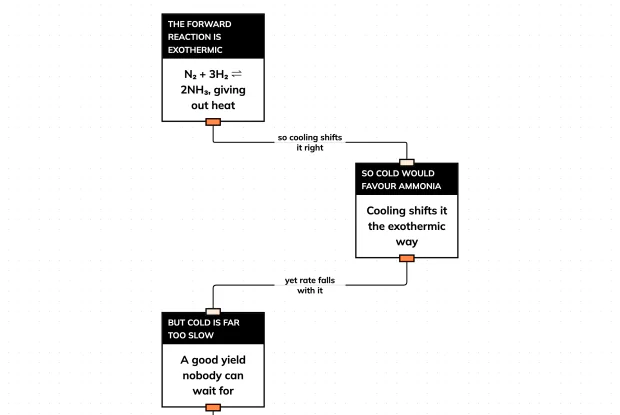
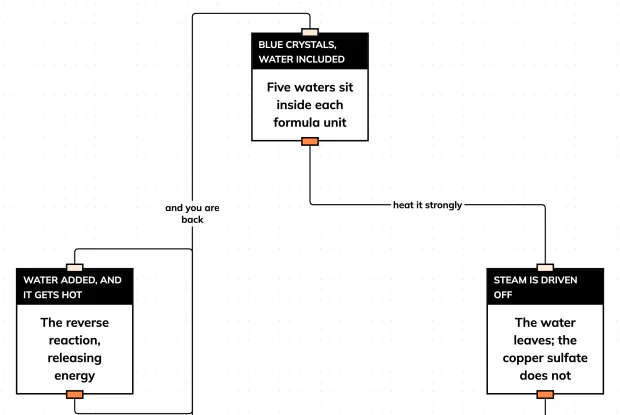
Because the two directions are not affected equally. A reversible reaction that gives out heat one way takes it in the other, by exactly the same amount — the point the copper sulfate tutorial made. Supplying more heat favours the direction that absorbs it, so the equilibrium shifts the endothermic way. The practical consequence catches people out: heating an exothermic reaction gives you LESS product, not more, because the forward direction is the one releasing heat and adding heat pushes against it. This is the single most important fact in the next two tutorials. It also explains why so many industrial reactions are run cooler than their rate alone would suggest, and why that creates a problem the last part of this track has to solve.
When does pressure matter?
Only when gases are involved, and only when the two sides have different numbers of gas molecules. Pressure comes from gas particles striking the walls, so squeezing a mixture raises it, and the system shifts towards whichever side has fewer gas molecules because fewer particles exert less pressure. If both sides have the same number, raising the pressure does nothing to the position at all — it speeds everything up, as the rates track explained, without moving the balance. Counting the gas molecules on each side of the equation is therefore the first thing to do with any pressure question. Solids and liquids are ignored in that count, because their volume barely changes under pressure.
What does "opposes the change" not mean?
It does not mean the change is undone. Raise the temperature and the equilibrium shifts in the direction that absorbs heat, but the mixture still ends up hotter than it was — the shift makes it less hot than it would have been, and that is all. The same goes for pressure and concentration: add more reactant and there is still more reactant afterwards than before, just less than you added. Reading the rule as "the system restores itself" leads to predictions that are straightforwardly wrong, and it is worth saying the weaker version to yourself instead. The system is not trying to do anything; it is simply settling where the two rates happen to match under the new conditions.
Real World Example
Three Equilibria Being Pushed on Purpose
Shifting an equilibrium deliberately is one of the most common things done to a reversible reaction, in a plant and in a body.
Step 1
Removing the product keeps a reaction going
In the ammonia process the gases are cooled as they leave the reactor so the ammonia condenses out as a liquid while the nitrogen and hydrogen stay gaseous. Taking the product away drops the reverse rate, so the forward reaction keeps winning and more ammonia forms from the recycled gases. The equilibrium is never allowed to settle, which is a more effective strategy than trying to improve the position itself — and it is why the yield per pass matters less than it looks. The position of the equilibrium has not been improved at all — it has been prevented from mattering.
Step 2
Limestone caves are an equilibrium shifting twice
Rainwater carrying dissolved carbon dioxide reacts with limestone and dissolves it, which is how caves form. Where that water drips into open air, some of the carbon dioxide escapes, the equilibrium shifts back, and solid calcium carbonate is deposited — which is how stalactites grow. The same reversible reaction running one way underground and the other way in a cavern, over thousands of years, with the escaping gas doing the shifting. The cave and the stalactite are the same equilibrium, pushed in opposite directions by whether the carbon dioxide can get away. Nothing about the chemistry differs between the two.
Step 3
Your blood runs on a buffered equilibrium
Carbon dioxide produced by respiration dissolves in blood and forms carbonic acid, in a reversible reaction that holds blood pH within a very narrow range. Breathing faster removes carbon dioxide and shifts the balance, which is why over-breathing changes blood chemistry rather than simply supplying more oxygen — a point the human-body category makes about why you breathe faster when you run. The equilibrium is doing the regulating. It is a good illustration that equilibrium is not an industrial trick but the normal state of a reversible reaction left alone — including inside a living thing.
FAQs
Final Words
An equilibrium holds itself, and it is not fixed. Change a condition and the two rates stop matching, so the amounts move until they match again at a new balance. The direction is predictable: the system shifts in whichever direction opposes the change. Add a substance and it shifts away from that substance; raise the temperature and it shifts the way that absorbs heat; raise the pressure and it shifts towards the side with fewer gas molecules.
Two cautions matter more than the rule itself. "Opposes" does not mean undoes — a heated mixture still ends up hotter, merely less so than it would have been, and reading the rule as self-restoration produces wrong answers. And the temperature result is counter-intuitive enough to be worth repeating: with a reversible exothermic reaction, heating gives you less product. The next tutorial separates shifting an equilibrium from simply speeding one up, which temperature confusingly does at once.
Continue This Track
This concept is part 3 of Reactions That Go Both Ways.
A Reaction You Can Run Backwards, and Watch
Heat blue copper sulfate and it turns white. Add water and it turns blue again, and gets hot. Follow a reaction round a closed loop in an interactive playground.
What Is Dynamic Equilibrium? Nothing Has Stopped
A reaction at equilibrium looks finished and is not — both directions are running at equal rates. Read it off a graph of rates in an interactive playground.
What Shifts an Equilibrium? Push It and See
An equilibrium that is disturbed settles somewhere new, and which way it moves can be predicted. Trace three kinds of change and their consequences in an interactive playground.
Does a Catalyst Shift an Equilibrium? No — Here Is Why
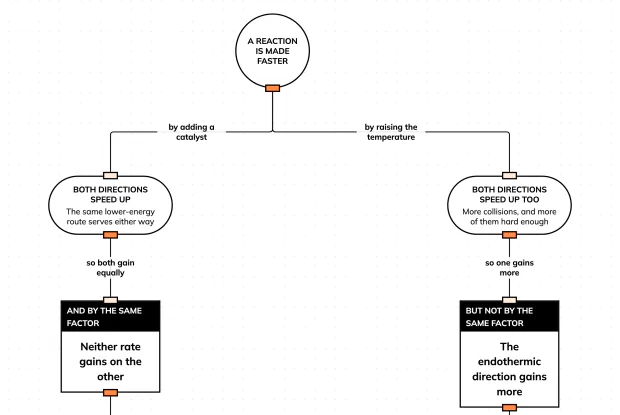
A catalyst and a temperature rise both speed a reversible reaction up, and only one changes where the balance sits. Follow both routes from one starting point in an interactive playground.
Why Is the Haber Process a Compromise? Rate vs Yield
The conditions that favour ammonia yield and the conditions that favour speed pull in opposite directions. Follow the argument to the figure a real plant uses, in an interactive playground.