Does a Catalyst Shift an Equilibrium? No — Here Is Why
Root Concept
A catalyst provides the same lower-energy route in both directions, so it speeds the forward and reverse reactions by the same factor and the equilibrium is reached sooner in exactly the same position — whereas a temperature rise speeds the two directions unequally and therefore shifts the balance as well.
CodePLU Goal
Upgrading Human Mental Models
Learn how to think in Workflows

Concept Development By codeplu.com
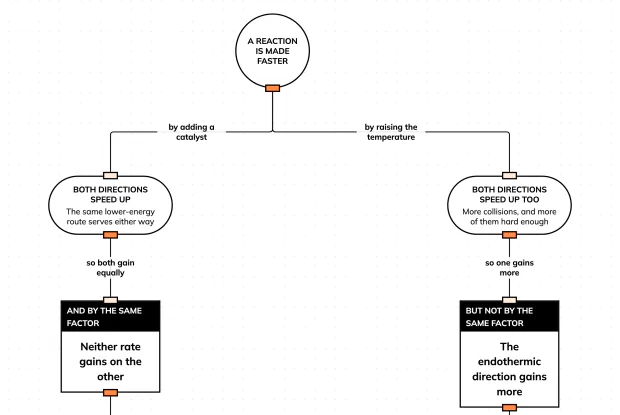
Both branches go faster. Only the right-hand one ends up somewhere different.
Two Questions That Keep Getting Merged
There are two separate things you can ask about a reversible reaction. How quickly does it reach equilibrium? And where does that equilibrium sit? They have different answers, different causes, and almost every confusion in this topic comes from treating them as one question.
A catalyst answers only the first. The rates track established what one actually does: it provides an alternative route with a lower activation energy, so a larger fraction of the collisions already happening is enough. The crucial point for equilibrium is that the route works in both directions — it is the same hill, and lowering it lowers it for traffic going either way. So the forward and reverse rates both rise, by the same factor, and they become equal at exactly the same position as before. Equilibrium arrives sooner and arrives in the same place.
Temperature answers both, which is why it is the source of the confusion. Heating a mixture speeds up both directions, as the rates track showed — but not by the same factor, because the two directions do not need the same energy. The endothermic one gains more. So a temperature rise makes the reaction faster AND moves where it settles.
The playground runs both from the same starting point. Both branches genuinely go faster; only one of them ends up somewhere different.
Why the Two Differ
Why does a catalyst help both directions equally?
Because it is the same route. A catalyst works by offering a path from reactants to products that needs less energy to get started, and a path is not one-way — the same sequence of steps run backwards takes products to reactants, and it is lowered by exactly the same amount. Picture a hill between two valleys with a tunnel cut through it: the tunnel shortens the journey in both directions by the same distance, and it does not make either valley lower than it was. Since both rates rise by the same factor, the point where they become equal is unchanged. The balance is reached sooner and is in the same place.
Why does temperature behave differently?
Because the two directions have different activation energies, so they do not respond to heat by the same amount. The fraction of collisions clearing a barrier rises steeply with temperature, and it rises more steeply for a higher barrier — so the direction with more to overcome gains the most. That direction is always the endothermic one. The result is that heating speeds both reactions up, which is a rates effect, and also tips the balance towards the endothermic side, which is an equilibrium effect. Two consequences from one change, and it is entirely reasonable to find that confusing. Nothing else on the list of levers does two jobs at once.
Is a catalyst useless for equilibrium problems, then?
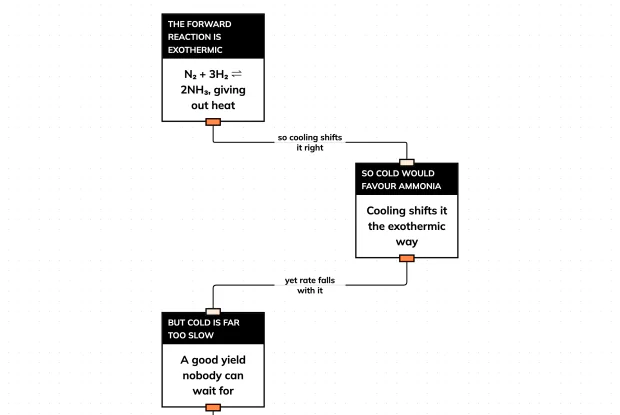
Far from it — it is often the thing that makes the process possible. If an equilibrium sits in a good position but takes a fortnight to get there, the chemistry is correct and the process is worthless. A catalyst turns a fortnight into minutes without costing anything at the other end of the trade. It is also what allows a reaction to be run at a lower temperature than its rate would otherwise permit — and since a lower temperature is often the better position for an exothermic equilibrium, a catalyst indirectly buys yield by removing the reason to heat. That is the argument the next tutorial is built on.
What about pressure and concentration?
Those move the position and are a different kind of lever again. Raising the concentration of a reactant speeds the forward reaction specifically, because rate depends on how much of a reaction’s own reactant is present — so it both speeds things up and shifts the balance. Pressure does the same for gases. The clean way to keep all four straight is to ask what each one does to the two rates: a catalyst raises both equally, temperature raises both unequally, and concentration or pressure raises one of them. Equal means no shift; unequal means a shift. That test is worth memorising in place of the four separate results, because it generates all of them and survives a case you have not seen.
Real World Example
What Each Lever Buys, in a Real Process
A plant chooses its conditions by deciding what it needs from each lever and what it is willing to pay for it.
Step 1
A catalyst is the cheapest thing on the list
It is not consumed, so a quantity bought once works for years; it needs no energy input; and it costs nothing in yield because it does not move the balance. The only reasons not to use one are that a suitable catalyst may not exist for a given reaction, and that some are poisoned by impurities and so demand very clean feedstock. Where one is available it is almost always used, which is why catalysts appear in the great majority of industrial processes. A lever that costs nothing and gives up nothing is rare enough to take whenever it is offered.
Step 2
Temperature is bought twice and paid for twice
Heating buys speed, which is what a plant needs, and for an exothermic reaction it costs yield, which is what the plant is selling. It also costs fuel. So the temperature chosen is never simply the highest achievable — it is a negotiated figure, and the negotiation is between a rate requirement and an equilibrium position pulling in opposite directions. That is what the word compromise means in the phrase every textbook uses about the ammonia process. The word is doing precise work there rather than being a vague gesture at moderation: two named quantities are in conflict and a figure has to be chosen between them.
Step 3
Removing the product is the lever with no downside
Separating the product as it forms shifts the balance forwards and costs nothing in rate, so where it is practical it is the most attractive move available. It needs the product to be separable from the mixture under the reaction conditions, which is why condensing ammonia out of a gas stream works so well and why many other reactions cannot use the trick. When it is available, the position of the equilibrium stops being a constraint at all. The reaction never gets the chance to settle, which beats settling somewhere favourable. It is the one lever with no cost on the other side of the ledger.
FAQs
Final Words
There are two questions about a reversible reaction and they are constantly merged: how fast does it reach equilibrium, and where does that equilibrium sit. A catalyst answers only the first. It offers a lower-energy route, and a route is not one-way — the same path run backwards is lowered by the same amount, so both rates rise by the same factor and become equal in exactly the same place. Equilibrium arrives sooner and arrives where it always would have.
Temperature answers both, which is why it causes the trouble. It speeds both directions up, but not equally: the endothermic one has the higher barrier and gains more, so it shifts the balance too. The test that keeps the four levers straight is to ask what each does to the two rates: a catalyst raises both equally and shifts nothing, temperature raises both unequally, and concentration or pressure raises one of them. The last tutorial puts all of it to work on a single reactor.
Continue This Track
This concept is part 4 of Reactions That Go Both Ways.
A Reaction You Can Run Backwards, and Watch
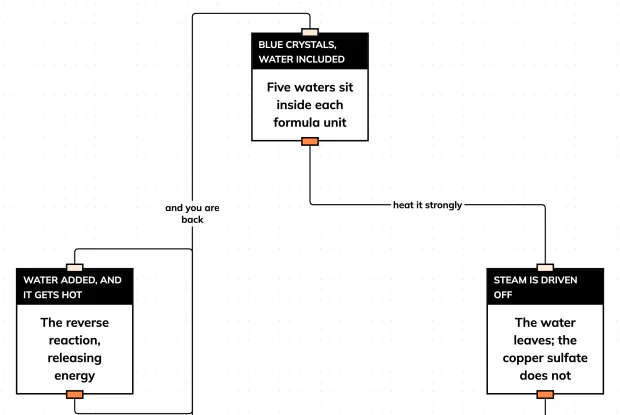
Heat blue copper sulfate and it turns white. Add water and it turns blue again, and gets hot. Follow a reaction round a closed loop in an interactive playground.
What Is Dynamic Equilibrium? Nothing Has Stopped
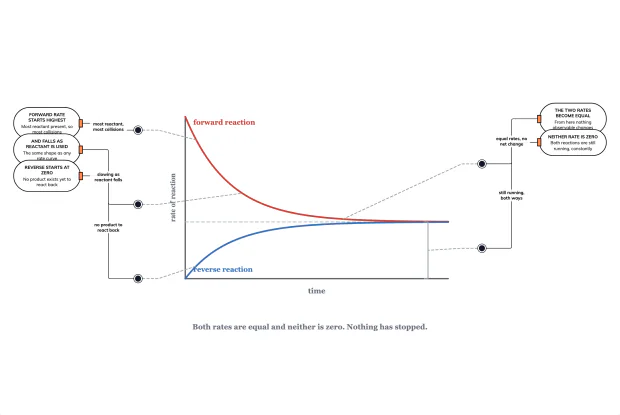
A reaction at equilibrium looks finished and is not — both directions are running at equal rates. Read it off a graph of rates in an interactive playground.
What Shifts an Equilibrium? Push It and See
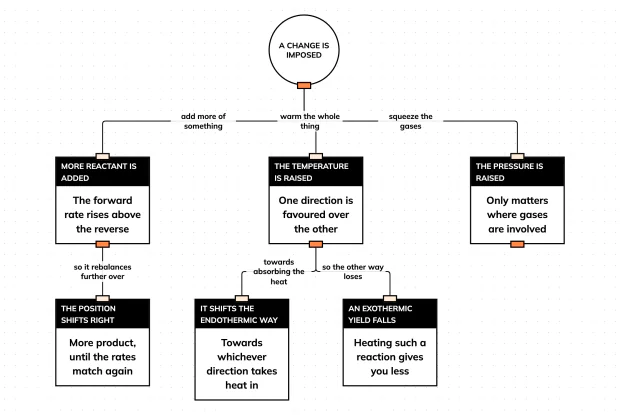
An equilibrium that is disturbed settles somewhere new, and which way it moves can be predicted. Trace three kinds of change and their consequences in an interactive playground.
Does a Catalyst Shift an Equilibrium? No — Here Is Why
A catalyst and a temperature rise both speed a reversible reaction up, and only one changes where the balance sits. Follow both routes from one starting point in an interactive playground.
Why Is the Haber Process a Compromise? Rate vs Yield
The conditions that favour ammonia yield and the conditions that favour speed pull in opposite directions. Follow the argument to the figure a real plant uses, in an interactive playground.