A Reaction You Can Run Backwards, and Watch
Root Concept
Some chemical reactions can be reversed by changing the conditions, so that the products turn back into the reactants and the substance returns to exactly what it was — which is why they are written with a double arrow rather than a single one.
CodePLU Goal
Upgrading Human Mental Models
Learn how to think in Workflows

Concept Development By codeplu.com
There is no first stage on this board. Start anywhere and you come back to it.
A Chemical Change That Undoes Itself
The reactions track drew a sharp line. A physical change is undone by reversing the conditions, because nothing had to be rebuilt; a chemical change is not, because bonds were broken and new ones made, and cooling does not unmake them. Melted butter resets. A cooked egg does not.
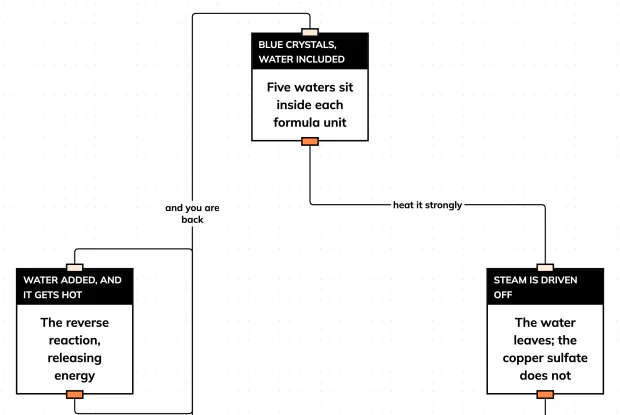
That line is right about most reactions and it is not right about all of them, and the clearest counter-example is one you can watch. Blue copper sulfate crystals, heated gently, give off steam and collapse into a white powder. Add water to the white powder and it turns blue again — and gets noticeably hot while doing it.
Nothing physical is happening here. The blue crystals contain water built into the compound itself, locked into the structure rather than wetting it, and driving that water out is a chemical change with a different substance as the product. Adding water back is the same reaction run in the other direction.
So some reactions are reversible: the products can turn back into the reactants if the conditions change. That is what the double arrow in an equation means, and the equations tutorial promised it as a later topic. This track is that topic, and the playground starts with the case you can see — a loop with no beginning, where you can start anywhere and come back to it.
What Is Actually Happening
Why is this a chemical change rather than drying?
Because the water is part of the compound rather than sitting on it. Hydrated copper sulfate is written CuSO₄·5H₂O, and those five water molecules occupy fixed positions in the crystal — the formula includes them because they are there in a fixed ratio, which is the test the mole track built an entire tutorial around. Drying a wet solid removes water that was merely clinging to it and changes nothing about the substance. Here the product is a different compound with a different colour and different properties, and the proportions are exact. Wet sand dried is still sand; blue copper sulfate heated is not still blue copper sulfate. The fixed ratio is what settles it either way.
Why does the colour change at all?
Because colour belongs to the substance and its structure rather than to the atoms in it, which is the point the bonding track made when the magnet stopped working on iron sulfide. The copper is present in both the blue and the white forms, in the same amount — nothing has been added or taken away except water. What changed is the arrangement around each copper ion, and that arrangement is what the colour comes from. It is a vivid reminder that a compound is not its ingredients sitting side by side, and it is why the demonstration is used so widely: the chemistry announces itself. Nothing has to be measured to see that something real has happened.
What makes a reaction reversible?
That both directions are achievable under conditions you can reach. Every reaction is reversible in principle, because nothing in the physics forbids the products turning back — but for most of them the reverse needs conditions so extreme that it never happens in practice. Burning a candle is the standard case: carbon dioxide and water can be turned back into hydrocarbon, and plants do exactly that, but it needs energy, enzymes and sunlight rather than simply cooling the flame. A reaction is called reversible when both directions are available under ordinary laboratory conditions, which is a practical boundary rather than a sharp one. Where the line falls depends on what conditions count as ordinary, which is why it is a useful word rather than a precise one.
What does the double arrow actually say?
That the reaction proceeds in both directions, and is written ⇌ instead of →. For copper sulfate: CuSO₄·5H₂O ⇌ CuSO₄ + 5H₂O — read aloud, hydrated copper sulfate gives anhydrous copper sulfate plus five waters, and back again. The single arrow of the equations tutorial meant becomes and recorded a direction; the double arrow refuses to commit to one, because which way the reaction runs depends on the conditions rather than on the chemistry alone. Heat it and it goes right; add water and it goes left. The next tutorial takes what happens when neither direction wins. Both arrows are drawn because both are true at once, which is a stronger claim than it first appears and the reason this track needs five parts.
Real World Example
Three Reversible Reactions Doing Useful Work
Reversibility is not a laboratory curiosity. It is the basis of several everyday products and one standard chemical test.
Step 1
White copper sulfate is a test for water
Because the white form turns blue the moment water reaches it, and because it does so reliably and visibly, anhydrous copper sulfate is the standard laboratory test for the presence of water. It is a test for water specifically rather than for a watery liquid — a sample that turns the powder blue contains water, whatever else is in it. The demonstration is carried out in a laboratory with eye protection, and the powder is kept in a sealed container precisely because it reacts with moisture in the air. A powder that tests for water is necessarily a powder that has to be kept away from it.
Step 2
Silica gel sachets work the same way
The small packets in boxes of electronics and new shoes hold a substance that takes up water from the air and can be driven dry again by heating. Some versions include an indicator that changes colour as they fill up, which is the copper sulfate idea used as a gauge. Because the process reverses, the sachets can be regenerated in an oven rather than thrown away — which is the practical value of reversibility, and the reason the same material is used for decades in industrial driers. A reaction that only ran one way would make the sachet a consumable.
Step 3
A rechargeable battery is a reversible reaction
The physics category describes a battery as holding chemicals rather than electricity, and a rechargeable one is simply a battery whose reaction can be driven backwards. Discharging runs it one way and delivers a current; charging forces it the other way using a current supplied from outside. A non-rechargeable battery is one whose reaction cannot practically be reversed, which is why it is finished rather than empty when it dies — the point that track made without naming reversibility as the reason. The chemistry is what decides whether a battery is rechargeable, and it is decided before the battery is built.
FAQs
Final Words
The reactions track said a chemical change is not undone by reversing the conditions, and that is right about burning and rusting and wrong about a family of reactions worth knowing. Heating blue copper sulfate drives water out of the crystal and leaves a white powder; adding water turns it blue again and releases heat. Nothing physical is happening: the water is part of the compound, in a fixed ratio, and what comes back is exactly what was there.
A reaction like that is called reversible, and it is written with a double arrow — ⇌ rather than → — because neither direction is privileged. Which way it actually runs depends on the conditions: heat it and the water leaves, add water and it returns. The double arrow was promised as a later topic in the equations tutorial, and this is it. What it does not yet explain is what happens when neither direction wins, which is the next tutorial.
Continue This Track
This concept is part 1 of Reactions That Go Both Ways.
A Reaction You Can Run Backwards, and Watch
Heat blue copper sulfate and it turns white. Add water and it turns blue again, and gets hot. Follow a reaction round a closed loop in an interactive playground.
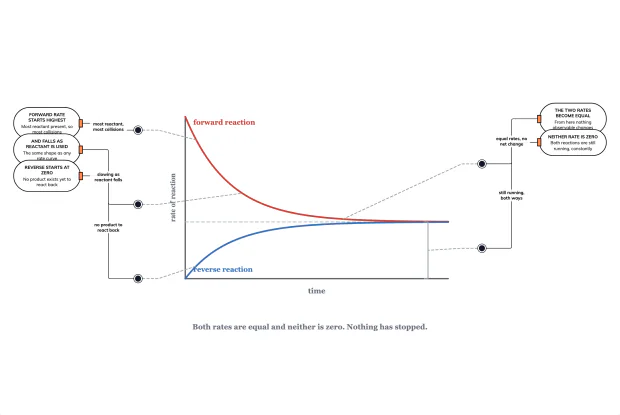
What Is Dynamic Equilibrium? Nothing Has Stopped
A reaction at equilibrium looks finished and is not — both directions are running at equal rates. Read it off a graph of rates in an interactive playground.
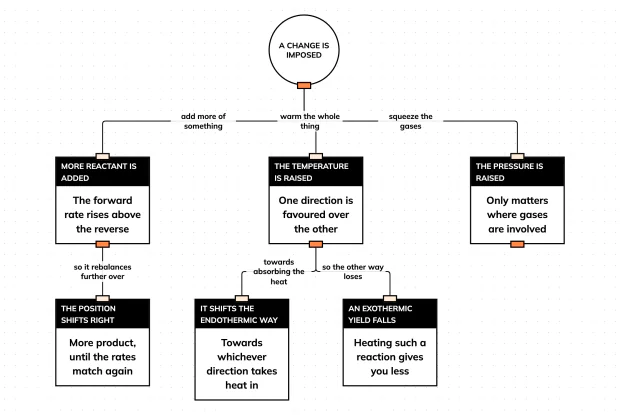
What Shifts an Equilibrium? Push It and See
An equilibrium that is disturbed settles somewhere new, and which way it moves can be predicted. Trace three kinds of change and their consequences in an interactive playground.
Does a Catalyst Shift an Equilibrium? No — Here Is Why
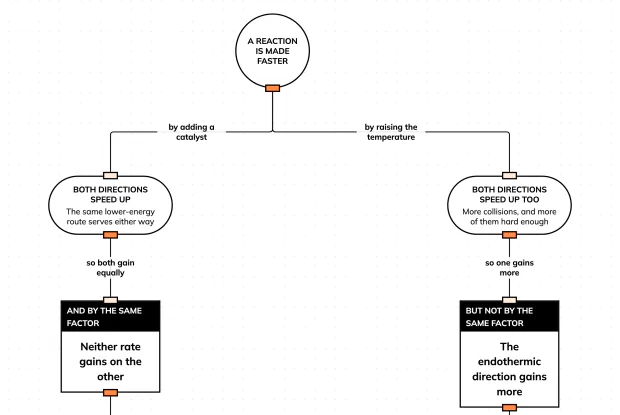
A catalyst and a temperature rise both speed a reversible reaction up, and only one changes where the balance sits. Follow both routes from one starting point in an interactive playground.
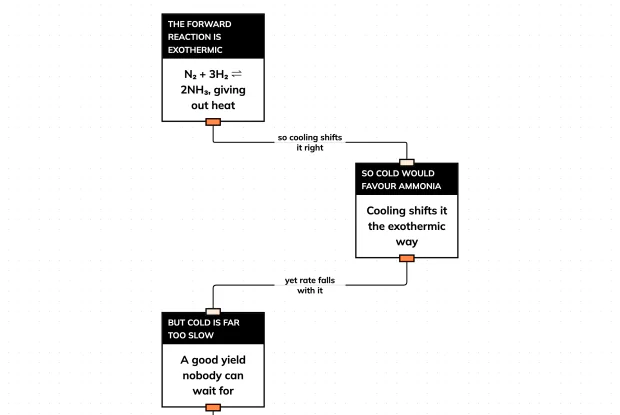
Why Is the Haber Process a Compromise? Rate vs Yield
The conditions that favour ammonia yield and the conditions that favour speed pull in opposite directions. Follow the argument to the figure a real plant uses, in an interactive playground.